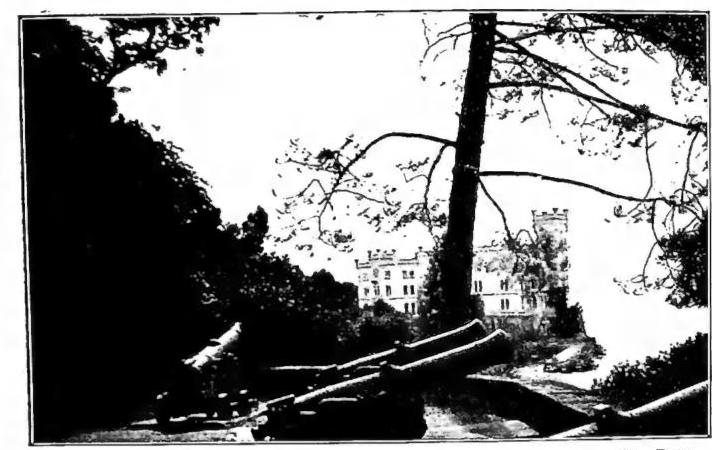
TRIESTE E CAPODISTRIA, DIOCESI di. – City and diocese in the Free Territory of T.
The part of the diocese situated in Italy covers an area of 730 sq. km., with 380,000 inhabitants, of whom 373,000 are Catholics, distributed among 59 parishes served by 167 diocesan priests and 69 religious priests; it has 12 male and 49 female religious communities.
The part situated in Croatia has a population of 60,000 Catholics distributed among 60 parishes served by 44 diocesan priests and 5 religious priests; and the part situated in Slovenia has 40,000 inhabitants in 30 parishes served by 24 diocesan priests (Ann. Pont. 1953, p. 431). It is suffragan to Gorizia. On 30 June 1828, Leo XII united « aeque principaliter » to T. Capodistria (v.).
I. HISTORY OF T
Tergeste is the Old Venetian name of the hill-fort that became a Roman colony around 46 B.C., flourishing especially in the second half of the 1st century and the first half of the 2nd. The Lombard invasion weighed heavily upon the city, as did the Frankish occupation, which introduced the first Slavs into the countryside toward the end of the 8th century. In the mid-10th century, Lothair II granted the bishops of T. seigneurial powers over the city, which, together with the bishopric itself, was then subjected by Henry IV on 20 July 1081 to the feudal authority of the patriarch of Aquileia. Gradually limiting episcopal rights, T. achieved full communal autonomy in 1295 under the supreme lordship of the patriarchate. In 1202 T., together with Muggia, swore allegiance and paid tribute to Venice; but this did not prevent it from engaging in open conflict with Venice in 1288–95, supported by the patriarch, and from resisting similar attempts again from 1369 to 1380, until in 1380 it joined Friuli, subsequently passing in 1382 under the rule of the duke of Austria, without, however, losing its communal constitution. Frequent internal struggles brought T. to extreme desolation in 1469; but thereafter the misfortunes of the Dominant Power favored the city with freedom to conduct flourishing trade with the hinterland and the East, until Charles VI in 1717 granted it a free port and freedom of navigation in the Adriatic, privileges increased by Maria Theresa. The Napoleonic whirlwind was brief, and made Austria’s weight felt, which, from 1813 onward, rendered the expression of the city’s national consciousness still more difficult. Union with Italy in 1918, although it diminished the vigor of its trade, gave vigorous impetus to its shipyards.Mario Mirabella-Roberti
II. FREE TERRITORY OF T
The establishment of this Territory was provided for by Articles 21 and 22 of Section II of the peace treaty imposed upon Italy by the United Nations and signed by Italy in Paris on 10 February 1947, as a compromise between the opposing Allied and Soviet positions, without regard for the wishes of the populations concerned or for their nationality.The new unit thus created consists of a strip of territory along the coast of the Gulf of T. and northern Istria, from the mouth of the Timavo to that of the Quieto, covering a total area of 718 sq. km. The boundary, which begins on the Italo-Yugoslav frontier slightly E. of Monfalcone and ends E. of Cittanova, is based neither on physical features nor on ethnic or economic considerations. In its northern part, the Free Territory of T. extends over typically karst terrain, with a sparse population, behind the large urban agglomeration of T.; in its southern part it encompasses an area of excellent agricultural land in the hinterland of the coast between T. and Pirano, followed by another karst tract, consisting of a plateau averaging 200 m. in elevation and cut by river valleys, including that of the Quieto. The entire coastline S. of T. is occupied by a series of maritime centers of some importance (Capodistria, Isola di Istria, Pirano, Umago, Cittanova), which are ethnically Italian.
The Free Territory of T. had (1951) 380,000 inhabitants, of whom 84% were Italian. The urban center of T. (277,000 inhabitants) alone accounts for almost two-thirds of this population; overall density is very high (529 inhabitants per sq. km.), but decreases considerably in the Istrian sector (152 inhabitants per sq. km.).
The origin and structure of the Free Territory of T. preclude speaking of it as a self-contained economic and political entity, not only because of its particular international status, but above all because it is inconceivable to separate it from the neighboring regions, with which it forms a whole and from which it essentially derives its means of livelihood. The very existence of a substantial urban center such as T. could not be justified by the resources of the Free Territory; both commerce (the port) and, even more so, the industry that developed alongside it and has flourished there for a long time (metallurgy, shipbuilding, food processing, etc.) presuppose a much wider function, which the frontiers imposed by the 1947 Treaty have not yet succeeded in eliminating.
The difficulties that arose in Italo-Yugoslav relations with the establishment of the Free Territory were subsequently aggravated by the division of the Territory itself into two zones, one (Zone A) occupied by Anglo-American troops and the other (Zone B) by Yugoslav troops. The former, covering only 233 sq. km. but including T. (together with the inhabited centers of Muggia, S. Dorigo, and Duino: 305,000 inhabitants in all, or 80% of the Territory’s total population), was in practice returned to Italian administration, though under Allied control, whereas the latter (S. of Muggia; 495 sq. km. with 75,000 inhabitants and the centers of Pirano, Capodistria, Isola d’Istria, Buie, and Umago) has by now in fact been incorporated into the Yugoslav state.
The Permanent Statute of the Free Territory of T. establishes that the independence and integrity of the Territory itself, which is demilitarized and declared neutral, are guaranteed by the Security Council of the United Nations. Nevertheless, the Territory’s existence as a political unit is limited by the understanding that it should return to Italian sovereignty, in accordance with the proposal made by the governments of the U.S.A., Great Britain, and France to the U.S.S.R. in March 1948. On 8 October 1953, the governments of the U.S.A. and England decided to evacuate Zone A, entrusted to them, transferring its military and civil administration to Italy, without prejudice to the rights recognized to Italy over Zone B.
III. DIOCESE
The circumstances surrounding the introduction of Christianity are unknown; it must have reached T. from Aquileia. The first known bishop is Frugiferus, around 549, but the diocese must be older, having been included within the metropolitan jurisdiction of Aquileia, and later of Grado. Severus, probably Frugiferus’s successor, played a notable part in the schism of the Three Chapters,later abjured by Firminus, his successor in 602. With the Frankish occupation of Istria, T. was removed from the metropolitan jurisdiction of Grado and placed under that of Aquileia. Around 1177 Alexander III decided to make C. (v.) and its territory a diocese in its own right; this was subsequently carried out on 5 July 1186, until in 1751 it was placed under the new archbishopric of Gorizia (by which it was absorbed in 1788–89). It had jurisdiction extending over the ancient territory of the Roman colony; in 1790 the territory of Pèdena, a small but ancient diocese in the interior of Istria, was incorporated into II. On 30 June 1828 Leo XII also united to it the territory of the suppressed diocese of Cittanova, while the diocese of C. was united aque principaliter. At present, the political conditions and Yugoslav overbearingness restrict the diocese’s direct activity to zone A alone of the so-called Free Territory. Among the bishops of T., E. S. Piccolomini, later Pius II, who defended the city from destruction, is noteworthy; P. Ponomo (1502–46), a shrewd diplomat; and A. Rapicio (1567–73), an elegant humanist. The diocese, which had a seminary in C. that was suppressed by the Yugoslav occupiers, has had a highly modern seminary in T. since 1950, through the efforts of Bishop A. Santin. Reflecting certain aspects of the population of this commercial city is the presence, besides a synagogue, of a Greek Orthodox church, a Serbian Illyrian-rite church, a Lutheran church, an Anglican church, a Seventh-day Adventist church, and a Waldensian church. T. has a combative Catholic weekly: Vita Nuova.
IV. ART
Of the Roman city, with intersecting streets even on the slope of a hill, one gate is well preserved: the Augustan Arch of Riccardo. The forum and basilica are also visible (badly damaged, Trajanic period), and nearby a propylaeum (Domitianic period), which stood before the Capitolium and was partly incorporated into the early Christian basilica. The theatre, outside the walls near the sea, is likewise Trajanic. The cathedral, S. Giusto, the symbol of the city, preserves traces of the great early Christian episcopal basilica, rectangular and tripartite (late fifth century), with an apse added by Bishop Frugiferus (mid-sixth century). The basilica discovered in 1825 in Via Madonna del Mare (near the sub divo cemetery) may likewise date from the fifth century. An early Christian see beneath S. Silvestro has not been confirmed; this is an eleventh-century rectangular basilica, now Waldensian. To this period dates the reconstruction of the Cathedral (Assunta) on a smaller scale, flanked by a square chapel with an inscribed cross plan and a dome, in which the body of the patron saint, s. Giusto, was received (a unique example in northern Italy). At the end of the 1300s the two buildings were merged into the present Cathedral, distinguished by the beautiful rose window in its gabled façade. The contemporary evidence of civic architecture, from the fourteenth and fifteenth centuries, has been lost. In painting, of the highest merit are the mosaics in the apses of S. Giusto (especially that of the Assunta, around 1200) and the triptych by Paolo Veneziano and by a Venetian-Byzantine painter (first half of the fourteenth century).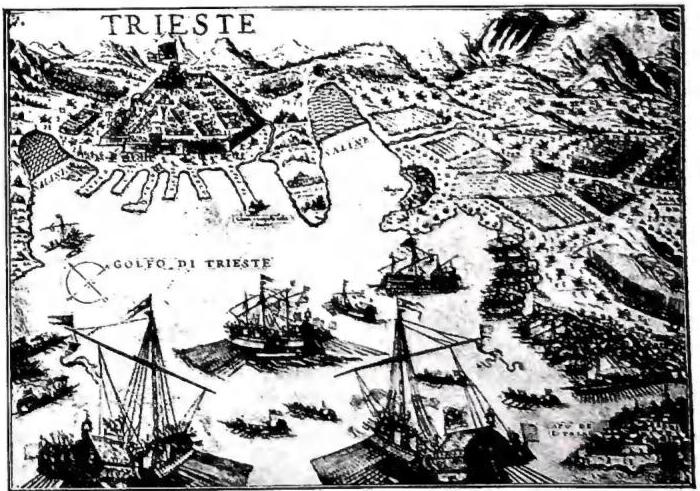
(photo Fiorentini)