
PARENZO, DIOCESI di. – Town and diocese on the western coast of Istria, formerly in the province of Pola. First a Roman municipium, then a colony under Tiberius (“Colonia Iulia Parentium”); a free commune around 1194, it gave itself to Venice in 1267, the first among the cities of Istria; seat of the Diet of Istria from 1861 until annexation to Italy.
The diocese of P., which still comprises the territory of the ancient Roman colonial district and, in addition, the territory of Rovigno, appears to have been a suffragan diocese of Aquileia at least since 451; with the suppression of the Patriarchate (1715), it came under Venice and, in 1892, after further changes, passed under Gorizia, to which the diocese of Pola was united. At present (1952), it is governed by an apostolic administrator whose see is at Pisino. Under Bishop Radossi (1942–47), the diocesan seminary had been established; the diocese then numbered 4 vicariates, 25 parishes, 34 priests, and 8 religious institutes, most of which the Yugoslav occupation dispersed.
The first bishop may certainly be considered to have been St. Mauro, also the first of whom there is any record for Istria, probably a martyr at the end of the 3rd century, whose body was brought to the Lateran by Giovanni IV. The bishop Eufrasio, from the middle of the 6th century, is especially renowned; to him is owed the construction
of the Cathedral, the Baptistery, and the episcopal residence, all still preserved, although he was among the most ardent participants in the schism “of the Three Chapters.” Besides St. Mauro, St. Eleuterio and Sts. Giuliano and Demetrio are venerated at P.; they are not, however, local saints.
ARCHAEOLOGY AND ART. – The complex of early Christian buildings is connected to the still-intact Roman street grid, with its intersecting roads, near the northern curtain wall; excavations begun in 1888 (Mons. Deperis) and recent restorations (completed in 1937) have brought it to prominence. It provides a most interesting example of the evolution from a private worship hall to a tripartite basilica.
The oldest building is a rectangular hall (8.70 × 21.80 m), with a mosaic floor decorated with geometric designs and inscriptions, dating from the end of the 4th century; on its eastern side it includes a square mosaic composed of a braided meander forming four other ones. This panel may have belonged to a room of the Roman domus that was the first meeting place: it may be assigned
to the end of the 3rd century. In the hall, on a flowering-vessel motif adorning its center, stood the movable altar; to the east was the seat of the cathedra and of the presbyters (two fish were then incorporated into the mosaic). South of this hall, another entirely similar one was built (duplicated hall) when, as an inscription states, the body of Bishop Mauro was brought within the city walls, probably into a martyrium to be sought near the second hall. Over this martyrium, around the middle of the 5th century, a large tripartite rectangular basilica was built, called the pre-Euphrasian basilica, with an internal presbyteral seat and cathedra, which encroached upon part of the duplicated hall. To its north, over the earlier mosaics, another smaller hall was erected, believed to have been the catechumenate-confirmation chapel. Finally, within the same boundaries as the pre-Euphrasian basilica, Bishop Euphrasius, in the eleventh year of his
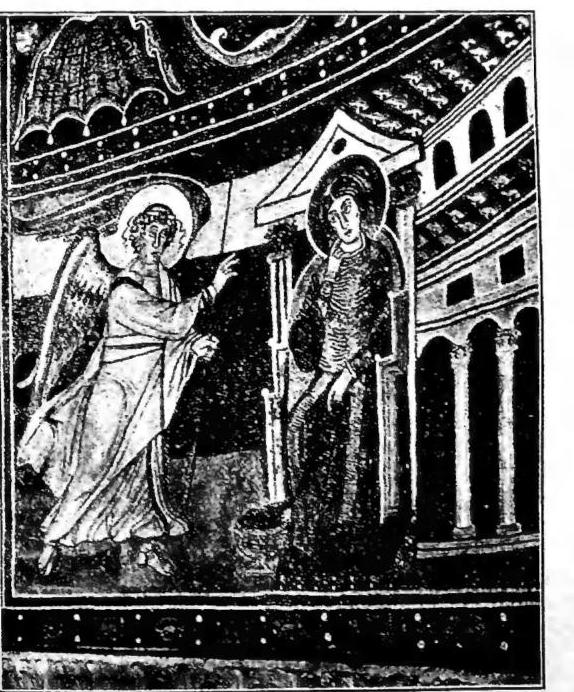
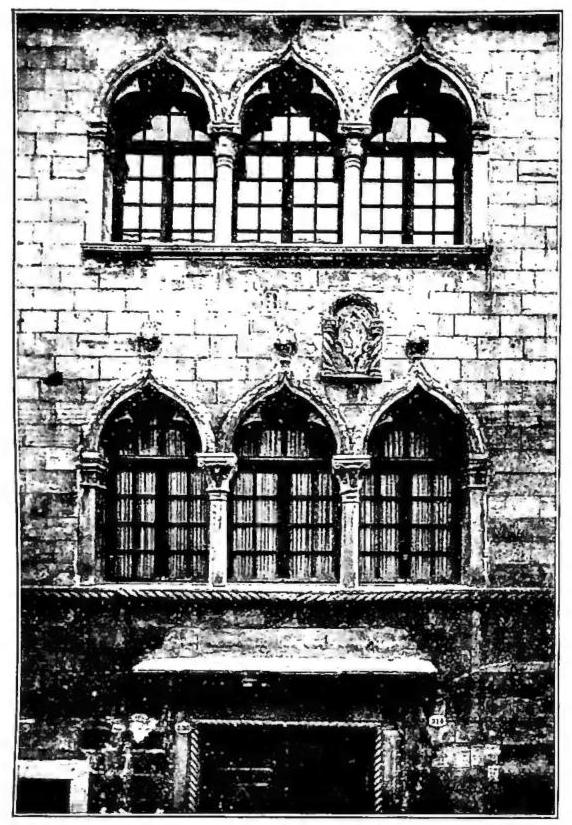
Without mentioning other works of art in the Basilica (the pavement mosaic has been lost, and the ciborium was remade in 1277), the attached buildings may be recalled: the octagonal Baptistery, the episcopal palace, a very rare building with a basilical plan, and the so-called mausoleum of Euphrasius, a trichora with a forceps-shaped atrium, all dating from the 6th century. Notable in the city are the remains of the Roman temple in the Forum, the canonry, dating from 1251, several fine Gothic-Venetian houses, and three towers of the 15th-century walls. – Vedi tav. LXVI.