
PALLADIO, ANDREA. – Andrea di Pietro dalla Gondola, «monaro» (miller), born on 30 November (P. Gualdo) 1508 (as shown by three documents, from 1524, ’28, and ’34), died at Vicenza on 19 August 1580.
A document discovered by Erice Rigoni in 1949 attests that P. was born in Padua, according to the deposition of three witnesses made in that same city on 24 May 1563. In 1521 the thirteen-year-old boy was apprenticed in Padua to the art of the «lapicida», under the sculptor Bartolomeo da Sossano. But, for unknown reasons, he fled to Vicenza with his father in 1523 or 1524. In that city he enrolled in the fraglia of
sculptors and stonecutters (1524), and from then onward lived there. In Vicenza he also found the affectionate guidance of his master, Giovanni da Pedemuro, and the enlightened patronage (documented from 1538) of Giangiorgio Trissino, poet and humanist, who would one day bestow upon him the appellation that made him immortal: Palladio.
Verona must have been the initial destination of his itineraries and of his surveys of Roman monuments, later continued in Rome, Pola, Spalato, France, etc. The second period of P.’s life begins with the journeys he undertook with Trissino to Rome: the first, in July–September 1541 (returning by way of Viterbo, Bagnaia, Florence, and Bologna); the second, between 1545 and 1547; the third at the end of 1549, the year in which P. won the competition for the design of the Basilica against such major competitors as Sansovino, Serlio, and G. Romano. The loggias of the Basilica (designed in a constrained rhythm, in order to take account of the windows of the pre-existing Gothic Palazzo) diverge from P.’s other conceptions as a unicum, through their dynamic chiaroscuro sequence.
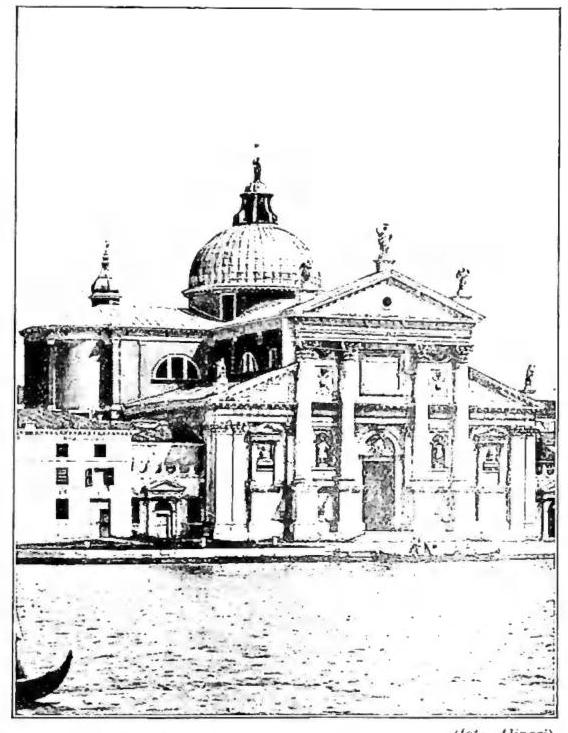
But P.’s most authentic vein reveals itself in the theme of the villas, which he dreamed of as abstract, lightly ambered volumes set against the soft shadows of colonnades amid the green of nature; as new values of light and tone that have forever remained his secret. The villa Angarano, near Bassano, comes first; followed by the villa Badoer at Fratta Polesine (1549), the Malcontenta (1551), and the first conception of that authentic masterpiece, the Rotonda (1550–53; Zorzi). In 1551 the Palazzo Chiericati arose, somewhat stiff in its solid wall between the shadows of the porticoes. The Palazzi Iseppo de Porti and Thiene date from 1552 (Zorzi); the powerful rustication had led it to be regarded as belonging to a later period. This, between 1549 and 1552, was P.’s happiest season: after the «discovery» of Rome, where he had assimilated imperial art and the art of the Bramantesque Renaissance, he had succeeded in making something new, original, truly created, with a variety of accents and tones. The third Palladian period begins in 1554, with the journey to Rome undertaken with several Venetian gentlemen, and with the publication of his short work The Antiquities of Rome, which must have sold extremely well, since it was reprinted twenty-two times up to 1722. This was a period of more intense activity as a writer of treatises, and of architecture that was at times less spontaneous; or that, in its chiaroscuro composition and the preciousness of its treatment, reflects new contacts. A subtle Michelangeloism is present in the Palazzo Valmarana at Vicenza (1566). The following works succeeded one another: the Palazzo Antonini at Udine (1556), unfinished; the Villa Pisani at Bagnolo (1561); the Villa Cornaro at Piombino-Dese (1565); the extremely refined Villa Barbaro at Maser (1566), frescoed by Veronese; the Villa Mocenigo at Marocco, near Mestre; the Villa Pisani at Montagnana, etc. The Vicentine palaces Porto-Barbaran and Porto-Breganze, and the Loggia del Capitaniato, date from 1570 and the following years. The latter presents, opposite the spontaneous vitality of the Basilica, the tired accent of mature age, because of a certain gigantism already present in the façades of the Venetian churches: S. Giorgio (1566), S. Francesco della Vigna (1568), and Redentore (1576).
The drawings illustrating Vitruvius by Daniele Barbaro (1556) are by P.’s hand. In 1570 his Four Books of Architecture appeared in Venice, produced with the collaboration of his sons: Leonida, in the drawings, and Silla, in the text. It was a genuine encyclopedia, which subsequently went through many editions and brought together drawings of ancient works, architectural orders, roads, bridges, squares, basilicas, temples, the Bramantesque tempietto of S. Pietro in Montorio, and various Palladian buildings. In 1575 P. published Julius Caesar’s Commentaries with 42 drawings. Of P.’s passionate graphic work, approximately 500 drawings are known to survive: 400 in London, 80 in Vicenza, and 6 in Verona, with some (for S. Petronio) in Bologna. Baths, fora, amphitheatres, theatres, sanctuaries, temples, and building projects thus come back to life from the
(photo Alineri)
PALLADIO, ANDREA - Façade of the church of S. Giorgio (1566), Venice.
from the hand of P., who was an excellent draughtsman, as well as an architect and a disciplined archaeologist. The artist was able to make his inventive genius flourish, not by imitating, but by causing the ancient material to ferment. Thus the Roman house returns, but transfigured, in the conception of certain palaces (e.g., Porto Barbaran) and in the cloister of the Carità in Venice (1561). The curved layout of the imperial fora reappears in the hyperbola of the Villa Mocenigo on the Brenta (never built) and in the conception of the Villa Trissino at Meledo (from which Bernini may perhaps have drawn a suggestion for his colonnades at S. Pietro). The structures of S. Giorgio in Venice and of the grandiose Villa Thiene at Quinto seem, in certain parts, to have been inspired by the Baths; from the survey of the Teatro Berga there finally emerged, like the sonorous and firm song of a genius that was fading, the Teatro Olimpico (1580).
The first biographer of P. was Paolo Gualdo, his contemporary. The seventeenth century did not understand P. Scamozzi in Vicenza and Longhena in Venice blocked his path. A return took place in the eighteenth century, a fortunate period for the extension of the Palladian empire, but one in which the understanding of this rare genius met with varying success. In 1730–32, the Baths were published by Lord Burlington and Leoni. New editions and revisions of Palladio’s work were produced by Francesco Muttoni (1740–48) and Ottavio Bertotti-Scamozzi (1776–83). The dissemination of P.’s work by these men harmed him, displacing the values of Palladian matter—-inspired, luminous, cordial—into the shadowed rigor of copperplate engraving. Thus neoclassical criticism (Temanza, 1762; Milizia, 1827), incapable of penetrating the abstract value of relationships and tones in Palladian art, but capable only of codifying them, often encouraged a flowering of presumptuous and forced academicism, which spread through England, Europe, Russia, and the Americas, with only a few graceful exceptions. The biography by Magrini (1846) and that by Zanella (1880), suffused throughout with subtle poetry, remained fundamental. A new return to P. took place in the declining nineteenth century, especially through the work of German architects such as Burkhardt, Durm, Burger (1909), and, more recently, Pee.
At the head of today’s Italian scholars, on account of his numerous discoveries, publications, and identifications, stands G. G. Zorzi. The research of Fiocco, with its further investigations, is invaluable. Excellent is Argan’s “tonal” interpretation of Palladian art. Fundamental is Pane’s publication, which establishes the authentic poetic values of P. and is accompanied by a brilliant history of Palladian historiography. - Vedi tav. XLIX.