
PELAGIO II, PAPA. — Of Germanic origin, born in Rome to Unigildus. Having entered the clergy, in 579, upon the death of Benedetto I, he was elected pontiff and consecrated on 26 November. In view of the precarious circumstances in which Italy found itself, devastated by the Lombards, who had advanced as far as the environs of Rome, the consecration took place without awaiting, as was customary, the approval of the Byzantine Emperor.
As soon as he had ascended the pontifical throne, P. employed every means to save Rome from the barbarian devastation; and, also taking charge of events together with the Roman Senate, he sent an embassy to Constantinople to request military aid. Since this proved insignificant, P. decided to appeal to the king of the Franks (October 580), urging him to form an alliance with the Empire against the Lombards. Having received no effective defense from the exarch of Ravenna, Smaragdus, he sent a new embassy to Constantinople. Following negotiations, in 585 he was able to conclude a truce with Authari, which lasted until 589. Taking advantage of the peaceful political conditions created by the truce, P. was finally able to devote himself more intensively to religious and spiritual activity, and first of all sought to bring to an end the Pelagio I (v.), writing to Bishop Elias of Aquileia to give him formal assurance that nothing had been done contrary to the Council of Chalcedon, the object and pretext of the struggle; but every negotiation on the matter, owing to the obstinacy of the schismatics, came to nothing. In fact, another letter to Elias, in which he explained in detail the attitude of the Apostolic See in the
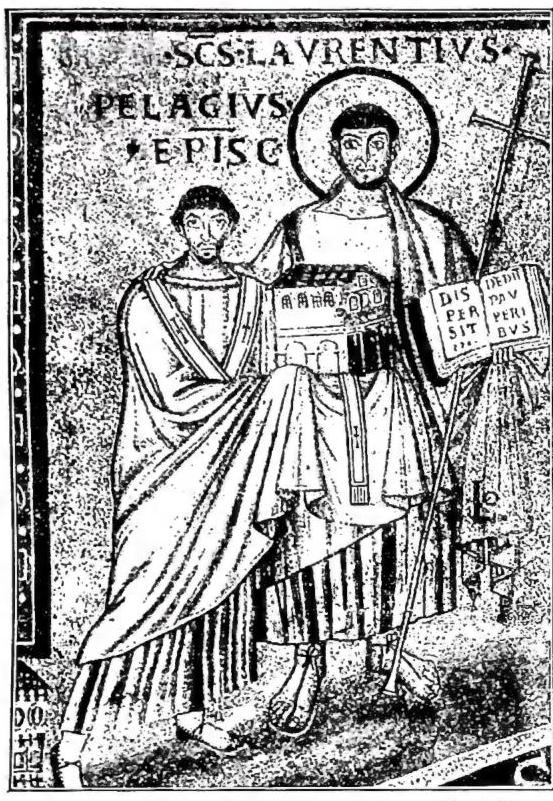
PELAGIO II, PAPA - The Pope, presented by S. Lorenzo, offers Christ the model of the Basilica. Detail of the musician on the triumphal arch of the basilica of S. Lorenzo fuori le mura (ca. 580) - Rome.
question of the « Three Chapters », of the popes Vigilio and Pelagio I, while at the same time he proved with strong arguments the condemnability of the « Three Chapters ». Not even the threats of the emperor Maurizio frightened the successors of Elia, and the attempts of the exarch Smaragdo likewise remained fruitless. During the pontificate of P. there also began the vexatious controversy provoked by the ambitious patriarch Giovanni of Constantinople, who arrogated to himself the title of « ecumenical patriarch ».
In Nov. 589 a terrible flood of the Tiber caused extensive damage and brought about a pestilence: among its first victims was P. himself (7 Feb. 590).