Machine translation of the 1948–1954 Italian original. The original text is authoritative.
PICCOLOMINI, FAMIGLIA. - Originally from Siena. A MARTINO di Piccolomo is mentioned in a document of 1090. The P. enriched themselves in the 13th century through commerce, and subsequently invested their wealth in landed estates. Of the Guelph faction, many of them held the highest political offices in Siena.
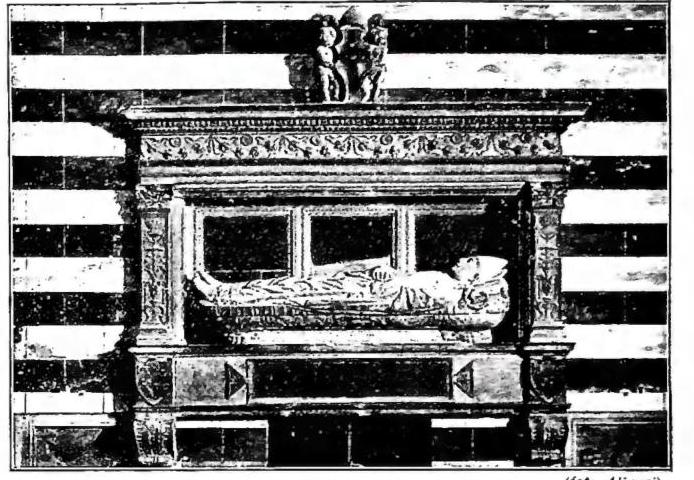
PICCOLOMINI, FAMIGLIA - Sepulchral monument to Bishop Tommaso P. (1483). Work by Neroccio di Bartolomeo - Siena, Cathedral.AMBROGIO di Nino P. was one of the three founders of the Abbey of Monteoliveto (1313). The fortunes of the family achieved their greatest luster when ENEA SILVIO was created pontiff (v. Pio II) and united it into a house consortium. He then received the dignity of count palatine from Emperor Frederick III (1458). Pius II was generous to his kin: his nephew ANTONIO, castellan of Castel S. Angelo (1st week of Sept. 1458), played a part in quelling the riots in Rome in 1460 and in the wars of the Kingdom of Naples in favor of King Ferdinand, and received the duchies of Sessa and Amalfi and the county of Celano. LAUDOMIA, the pope's sister, wife of Nanni Tedeschini, was the mother of FRANCESCO Tedeschini P., created cardinal by his uncle and pontiff in his turn for a few weeks in 1503 (v. Pio III). The latter left his bishopric of Siena to his nephew GIOVANNI Tedeschini P., created cardinal by Leo X on July 1, 1517, who was also administrator of L'Aquila and bishop of Ostia, and died in the Curia on Nov. 21, 1537. ALFONSO P., duke of Montemarciano, left a poor memory of himself as a bandit leader in the Roman State under Gregory XIII, when in 1583 he dared to enter Rome to foment unrest and was put to death in Florence on March 16, 1591. OTTAVIO P. (1600-56) was in the service of the Empire during the 17th century and was created field marshal and prince. The archbishopric of Siena was frequently held by the P. Besides the two pontiffs, one finds ANTONIO, abbot of Vilio from Sept. 18, 1458 to Nov. 8, 1459; in the following century there were ASCANIO, elected in 1588, d. May 13, 1597, and the other ASCANIO (Sept. 18, 1628-March 18, 1671) who hosted Galileo Galilei after his condemnation. Other members of the family held the bishopric of Pienza: TOMMASO (Testa) P. (Sept. 20, 1480-83), GIROLAMO (Dec. 10, 1510-33), a second GIROLAMO (1535-54), FRANCESCO MARIA (1554-99), FRANCESCO (July 3, 1741-45). Under Alexander VII, CELIO P. distinguished himself as secretary of memorials, archbishop of Cesarea, sent as nuncio to France in 1656 during the Jansenist controversies, created cardinal on Jan. 14, 1664, d. in 1681; he had held the archbishopric of Siena from March 18, 1671 onward. The last of the ecclesiastical dignitaries of the house of P. was GIACOMO (b. in Siena in 1795), created cardinal by Gregory XVI in 1844 and who died in 1864. The P. of the family of Pius II divided into several branches, some of which became extinct.
BIBL.: A. Lisini and A. Liberati, Genealogia dei P. di Siena, Siena 1900; E. Vecchi-Pinto, La missione del card. Francesco P. legato pontificio presso Carlo VIII, in Archivio Deputazione romana Storia patria, 68 (1945), pp. 97-110. Cf. furthermore the bibl. under the entries Pio II and Pio III. Roberto Palmarocchi
Cite this article
“PICCOLOMINI, FAMIGLIA.” Enciclopedia Cattolica, vol. IX (1952), p. 813. Azione Romana digital edition, https://azioneromana.com/article/piccolomini-famiglia.