Machine translation of the 1948–1954 Italian original. The original text is authoritative.
GIACOBINI. — The G. club was, among the societies and political groups that arose during the French Revolution, one of the most important, and through its activity in Parliament and its influence on public opinion it decisively affected the course of the Revolution itself. Established even before 17 June 1789 (the constitution of the National Assembly at Versailles), among the Breton deputies of the clergy and the Third Estate in May, it initially took the name of club breton. This committee, at first regional in character, soon became a center of attraction for other deputies as well; and, after the transfer of the Assembly to Paris in October, it rented the refectory of the Dominican convent, known as G., on the rue St-Honoré, becoming first the Société des Amis de la Constitution and later the Société des Jacobins. Once it had lost the characteristic of being essentially a society made up of members of the assembly, the G. club counted among its adherents not only politicians but also merchants, artists, and journalists—all people eager to participate in and influence, even if indirectly, the implementation of the new revolutionary principles. During the monarchy, the G. were loyal supporters of the Bourbons. They were not yet republicans, but merely determined supporters of the Constitution. Trusting in the establishment of a constitutional monarchy under Luigi XVI, they were not opposed to the king; but when, in 1792, they realized that this program was impracticable, they abandon-
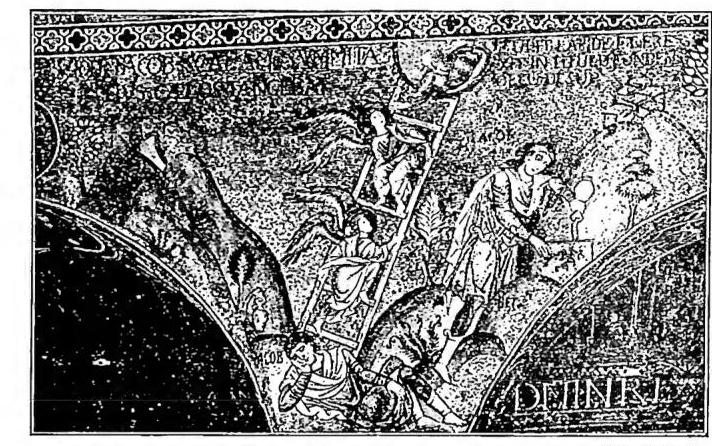
(phot. Alinari) GIACOBBE — Jacob’s ladder (Gen. 28:12) and the altar of Bethel (ibid. 18). Mosaic of the Palatine Chapel (12th century) — Palermo.they abandoned the platform of a monarchical Constitution and, once the death of the sovereign had been decreed and carried out on the guillotine, became advocates of the most uncompromising revolutionary intransigence. The influence of the club of the G. grew immensely: even the Convention, considered omnipotent, in substance did nothing but conform to the wishes of this society. The Terror and the dictatorship of Robespierre, with the violent persecution of the clergy faithful to Rome and of Catholics that characterize the bloodiest period of the Revolution, were the consequence of the political action carried out by the G. in Paris and throughout France (there were almost 2,500 Jacobin societies in the various French provinces) in favor of the energetic repression of every activity or thought not considered orthodoxly revolutionary. After the arrest and condemnation of Robespierre, the club of the G. was dissolved, and an attempt at reconstruction undertaken in 1799 was harshly suppressed by Fouché, minister of police and former G.
BIBL.: A. Aulard, La Société des Jacobins. Recueil de documents pour l'histoire du Club des Jacobins de Paris, 6 vols., Paris 1889–97; E. Boursin-A. Challamel, Dictionnaire de la Révolution Française, ibid. 1893, p. 354; A. Fribourg, Le Club des Jacobins en 1790 d'après de nouveaux documents, ibid. 1910; A. Aulard, Le Club des Jacobins sous la monarchie (Etudes et leçons sur la Révolution Française), 1st series, ibid. 1911, pp. 71–92; id., Les derniers Jacobins, ibid., 7th series, ibid. 1913, pp. 84–112; G. Martin, Les Jacobins, ibid. 1945; G. Gratton, Origine ed evoluzione dei partiti politici, Trieste 1946, passim; J. Castelnau, Le Club des Jacobins 1789-95, Paris 1948. Silvio Furlani
Cite this article
“GIACOBINI.” Enciclopedia Cattolica, vol. VI (1951), p. 210. Azione Romana digital edition, https://azioneromana.com/article/giacobini.