
ROBESPIERRE, MAXIMILIEN-MARIE-ISIDORE. — Politician, one of the leading figures of the French Revolution, born in Arras on 6 May 1758, guillotined in Paris on 28 July 1794. He spent his youth in the provinces, cultivating literature and practising law; elected deputy to the Estates-General in 1789, owing to his serious and cold temperament, his ponderous and sententious eloquence, he did not win excessive sympathy. Nevertheless, he gradually won over the Assembly and the Société des amis de la Constitution, later the Club des Jacobins, and became its president on 24 March 1790.
As early as 1789 he supported universal suffrage, the absolute equality of rights, and the defence of Jews, people of colour, and slaves; he recommended assistance for poor ecclesiastics and opposed the privileges of the nobility, in an effort wholly directed toward the broadest and most uncompromising implementation and defence of the «principles» of the Revolution and its «conquests»: in this sense he delivered several hundred speeches between 1789 and 1791. Appointed president of the Versailles Tribunal on 5 October 1790 and public prosecutor at that of Paris on 15 May 1791, he resolutely supported excluding the «constituents» from the Legislative Assembly; after Varennes, he opposed the restoration of the King’s royal prerogatives. He fought the bellicose policy of the Girondins, which would have divided France and led to European solidarity against the Revolution; in the face of the danger of invasion, he was the driving force behind the movement that called for the deposition of Louis XVI and the convocation of the Convention (July 1792). On 11 August he became a member of the General Council of the Commune and intensified its antagonistic role toward the Assembly, which came under its pressure; on the 17th he refused the presidency of the Revolutionary Tribunal; on 5 September he was elected by Paris at the head of its representatives to the Convention, which witnessed his prolonged duel with the Gironde. He demanded the prompt trial of Louis XVI, on grounds of public safety. From 31 May to 2 June he directed the insurrection against the Girondins; on 27 July he entered the Committee of Public Safety victorious. France’s situation was disastrous: the frontiers were open to the coalition of Europe, the royalists were triumphant in Vandea, Corsica, and Tolone; the Girondins were in arms in Normandy and Provence, while the economic crisis intensified, aggravated by alarming rumours of conspiracies and treason. R. and the Committee succeeded in confronting it—
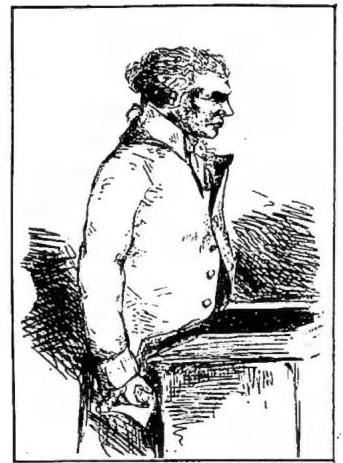
ROBESPIERRE, MAXIMILIEN - MARIE-ISTIDORE - R. standing at the tribune, drawing from life (author unknown) - Paris, National Library, Prints Cabinet.
and its members are arrested. The Commune, having risen, liberates them; but the troops of the Convention burst into the Hôtel de Ville, and R., who has attempted suicide, is executed the following day together with his faithful followers.
Convinced that civil and political equality was incompatible with a regime of excessive social inequality, R. tended toward a democracy of small proprietors and independent artisans, opposing the socialist or communist tendencies of the extreme left. In the religious sphere, he fought the systematic de-Christianization of France, because it led to atheism, an “aristocratic” attitude dangerous to public and private morality: hence his numerous interventions on the subject of freedom of worship; he attempted to substitute the worship of the Supreme Being and of Nature—a “civic,” “patriotic” religion with many Rousseauian resonances—for traditional religion, in order both to eliminate the latter’s resistance and to recover, for the benefit of the revolutionary State, the people’s deep-rooted religious sentiment. An unsuccessful attempt, arising, like the separation of Church and State, from the ever more irremediable failure of the religious policy of the Constituent Assembly of 1789. R.’s work was too centered on his own person; it was not understood even by those for whom he labored.