
SPERONI, UGO. - A civil lawyer and heretic from Piacenza of the 12th century. He studied Roman law in Bologna before 1145; he was a teacher and legal expert in it and exercised the office of judge.
There is no difficulty in identifying him with the homonymous consul of Piacenza in the years 1164, 1165, 1171, described
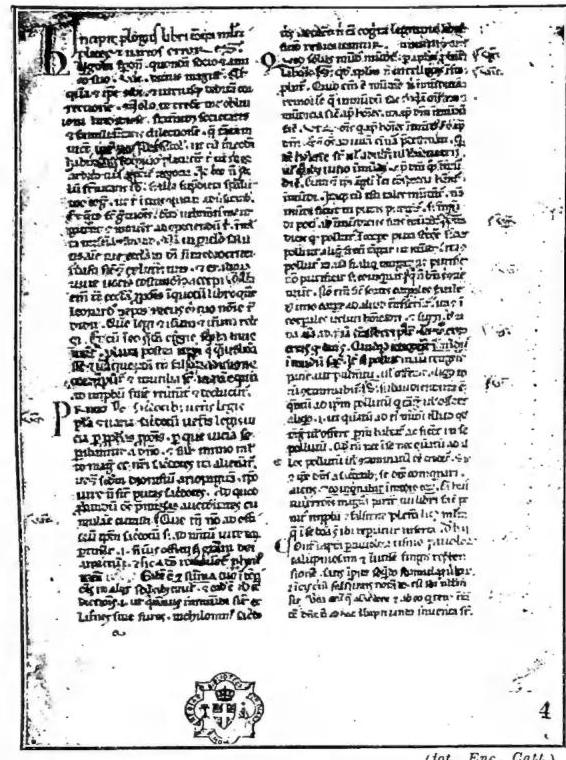
SPERONI, UGO - Liber contra multiplices et varios errores, by Master Vacarius, containing the refutation of the Adversus antichristum by S. - Vatican Library, Codex Chigiano A. V. 150, f. 4° (12th century).
in 1161 as a judge in the Imperial Court, who in the long judicial dispute concerning the rights over the Piacenza bridge of the Po against the Brescian monastery of S. Giulia supported the Commune, with the Emperor's backing, in contrast with the ecclesiastical authorities both local and of the Roman Curia. It is likely that these anti-ecclesiastical animosities and the Ghibelline spirit also influenced his heretical evolution. Before 1177 he wrote a very violent book: Adversus antichristum, against the priestly Order and the prevailing religion. Its content is known only through the refutation of the famous master Vacarius (v.), his former university companion, to whom S. sent it for examination.
S. attacks the priesthood and the Catholic hierarchy, declaring them stripped of authority due to the bad conduct with which he gratuitously asserts all their representatives are defamed; they are therefore unable to sanctify others through the Sacraments and liturgical rites. S. then proceeds to eliminate with various arguments Baptism (furthermore not admitting original sin), the Eucharist as communion, as sacrifice, and as worship, considering it an idolatrous materialization; oral confession, Holy Orders as a priesthood and as a hierarchy with the consequent division of the Church into clerics and laity; he rejects the doctrine of justification declaring works and external observances of any kind useless, and reduces religion to an entirely interior spiritualism, based on so-called intrinsic justice. He considers holiness necessary to be true Christians and just before God and to be saved, but makes it consist in an interior and permanent justification, in which those who are predestined according to an immutable decree of God are fixed in a stable and passive way, who in the presentness of His knowledge considers them as just, pure, holy even when outwardly they commit sins and persevere in guilt. In the predestined person, even
though currently a sinner, the desire for purity, mental—that is, interior—sorrow for sins, faith in Jesus Christ, loving communion with Him, etc., are sufficient; but these acts are also considered by God as always existing and in action in His elect. It is not clearly apparent what place S. reserves, in his economy of salvation, for the redemption of Jesus Christ; the Speronists held that the good ascended to heavenly glory even before the advent of Jesus.
GLI SPERONISTI. - From about 1185 onwards they formed a heretical sect, which remained distinct during the first half of the 13th century. The entirely internal and uncontrollable spiritualism of S. should not have favored an association with external traits as found in other ascetically-based groups; in fact, he remains a controversialist, and the s. own property and live in the married state. However, their founder admitted the commemorative banquet of Jesus' Last Supper. The necessity, albeit purely formalistic, of water Baptism, and certain other external actions such as preaching, psalm-singing, and collective prayer, although he considered them devoid of merit and sanctifying efficacy.