
EXORCIST, EXORCISTATE. – An exorcist, in the current practice of the Latin Church, is one who has received the Minor Order (v. ORDINE) of the exorcistate, which confers the power to drive out demons, that is, to perform exorcisms (v.).
The word ἐξορχοστής designates one who administers oaths (cf. Act. 19:13; Josephus, Antiq. lud., 8, 2, 5). In the earliest times of the Church every member of the faithful, as though by a charismatic gift, possessed the power to drive out demons (cf. Justin, Apol., II, 6, 6; Irenaeus, Epideixis, 96, 97; Tertullian, Apolog., 23). Around the middle of the third century exorcists appear in Rome as a special class of the faithful (Pope Cornelius, Ep. ad Fabianum Antioch.: Pl. 3, 768), whose existence is also attested by other documents. According to s. Paulinus of Nola, the martyr Felix, after having been a lector, became an exorcist. The epitaph of Flavius Latinus, bishop of Brescia (d. at the end of the third century), says that he was an exorcist for 12 years. Peter, who suffered martyrdom together with the priest Marcellinus (a. 392), is remembered as an exorcist by s. Damasus (Martyr. Hieronymianum, p. 292); s. Martin of Tours was ordained an exorcist by s. Hilary, as Sulpicius Severus relates (Vito S. Martini, cap. 5). In a small community such as that of ad decimum, the offices of exorcist and lector were united in the same person: Proficiis lector et exorcista, in H. Leclercq, Grottaferrata, in DACL, VI, coll. 1838.
There cannot have been absolute uniformity in all the Churches concerning their institution and respective offices: for example, the De septem ordinibus (Pl. 30, 148–62), falsely attributed to s. Jerome, mentions neither lectors nor exorcists, but fossors, as the lowest rank of the Minor Orders.
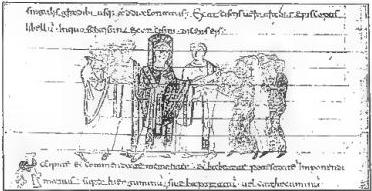
(Int. Enc. Cult.)
ESORCISTA, ESORCISTATO - Ordination of Exorcists. Miniature from the Pontifical of Landolfo I of Benevento (957–84) - Rome, Biblioteca Casanatense, 724 B I, 13.
menda memoriae et habe potestatem imponendi manus super energumenos sive baptizatos sive cathecumenos. This ceremony is preserved in the Roman Pontifical, which, in addition to a final blessing, has added a preliminary admonitio: Exorcistam oportet abicere daemenes et dicere populo ut qui non communicat det locum et aquam in ministerio fundere.
The functions of the exorcists are indicated in these words: a) to drive out demons; this office was performed especially when the catechumenate flourished (fourth–fifth centuries); at that time the exorcists carried out the ritual manus impositio to drive demons from candidates for Baptism. With the decline of the catechumenate, the importance of exorcists also declined, because, although in theory they were also assigned the office of exorcising the faithful, nevertheless this function from the beginning began to be reserved to priests, who, according to the law in force, exercise it prudently and with the explicit authorization of the bishop (can. 1121); b) to dismiss those who were not to receive Communion; originally this was the office of deacons; in the Ordo Romanus of the tenth century it was assigned to exorcists, but soon fell into disuse; c) to bring water to the ministers during Mass; initially this was the office of subdeacons, and in the tenth century passed to the exorcists.
In the East, in the fourth century, exorcists are mentioned at the Council of Antioch (341) and that of Laodicea (318); they did not, however, form part of the clergy nor were they ordained, as the Apostolic Constitutions explicitly attest (VIII, 26, 1, 2): «exorcista non ordinantur». The power to drive out demons was regarded as a charism granted directly by God to some privileged soul, as the same Apostolic Constitutions indicate: «Haec enim certaminis laus pendet a libera et bona voluntate et a Gratia Dei per Christum... qui enim acceptit chariama sanationum per revelationem a Deo declaratur» (ibid.). On the sacramental nature of the exorcistate V. ORDINE.
BIBLI. F. Wieland, Die genetische Entwicklung der sog. ordiner minaret in den drei ersten Jahrh., Triburgo in Br. 1807; J. Forget, Exorciste, in DThC, V, coll. 1780-86; H. Leclercq, Exorcisme-esorciste, in DALC, V, coll. 1985-78; P. De Puniet, Le Pontifical romain, I, Lovanio 1930, pp. 147-49; A. Villien, Les Sacraments, Histoire et liturgie, 2e ed., Parigi 1931, pp. 288-91; I. Ticerone, L'ordine e le ordinazioni, trad. R., Brescia 1939, pp. 92-93; B. Kurtscheid, Historia Iuris canonici, I, Roma 1941, pp. 47-48; P. Alfonzo, I riti della Chiesa, III, ivi 1946, pp. 74-80; Ph. Oppenheim, Sacramentum Ordinis secundum Pontificale Romanum, ivi 1946, pp. 34-42 e passim. Antonio Piolanti