Machine translation of the 1948–1954 Italian original. The original text is authoritative.
ERIGERO di LOBBES. – Benedictine abbot and writer, b. in the first half of the 10th century, d. at Lobbes (Liège) in 1007. He entered the abbey of Lobbes in 955 and soon became its scholasticus; through his learning and administrative ability he made its monastic school famous. A friend of the powerful Notkero of Liège, he became his most highly esteemed counsellor. Elected abbot in 990, he fully fulfilled the monks’ expectations.
His writings are predominantly historical: Gesta episcoporum Tungrenium, Traiectenium, Leodienium (MGH, Script., VII, 162–89; PL 139, 1001–1666), a work of scant critical value but good literary taste, continued to 1052 by Anselmo of Liège; Vita s. Urmari, of which a fragment remains (PL 139, 1125–28); Vitae s. Landaoldi, s. Adelini, s. Remacli (PL 139, 1111–68),
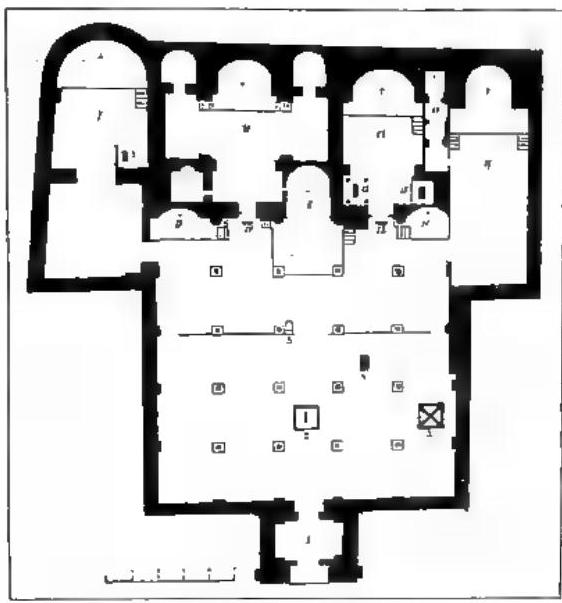
ERINCLAK, DIOCESI di – Painting of the church of the monastery of Karapet. (from J. Stropowski, Die Baukunst der Armenien in Europa, II, Piceno 1911, p. 78)written perhaps in collaboration with Notchero; Epistola ad quemdam Hugonem monachum (PL 139, 1129–1366), which deals with chronological questions; the Regulae Herigeri in abacum (ed. N. Bubnov, Gerberti opera mathematica, Berlin 1899, pp. 205–25) show him to have been an accomplished mathematician. Other works are lost. Sigeberto of Gembloux attested that E. had collected many texts of the Fathers against Pascasio Radberto. In 1655 Celiot published an anonymous De corpore et sanguine Domini, which Mabillon immediately claimed for E. Pez, however, attributed it to Gerberto (Silvestro II), and under this name it was reprinted by Migne (PL 189, 179–88). According to Hauck, every attribution is unfounded; in Dümmler’s judgment, E.’s authentic work is found in ms. 909 of the University of Ghent under the title: Herigeris abhatia exaggeratio plurimorum onctorum de corpore et sanguine Domini, which is essentially a florilegium of texts on the real presence (Ilario, Ambrogio, Agostino, Gregorio, Beda, Pascasio Radberto) set against Ratramno, with an epilogue by the compiler. Amann also holds this view. Heurtentvent, Morin, and Vernet, on the other hand, consider Mabillon’s attribution correct. The author begins by recalling the divergences between Pascasio and Ratramno concerning the Eucharist; he reproduces many texts representing both tendencies and concludes rather in favour of Pascasio, in whose doctrine figura and veritas are reconciled. To explain the identity of the Eucharistic body with that born of the Virgin, he announces this principle: «credendum in ipsa immolationis hora... illud (corpus) angelorum ministerio in sublime deportari altare, quod est ipse Christus... contactque illius unum fieri» (col. 187). An obscure and unfortunate phrase, but not so laden with errors (Christological-Eucharistic dualism) as some have claimed.
BIBL.: Hutter, I, coll. 960–62; E. Dümmler, Zum H. von L., in Neues Archiv, 26 (1901), pp. 754–9; O. Hirzel, Abt H. von L., Lipala-Berlin 1910; R. Heurtentvent, Durand de Trocen et les origines de l'hérésie beregarienne, Paris 1912, pp. 108–99, 255–66; F. Vernet, Eucharistie, in
DThC, V, col. 1216; G. Morin, Les dicts d'Heriger sur l'Eucharistie, in Revue bénédictive, 25 (1910), pp. 1–18; J. Geiselmann, Die Eucharistielehre der Verscholistik, Paderborn 1926, pp. 267–81 (some statements should be qualified); E. Amann, Nather de Liège, in DThC, XI, coll. 867–869 (under this heading he also treats E., who had been omitted in his proper alphabetical place); J. Geiselmann, Der Einfluss des Remigius von Auxerre auf die Eucharistielehre des Heriger von Lobbes, in Theol. Quartalschrift, 1935, pp. 222–44; J. De Ghefflinck, Littérature latine au Moyen-âge, II, Paris 1938, p. 26 (he maintains that the De corpore was directed against Gottescako).
Antonio Pidotti
Cite this article
“ERIGERO DI LOBBES.” Enciclopedia Cattolica, vol. V (1950), p. 315. Azione Romana digital edition, https://azioneromana.com/article/erigero-di-lobbes.