
RATERIO di VERONA. — Bishop and theologian, born near Liège around 890, died at Namur on 25 April 974.
I. LIFE
He grew up at the school of Ilduino, abbot of Lobbes, with whom he came down to Italy in 926; in Aug. 932 he was elected bishop of Verona. The governance of this diocese cost him innumerable sacrifices and sorrows. Having fallen into the disfavour of Ugo di Provenza, he was imprisoned by him in the tower of Walberto at Pavia, where he remained until Aug. 937.Released from prison, he left Italy and, after many wanderings and painful vicissitudes, found refuge, at the end of 944 or the beginning of 945, among his monks at Lobbes. Soon, however, unable to tolerate a quiet life and even more desirous of putting a stop to the evils he had observed in his diocese, he returned to Verona in 946. He remained there for only two years, since, opposed by new and violent enemies, he had to leave in 948. After further wanderings, on 21 Sept. 953 he was elected bishop of Liege. But having also there begun to inveigh “aequo mordacius” against corrupt morals, at the beginning of 955 he was expelled from the see. He was then elected abbot of a monastery (perhaps that of Alma), which depended on Lobbes. In 961 he was brought back to Verona by Ottone, where he remained until 968. In July or Aug. of that year, beset by too many enemies and now advanced in age, he renounced his dignity and, retiring to Namur, died there a few years later.
R. belongs among the great reformers; but his principal error perhaps consisted in demanding the immediate implementation of his reform program: he wished to bring about a radical and complete transformation in too short a time and to change, almost as if by magic and perhaps by excessively resolute means, an entrenched state of affairs.
II. WORKS
R.’s numerous writings, edited by the Ballerini brothers (Verona 1775) and reprinted by Migne (PL 136), are a mirror of his soul and of his age; the principal ones are noted here: Praeloquaturum libri sex (PL 136, 145–344): this is his major work, written during his imprisonment at Pavia (935–37), in which R. reviews all the states of human life, showing their defects and indicating the remedies offered by the Gospel; it is noteworthy for the history of moral theology and for the doctrine of relations between Church and State; Excerptum ex dialogo confessionali (ibid. 393–444): a very interesting examination of conscience for the history of religious psychology; Exhortatio et preces (ibid. 444–50): beautiful prayers in preparation for Mass; Decreta de clericis a Milone ordinatis (ibid. 477–78): on 12 February 965 R. declared the ordinations performed by the intruding bishop Milone null, but, because of the disturbance caused among the clergy, he revoked the declaration; Libellus cleri Veronensis nomine inscriptus ad Romanum Ecclesiam (ibid. 479–82): submits the preceding case to the Pope; Itinerarium Ratherii Romanum euntis (ibid. 579–600): a reform program made known to the Veronese clergy before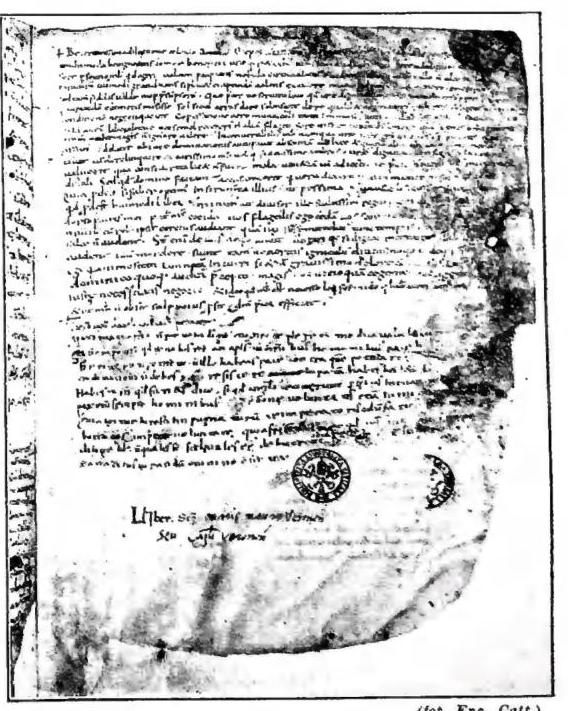
RATERIO DI VERONA - Manuscript originating from Verona, containing the Canons of the Fourth Council of Constantinople (869), with autograph annotations by R. and drafts of his letters. Folio 1ª contains Epistles 17 and 18 - Biblioteca Vaticana, cod. Vat. Ist. 4965, f. 1ª.
before going to the Council, which was to be convened in Rome at the end of 966: a clear affirmation of the primacy of the Pope (ibid. 582); Epistolae (ibid. 643-88; others in Studi e documenti di storia e diritto, 24 [1903], pp. 51-72; V. now the edition by F. Weigle), important for history; Sermones (PL 136, 689-758), one of which describes the penitential discipline of the period (ibid. 714-19).