EVA, BEATA

BEATA EVE. - Recluse of Saint Martin’s, Liège, born c. 1205 in Liège, died there c. 1265. Confidante of Saint Juliana of Cornillon, she shared her zeal for the institution of the feast of Corpus Christi.

Through her pious insistence, this solemnity was introduced before 1231 in the Collegiate Church of Saint Martin, where her recluse cell was located, and throughout her life she worked to have it extended to the whole Church. After the death of Saint Juliana (1238), she composed an account of her in the vernacular, which forms the basis of the ancient *Vita Juliana*, in which the episodes concerning her relationship with the Saint of Cornillon are marked by great candor and simplicity. The former archdeacon of Liège, who became Pope Urban IV, after instituting the feast of Corpus Christi with the bull *Transitoria* of 1245, sent a letter that same year to Eve (reproduced in G. Barbero, *Le confraternite del S. Marco Sacramento prima del 1539*, Vedelago [Treviso] 1944, p. 234) to inform her of the great news; he also sent her a copy of the office for Corpus Christi, composed in the Roman Curia and different from the one attributed to Saint Thomas Aquinas.

Bibl.: I. Demarteau, *La première auteur volante: la bienheureuse Eve de St-Martin*, Liège 1866; C. Lambot, *Eve de St-Martin et les premiers historiens héroïques de la Fête-Dieu*, in *Studia Eucharistica DCC annu a condito festo S. mo Corpus Christi*, Antwerp 1946, pp. 10-35; F. Callay, *Documentazione eucaristica liegeo dal vescovo di Liegi Roberto di Torte al papa Urbano IV (1239-24)*, in *Miscellanea Pia Paschini*, I, Rome 1948, pp. 215-35.

---

**EVE**

Article illustration
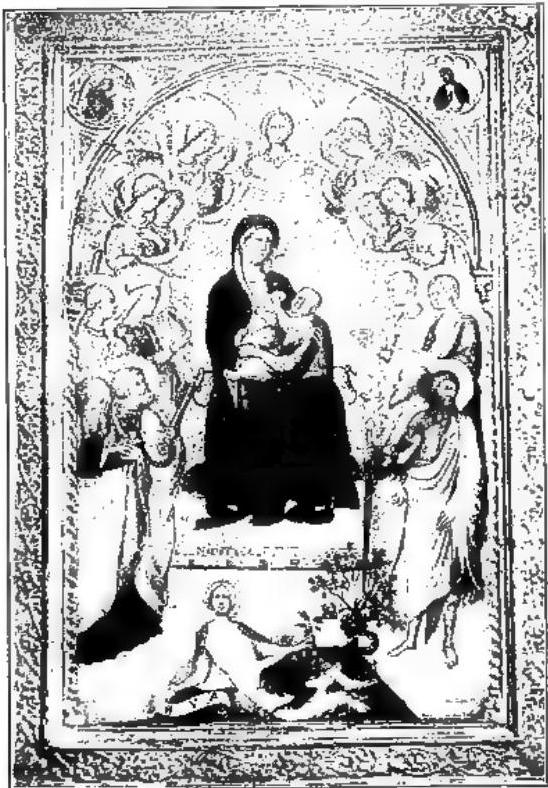
Eve – Eve, prototype of the Most Holy Mary, panel by Paolo di Giovanni Fe(li) (1372-1410) – New York, Mrs. Goodhart collection.

Article illustration
Eve – The Toil of Adam and Eve (late 12th c.) – Monza, Cathedral.

The historical reality of the event is also attested by Adam’s words (Gen. 2:23); in the Hebrew text, the name “woman” (*’iššâ*) is the feminine form of the name “man” (*’îš*), which the Vulgate renders: *“haec vocabitur virago quia de viro sumpta est.”* Illuminated by God, Adam probably reveals the indissoluble and total bond of marriage (Gen. 2:24; cf. Mt. 19:4-6).

To these considerations the Apostles and Fathers add other reasons, such as: 1) that man might be the principle of the entire human race and manifest the unity of origin and species (Mt. 19:4; Acts 17:26; cf. Gen. 3:26; 5:1-2); 2) that the dignity and authority of man might be evident (1 Cor. 11:7-9; 1 Tim. 2:13-14); 3) that it might prefigure the union of Christ and the Church (Eph. 5:23-32; Jn. 19:34).

After the sin of origin, of which Eve was the instigator, God pronounces judgment against her: *“I will greatly multiply your pain in childbearing; in pain you shall bring forth children, yet your desire shall be for your husband, and he shall rule over you”* (Gen. 3:16); to pride and sensuality, the essential elements of the fault, corresponds the punishment. The condition of woman as spouse has not changed, but as a natural consequence of sin, woman’s subjection will be hard and painful (St. Thomas, *Summa Theologiae*, II-II, q. 164, a. 2, ad 1). To our first parents, God in his mercy deigned to give consolation by announcing the Redeemer, the new Adam, and likewise the co-redeemer, the new Eve, as the Fathers have called the Most Holy Mary (cf. St. Justin, *Dialogue with Trypho*: PG 6, 70; St. Irenaeus, *Against Heresies*, III, 22, 4; PG 5, 19, etc.).

Bibl.: C. Passaglia, *De Immaculato Deiparae conceptu*, II, Naples 1855, pp. 812-54; A. Bea, *Institutiones Biblicae*, II, 1, *De Pentateucho*, 2nd ed., Rome 1933, pp. 152-54; V. Jacono, *Maria S.ma mediatrice di tutte le grazie*, Pompei 1937, p. 20 ff.; E. Mangenot, *Ève*, DThC V, cols. 1640-55; J. Schuster-J.-B. Holzhammert, *Manuale di storia biblica. Il Vecchio Testamento*, Turin 1942, p. 142 ff.

---

GOSPEL OF A. - Apocryphal work in use among the Nicolaitans, heretics of the apostolic period, according to Saint Epiphanius (*Panarion*, 26, 2, 3, 5: PG 41, 334-35, 339). From the two brief quotations made by Epiphanius, it appears that this apocryphon was of a Gnostic