
CORPUS DOMINI, FEAST OF. — This is the solemnity of the Most Holy Body of Christ, celebrated on the Thursday after the First Sunday of Pentecost, to commemorate in a particularly special way the Most Holy Eucharist: sacrifice and Sacrament.
The remote cause of the institution of this feast is to be sought in the new and intense orientation of theologians and popular piety toward the Eucharist during the course of the twelfth century, chiefly in reaction to Berengar of Tours (v.) concerning transubstantiation. Indeed, for Robert of Thourotte and Cardinal Hugh of Saint-Cher, the institution of the feast was first and foremost directed “ad confutandam haereticorum insaniam.”
The feast is connected with the visions of Blessed Juliana of Mont-Cornillon, who received from the Lord himself the mission of introducing it into the Church.
Bitterly opposed at the beginning, the feast was finally approved by Bishop Robert of Thourotte (or Torote) in 1246; the following year it was celebrated by the Canons of Saint Martin at Liège. In 1247, by virtue of a synodal constitution of the preceding year, the feast was instituted in the diocese of Liège. In 1252 Cardinal Hugh of Saint-Cher, then papal legate in Germany, introduced it throughout his jurisdiction, and two years later his successor, Pietro Capocci, confirmed it (J. Chapeville, Gesta Pontif. Leodien., II, Liège 1613, pp. 646 ff.). Urban IV, formerly archdeacon of Liège, urged by Bishop Henry of Guelders and also moved by the miracle of Bolsena (whose corporal was carried in procession to Orvieto on 19 June 1264), extended the feast to the whole Church with the bull Transiturus of 8 September 1264, fixing it for the Thursday after the octave of Pentecost. Clement V confirmed it in 1314.
A first Office of the Most Holy Sacrament was composed by Brother Giovanni of the monastery of Mont-Cornillon, following the direction of Blessed Juliana herself. The one that Pope Urban IV sent in September 1264 to the recluse
Eva, a masterpiece of theological doctrine, was composed by Saint Thomas Aquinas, who made use of antiphons, lessons, and responsories already in use in certain particular churches.
Here and there, the procession with the Most Holy Sacrament was introduced, becoming customary above all after Popes Martin V (1417–31) and Eugenius IV (1431–47; constitution Excellentissimus, 1433) enriched it with indulgences. The origin of this ceremony derives from the custom of going in procession outdoors before the sung Mass on the greater feasts. The English Benedictines already celebrated a Eucharistic procession in the eleventh century on Palm Sunday (PL 150, 456 ff.); in the twelfth century it was customary to carry the Most Holy Sacrament around inside the church in a pyx or chalice, and ordinarily the Eucharistic procession formed part of the rites of Holy Week (PL 147, 123: for the Church of Rome). Thus, on the day of C. D. as well, the Most Holy Sacrament came to be carried in procession; for example, it was already carried in Cologne before 1277. Following a fervent desire expressed by Urban IV, Eucharistic hymns were sung in this procession, especially those of Saint Thomas; the blessing was given only at the end. The Most Holy Sacrament was often carried on richly decorated “chests” or “litters,” supported by priests. The need to provide the greatest possible decorum for these processions gave rise to the confraternity of the Most Holy Sacrament. In the fifteenth century, in Germany, the custom arose of giving the blessing with the Most Holy Sacrament four times outside the church, preceded by the singing of the beginning of the four Gospels. Also in the fifteenth century, Eucharistic spectacles or dramatic representations originated, especially of the Passion or the Lord’s Last Supper; in Spain, during the seventeenth century, these attained great fame and perfection in the Autos sacramentales (Calderón). They nevertheless gradually fell into disuse during the eighteenth century.
According to the prescriptions of the Church, the procession takes place in the morning after the solemn Mass; the rite is described in the Rituale romano, title IX, chapter 5. In every center (city or town, even one with several parishes), on the day of C. D. there is to be only one procession, at the principal church; all religious families, including exempt ones, must take part in it, with the exception of those regulars who live under strict perpetual enclosure or reside more than three miles from the city; moreover, all lay confraternities must take part (canon 1291 § 1). In all other churches or parishes, the procession may be held during the octave, including outside the church. Throughout the octave, solemn exposition of the Most Holy Sacrament is permitted during Mass and Vespers; at other times it is lawful only for a grave reason (canon 1274 § 1).
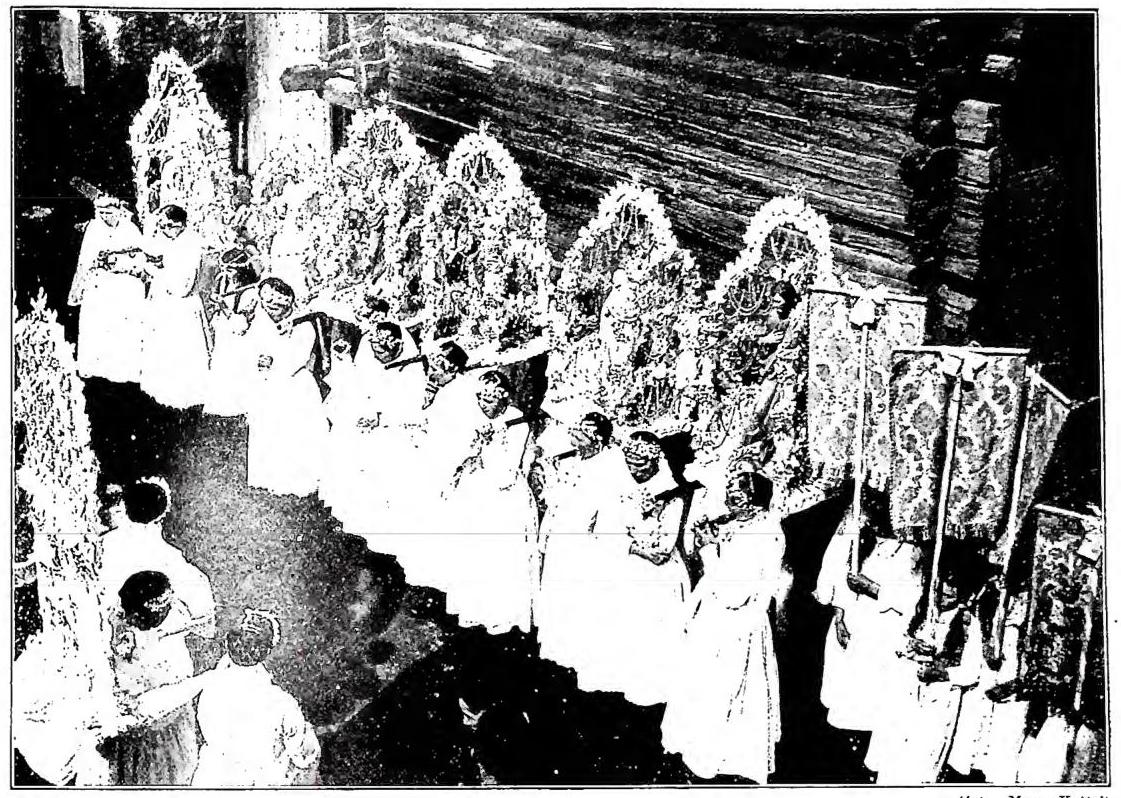
CORPUS DOMINI — Young people carrying statues on their shoulders, waiting to take part in the procession of the C. D. in Visperterminen, Valais (Switzerland).
published under the direction of Fr. St. Axters, the last of which is devoted to the bibliography); M. Righetti, Storia liturgica, II, Milan 1946, pp. 222–27; F. Callacy, Documentazione eucaristica liegete dal vescovo di Liegi Roberto Torote al papa Urbano IV, in Miscellanea Paschini, I, Rome 1948, pp. 215–36. Filippo Oppenheim
FOLKLORE. - The most important episode in the popular celebration is the procession.
The splendor of the greenery and flowers with which the streets and squares of the cities and villages are adorned along the entire route of the procession is completed by the display of tapestries, carpets, and coverlets. Orvieto remains the center where the feast preserves its highest significance and most solemn character. Preceded by long processions of confraternities, girls dressed as angels, pious women carrying tapestries depicting scenes from the miracle, and young men dressed in the costumes of the various trades (wool workers, smiths, etc.), the Reliquary of the Most Holy Corporal, borne by priests and followed by the bishop, is carried in procession beneath a rich canopy. In some towns flowers are also used to decorate the street along which the procession passes. Famous is the “infiorata” of Genzano (Rome), in which the entire uphill street leading from the square to the church is carpeted with flowers for a length of approximately 300 m. and divided into various sections with different designs and well-conceived effects of color. In Sicily the procession passes over genuine carpets which skilled workers, with extraordinary promptness, spread on the ground as the sacred cortege proceeds. In Bologna the “sagra degli addobbi,” instituted by Cardinal Paleotti in 1566, takes place. For two or three Sundays following the feast, certain parishes of the city, according to a ten-year rotation, decorate their own quarter with garlands of greenery and flowers, while rich carpets hang from the windows. In past centuries numerous allegorical floats also took part: at the festival celebrated in 1677 by the parish of S. Maria del Paradiso, a pyramid made of 3,400 ounces of bread was erected beside the church, with its base formed by eight wine casks, from which the people could freely draw.
At Vicenza there took place the feast of the “rua” (wheel), a large wooden structure in the form of a tower or castle, 24 m. high, mounted on a cart carried on the shoulders of 80 bearers. The tower was divided into several levels; at the top “Justice” held court, while in the middle the “wheel,” which gave the structure its name, revolved. In many regions the feast retains dramatic features: particularly well known are the twelve “mysteries” of Campobasso (there were once eighteen), a kind of structures carried on the shoulders of sturdy young men and depicting sacred scenes through tableaux vivants (s. Antonio, s. Isidoro, Mary Magdalene, the Immaculate Conception, the sacrifice of Abraham, etc.). At Scanno too, the sacrifice of Abraham and other sacred episodes, such as the Marriage of the Virgin, were represented in silent tableaux. There are numerous beliefs among the common people relating to the various aspects of the procession. At Ortona it is believed that fabrics displayed at the windows, once blessed as the Blessed Sacrament passes by, are not attacked by moths; at Lanciano, on the other hand, it is believed that the spot where the great cross rests—the work of the celebrated goldsmith Nicola da Guardiagrele, which is carried in procession only for C. D.—indicates the imminent death of the head of one of the nearest households.
The feast of C. D. has also spread very widely beyond Italy, giving rise to celebrations involving floats, dances, and other expressions of popular joy. - Vedi tav. XXIX.