«CORPUS DOMINI JEJUNIIS». — Hymn of Matins for the Office of St John Cantius, by an unknown author, composed for his canonization in 1757. The saint’s virtues, the many penances by which he chastised his body, and the charity that led him to refuse nothing are recounted in verses devoid of any poetic inspiration. The final stanza is an ardent prayer for the salvation of Poland.
Eva, a masterpiece of theological doctrine, was composed by St Thomas Aquinas, who drew on antiphons, lessons and responsories already in use in certain particular churches.
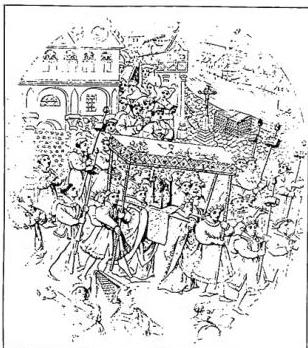
Here and there the procession with the Blessed Sacrament was introduced and became common especially after Popes Martin V (1417–31) and Eugenius IV (1431–47; const. Excellentissimus, 1433) enriched it with indulgences. The origin of this ceremony derives from the custom of processing outdoors before the sung Mass on major feasts. English Benedictines already celebrated an eucharistic procession in the 11th century on Palm Sunday (PL 150, 456 sqq.); in the 12th century it was customary to carry the Blessed Sacrament around inside the church in a pyx or a chalice, and ordinarily the eucharistic procession formed part of the rites of Holy Week (PL 147, 123: for the Church of Rome). Thus on the feast of Corpus Christi it became customary to carry the Blessed Sacrament in procession; for example, at Cologne it was already being carried before 1277. Following a lively desire expressed by Urban IV, eucharistic hymns—especially those of St Thomas—were sung during this procession, and the blessing was given only at the end. The Blessed Sacrament was often carried on richly adorned “casses” or “biers” borne by priests. The need to provide the utmost decorum for these processions gave rise to the confraternity of the Blessed Sacrament. In the 15th century in Germany the custom arose of giving the blessing with the Blessed Sacrament four times outside the church, preceded by the chanting of the opening of the four Gospels. Also in the 15th century eucharistic plays or representations began to appear, especially of the Passion or the Last Supper of the Lord, which in Spain in the 17th century attained great renown and perfection in the Autos sacramentales (Calderón). They gradually fell into disuse in the 18th century.
According to the Church’s prescriptions the procession takes place in the morning after the solemn Mass; the rite is described in the Roman Ritual, tit. IX, cap. 5. In every centre (city, hamlet, even one with several parishes) on the feast of Corpus Christi a single procession is held in the principal church; all religious families, even exempt ones, must attend, except those regulars who live in strict perpetual enclosure or reside more than three miles from the city; all confraternities of the laity must also attend (can. 1291 § 1). In all other churches or parishes the procession may be held during the octave, even outside the church. Throughout the octave solemn exposition of the Blessed Sacrament is permitted during Mass and Vespers; at other times it is licit only for a grave cause (can. 1274 § 1).