Machine translation of the 1948–1954 Italian original. The original text is authoritative.
BAYMA, GIUSEPPE. — Theologian and scientist, born in Chieri on 9 November 1816, died at S. Clara on 7 February 1892. He entered the Society of Jesus in 1832 and immediately distinguished himself through his aptitude for the exact sciences. Expelled from Piedmont with his confrères, he took refuge in the Papal States, at Bertinoro, where he was warmly received by the bishop G. B. Guerra, who entrusted him with the direction of the seminary (1853–1860). Having gone to England, he moved to the United States in 1868, where he became rector of the college of S. Francisco and subsequently professor there and at S. Clara in California.
Extremely active and endowed with multifaceted talents, in England and America he distinguished himself through numerous writings of a philosophical, physical, and mathematical nature, in which, while demonstrating respect for S. Tommaso, he approaches the cosmological theories of Fr. Boscovich. He is known above all for an unusual theory concerning transubstantiation, advanced as a simple hypothesis in The Catholic World in 1873–75, but immediately declared “intolerable” by the Holy Office in a decree of 7 July 1875 (cf. Denz-U, nn. 1843–46). He also wrote an excellent ascetical booklet: De studio religiosae perfectionis excitando, augendo et conservando, Rome 1851, reprinted several times
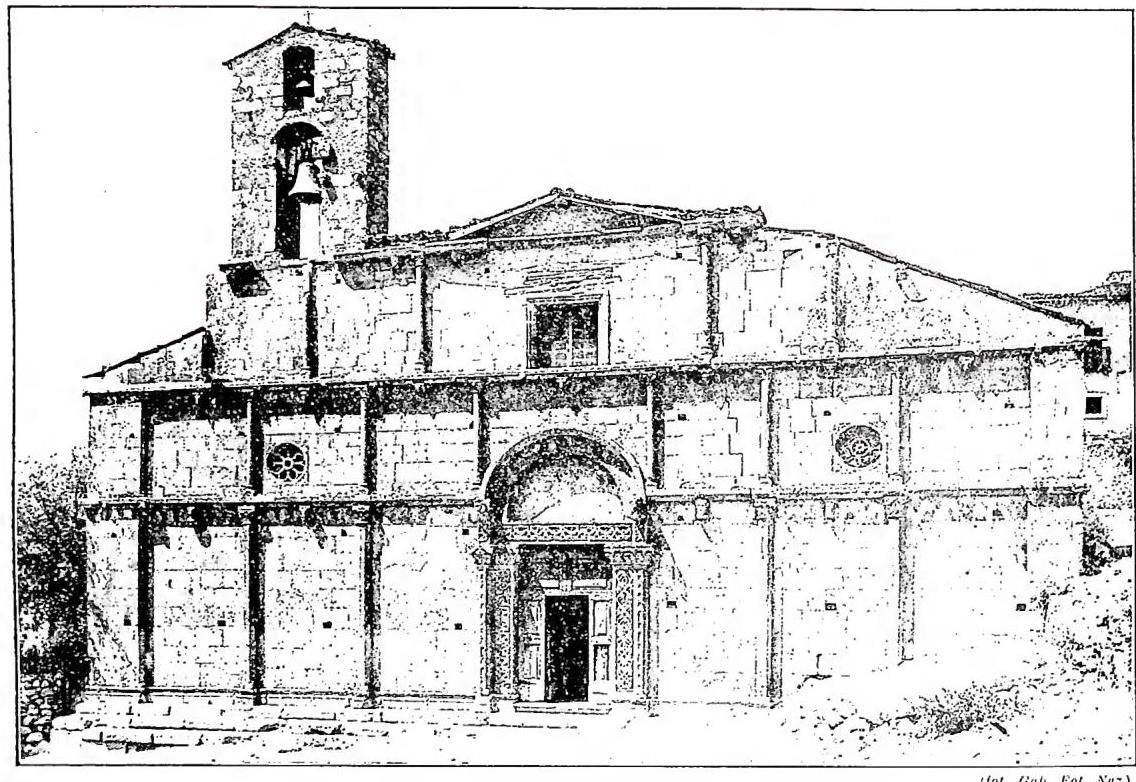
(phot. Gab. Pat. Naz.)
BAZZANO — Façade of the church of S. Giusta. The portal dates from 1238.
and translated into various languages (in Italian, Rome 1867, and Amelia 1889), wrongly attributed to Fr. G. Roothaan.
BIBL.: Sommervogel, VIII, 1783-85; S. Casagrandi, De claris sodalibus provinciae taurinemis S. I. commentarii, Turin 1906, pp. 191-210; J. Rickaby, B., in The Cath. Enc., II, col. 360. The eucharistic theory of B. is extensively refuted by G. B. Franzelin, De Eucharistia, 5th ed., edited by G. Filograssi, Rome 1932, pp. 291-98, and by Fr. C. Piccirelli, Disquisito de catholico intellectu dogmatis transsubstantiationis, Naples 1912, pp. 130-31, 174, 185, 240. Antonio Piolanti
Cite this article
“BAYMA, GIUSEPPE.” Enciclopedia Cattolica, vol. II (1949), p. 637. Azione Romana digital edition, https://azioneromana.com/article/bayma-giuseppe.