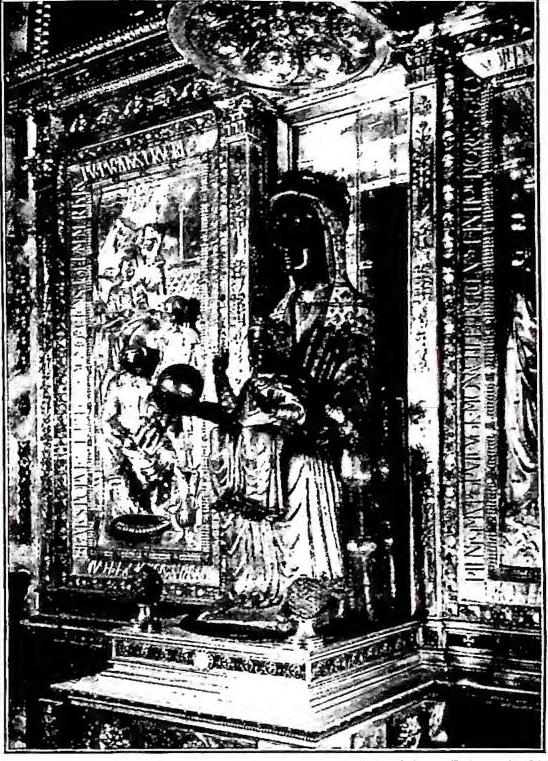
At the end of the ninth century, a chapel dedicated to Our Lady was built; subsequently incorporated definitively into Ripoll, it was transformed into a cenobium between 1023 and 1025 through the work of the abbot and bishop Oliba. Toward the end of the eleventh century, together with Ripoll, it belonged for several decades to the monastic confederation of St-Victor of Marseille as a simple priory. In fact, independence from Ripoll was not achieved until the time of Prior Giacomo de Vivers (1348–75). At this point M. attained the height of its feudal power, being regarded by the kings of Aragon as “a state within his kingdom” (Pietro III). During the Western Schism the monastery remained consistently on the side of the popes, despite the fluctuations in allegiance that occurred in Catalonia. The last prior, Vincenzo de Ribes, was made a cardinal by Gregorio XII, while Benedetto XIII entered the monastery and raised it to the status of an abbey (1409), a dignity previously withheld for political reasons by the sovereigns and for economic reasons by Ripoll.
In the fifteenth century several great abbots succeeded one another: Marco de Vilalba (1409–39), a delegate to the Council of Constance; Antonio Pietro Ferrer (1450–71); and Giovanni de Peralta (1483–93). With Cardinal Giuliano della Rovere there was the only commendatory abbot (1472–83) who never lived in the monastery; he was nevertheless responsible for several buildings and for the granting of numerous privileges during his pontificate. After a reform attempted in the middle of the century by Cassinese monks, and while the spiritual order was flourishing under Abbot de Peralta, the observance of the Congregation of Valladolid was introduced by royal authority (1493), through the well-known Garcia de Cisneros. During those years, an hermit of M., Bernardo Boil, accompanied Columbus’s ships as apostolic delegate on their voyage of discovery to America; perhaps for this reason one of the first islands discovered was called Montserrat. Under Cisneros the monastery possessed a genuine school of mystics and ascetic writers,
From the twelfth century onward, following the first miracles attested in writing, pilgrimages began and became increasingly numerous in the centuries that followed. In 1225 the Confraternity of Our Lady was established, and soon counted bishops, kings, and popes among its members (new regulations in 1445 and 1881). As early as the fourteenth century, the imagination, following popular piety, clothed the somewhat obscure origins in the most beautiful and poetic legends it could find. Poets of every period have sung of her miracles and beauty, from the king of Castile Alfonso the Wise, in his Cantigas, to Lope de Vega, Verdaguer, and Sagarra; although the connection with the legend of the Holy Grail, so often mentioned in relation to Wagner’s Parsifal, is not genuine. During the seventeenth to nineteenth centuries, the Benedictine Congregation of M. spread through Austria, Bohemia, and Brazil, as well as Australia and the Philippine Islands. Today the pilgrims who ascend annually to the Shrine quite often number 500,000.
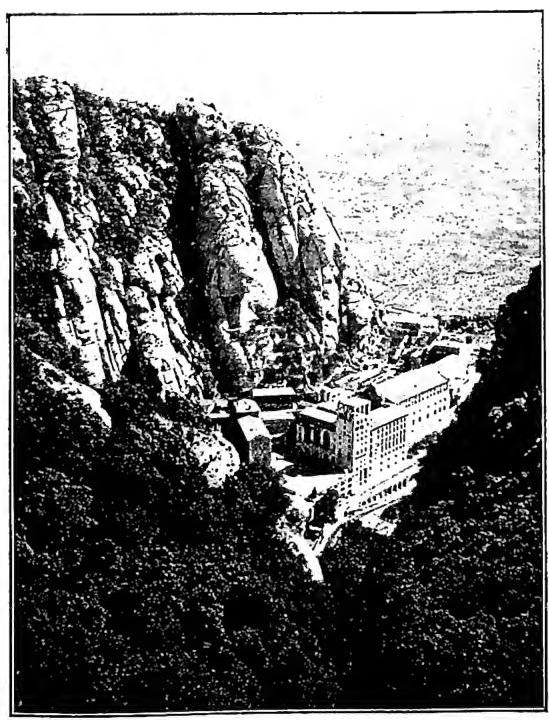
The church (a basilica since 1881) dates from the second half of the sixteenth century (its interior decoration from the late nineteenth and twentieth centuries); of the ancient church, only the doorway with Romanesque sculptures remains (twelfth century). The bell tower is an old defensive tower (fourteenth–sixteenth centuries); the Gothic cloister was built in the time of Cardinal Della Rovere (around 1480); the monastery dates from 1755–64. Nearby (2 km away) the monastic church of S. Cecilia, consecrated in 957, is still standing, with remains of contemporary wall paintings. Scattered across the mountain are several chapels once inhabited by hermits; the oldest preserved are: S. Margherita (Visigothic, eighth or ninth century?), S. Paolo (eleventh and twelfth centuries), S. Aciscio (within the present monastery, eleventh and thirteenth centuries), and S.ma Trinità (remains from the fifteenth century).
The monastery possesses a library (approximately 170,000 volumes, 1,150 manuscripts, 400 incunabula, and 30,000 pamphlets), a musical archive (2,000 manuscripts), an archive (5,000 parchments and approximately 30,000 documents concerning Catalan monasteries), a picture gallery (more than 300 paintings: Perin del Vaga, Sassoferrato, il Francia, il Greco, van Dyck, Ricci, Morales, Bermejo, Berruguete, Catalan panels of the fifteenth century, and modern works), an Egyptological and biblical museum, and a printing press that publishes