
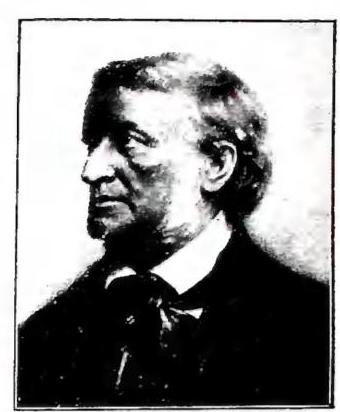
WAGNER, RICHARD. - Musician, Protestant, b. in Leipzig on May 22, 1813, d. in Venice on Feb. 13, 1883.
Having devoted himself since childhood to the study of ancient tragedies and Shakespeare's dramas, at 12 years of age he wrote a poem, and at 16 a pastoral for which he also composed the music, a field in which he very soon tried his hand by completing
Of all his rich artistic production, among the twelve dramas, 4 of which form the immortal tetralogy Der Ring des Nibelungen (Rheingold-Walhäre-S, the one that is of particular interest for its inspiration drawn from a religious subject is Parsifal, which seems almost to crown, with a mystical surge toward heaven, the tempestuous journey of his tormented soul. The drama hinges on the figure of the pure fool, who philosophically can be likened to the pure monad, symbol of the imperishable realm of innocence, which triumphs, with the return of the ring, in the Rheingold, closing with the unity-multiplicity-unity cycle of German idealist thought. Here, rather than the Christian hero, there shines through the spirit of the Germanic pagan myth which, symbolized in the young knight, modelled on the figure of Christ, seems almost to represent the triumph of the Germanic pagan myth over the Latin tradition and over the Catholic spirit of Christianity (represented in the wounded and dying Amfortas), which had shattered the primitive unity of the German epic.
In addition to his musical production, mention must be made of W.'s very rich harvest of prose writings, including important theoretical, critical, and philosophical works, in which his dramatic ideal is illustrated and in which his aesthetic thought is expounded, such as Oper und Drama (1851), Die Musik der Zukunft (1860), Beethoven (1870), etc.
With regard to sacred music, it is interesting to note that W. did not disdain drawing upon the liturgical repertoire, as with the Grail theme, in the first act of Parsifal, from the Amen responsory of Joh. Gottlieb Naumann (1741-80), in use in the cathedral of Dresden; and he had a profound admiration for Palestrinian polyphony, which he considered the artistic pinnacle of church music.