Machine translation of the 1948–1954 Italian original. The original text is authoritative.
NIBELUNGI, SAGA dei. — This is a complex of epic legends that spread during the Middle Ages throughout the Germanic lands, from Scandinavia to Austria,
and were repeatedly elaborated in popular songs and narratives, the most noteworthy of which are the heroic lays of the Edda (v.), the Volsunga-saga, and the Middle High German poem Der Nibelunge nôt. The word N., which etymologically means “children of the mist,” that is, subterranean beings, originally designated the elves from whom Sigfrido took the treasure; it then came to designate Sigfrido himself and his companions and, after the treasure had come into their possession, the Burgundi.
The saga is composed of mythical elements, such as the figures of Sigfrido and Brunilde, and historical elements, such as the account of the destruction of the Burgundian people by the Huns in 437 and the figures of Attila and Teodorico il Grande. The union of these elements, to which other motifs from novellas and fairy tales were subsequently added, perhaps took place during the 5th and 6th centuries among the Franks of the Lower Rhine, heirs to the Burgundian traditions. In its definitive form, the saga presents a sequence of events linked by a relationship of injury and vengeance; in its final development, however, the Nordic form of the saga differs somewhat from that established in the German poem. According to the latter, Sigfrido, of the lineage of the Volsungi, son of Sigmund, king at Xanten in the Netherlands, after a youth filled with fabulous adventures, including his encounter with the Valkyrie Brunilde, whom he awakened from a centuries-long sleep within a castle enveloped in towering flames, is seized by a nostalgic love for the beautiful Crimilde, sister of Guntero, king of the Burgundi, to whose court he goes, remaining there as a guest. Through an innocent deception he obtains for Guntero the hand of Brunilde in exchange for the promise of taking Crimilde as his wife. The two marriages are concluded, but Brunilde, who comes to learn of the deception of which she has been the victim, and consumed by an ancient jealousy, takes revenge by having Sigfrido treacherously killed by her faithful Hagen. Crimilde is inconsolable and spends year after year in tears and mourning; only in the great treasure left to her by her husband does she find some comfort for her grief. But Hagen, fearing that the treasure might become a dangerous instrument of vengeance in her hands, takes it from her and sinks it in the Rhine. Crimilde swears revenge and devises a terrible plan. She therefore accepts the proposal of Attila, who has been widowed, and unites herself with the powerful king of the Huns in order to carry out her revenge more easily. She waits many more years and finally, when the moment seems propitious, invites the Burgundi to her palace and has them treacherously attacked in order to destroy them. A general slaughter then takes place, in which Guntero and Hagen also perish at the hands of the enraged Crimilde, armed with the sword
(phot. H. Goldstein)
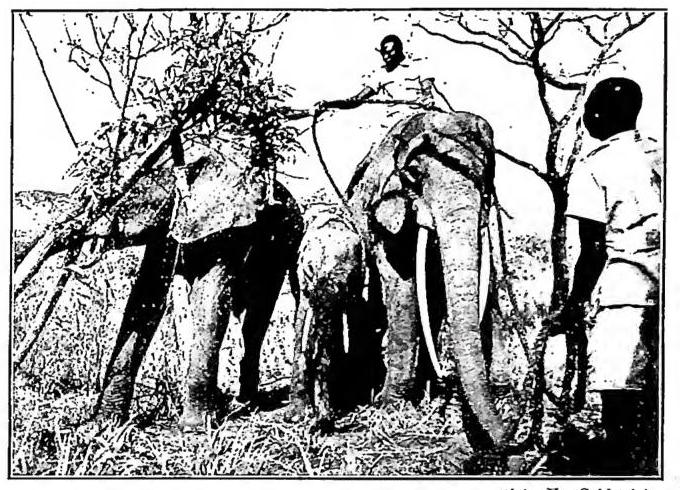
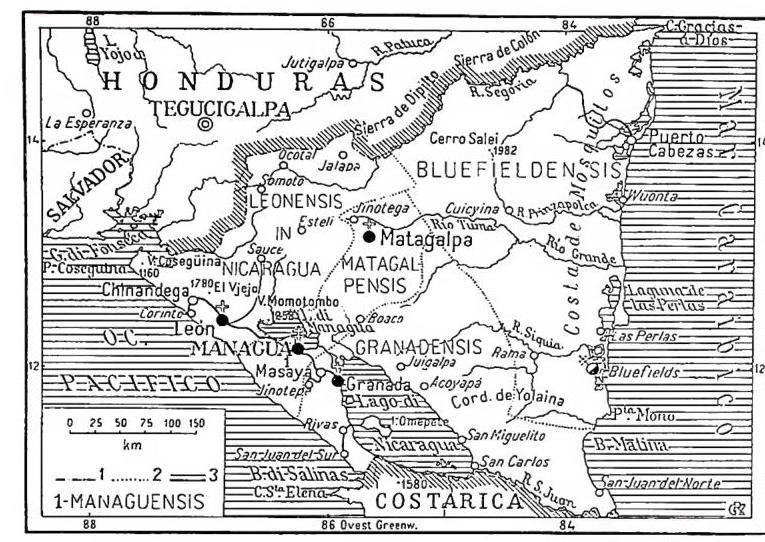
NIANGARA, VICARIATO APOSTOLICO di — Capture of a young elephant.NICARAGUA — 1) State boundaries; 2) regional boundaries; 3) ecclesiastical jurisdictional boundaries.
of Sigfrido; the woman herself is killed by Ildebrando, Teodorico’s squire, the sole survivor, together with Attila, of the immense slaughter. In the Nordic sources, Crimilde, under the name Gudrun, does not avenge her husband’s death upon her brothers, but their murder upon her husband. This form of the saga is certainly the original one, because it conforms more closely to the historical fact: Attila, as is known, died during his wedding night with the Germanic Hildico and, as was then believed, at her hand. The change may perhaps be attributed to an evolution in the ethical concept among the Germans, namely, to the increasing pre-eminence that the marriage bond gradually acquired over the bond of consanguinity.
As it has been preserved, the s. dei N. has lost every trace of paganism and assumed, especially in the German poem, a markedly Christian and chivalric coloring. Nevertheless, the principles that shape the substance of the action—namely, that law of barbarian moral right according to which blood demands blood, that pessimistic sense of tragic fatality governing the characters’ actions, that kind of gravitation toward ruin and death, and above all that concept of fidelity in relations of subjection, not abstract but practical, which not only excludes fidelity toward one’s lord’s enemy but imposes treachery—are characteristically and unequivocally pagan. This saga may therefore be called a typical and representative product of the ancient Germanic world and a mirror of its tragic destinies during the centuries of the migrations of the peoples.
BIBL.: H. Lichtenberger, Le poème et la légende des Nibelungen, Parigi 1891; R. C. Boer, Untersuchungen über den Ursprung und die Entwicklung der Nibelungenage, Halle 1906-1908; Th. Abeling, Das Nibelungenlied und seine Literatur, Lipsia 1907; B. Vignola, Il poema dei N., Verona 1912; H. Schneider, Germanische Heldensage, Strasburgo 1932-34, V. indice. Bruno Vignola
Cite this article
“NIBELUNGI, SAGA DEI.” Enciclopedia Cattolica, vol. VIII (1952), p. 1061. Azione Romana digital edition, https://azioneromana.com/article/nibelungi-saga-dei.