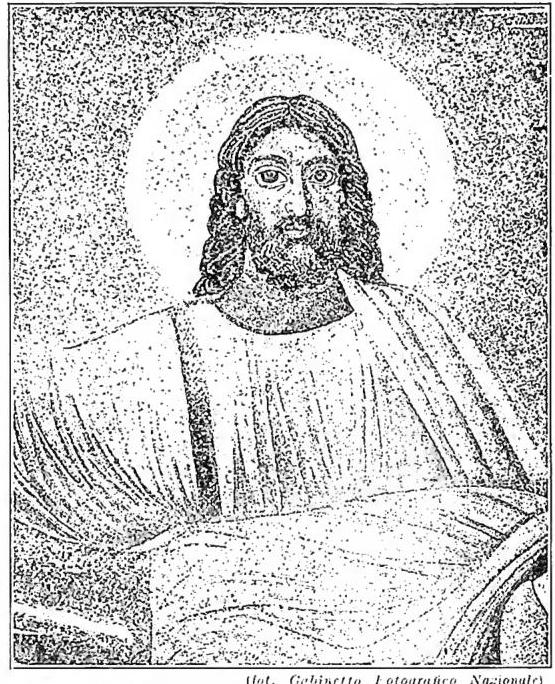
BARBA. — Among the ancient Christians, the beard was a sign of authority, as Clement of Alexandria asserts (Paedagog., III, 11: PG 8, 633). In early Christian art, the following are shown with beards: the Eternal Father in various scenes (the creation of Adam and Eve, the offering of Cain and Abel, the conversation with Jacob in the dream), Abraham, Pharaoh, Jacob, Elijah, Elisha, Nebuchadnezzar, the elders of Susanna, John the Baptist; Jesus Christ almost always in the giving of the Law; the Apostles Peter, Paul, Andrew, and James the Less; sometimes the artist alternates bearded and beardless apostles, as on the sarcophagus of Gorgonius in Ancona Cathedral (Wilpert, Sarcofagi, pl. 14, 3). Many sarcophagi depict bearded Christians, in which case they are actual portraits, as on the sarcophagi of the two brothers, of Comes Balerius, of Giulio Caterio, of Valerio Valentiniano, etc.
The type of the bearded Christ never became predominant in the West, even later, especially in Carolingian art, which deliberately drew its inspiration from classicism. In Italy, before the very recent period, when Christ is either completely orientalized or set in the context of our own century, artists are divided; among the most famous Christs, some are bearded (Raphael’s Transfiguration, Titian’s Christ), while others are beardless (Michelangelo in the Last Judgment, Leonardo da Vinci in the Last Supper). A special chapter of iconography has created the legend of female saints with beards (cf. H. Delchaye, Les Légendes hagiographiques, 3rd ed., Bruxelles 1927, pp. 103, 195).
With regard to the beard, there is an entire ecclesiastical tradition. Eastern monks and clerics always retained the beard; in the West, on the other hand, there was never a fixed rule. The Statuta ecclesiae antiquae (Mansi, III, 955) merely prohibit cultivating the beard. Sidonius Apollinaris (Ep. 4, 13; PL 58, 519), in the fifth century, describes a perfectly beardless priest. Nevertheless, in the West in the eleventh century there are monks with beards, as is shown by M. Inguanez - M. Avery, Miniature cassinesi del sec. XI illustranti la vita di s. Benedetto, Montecassino 1934. Yet, from as early as the ninth century, the practice of not wearing a beard must have been
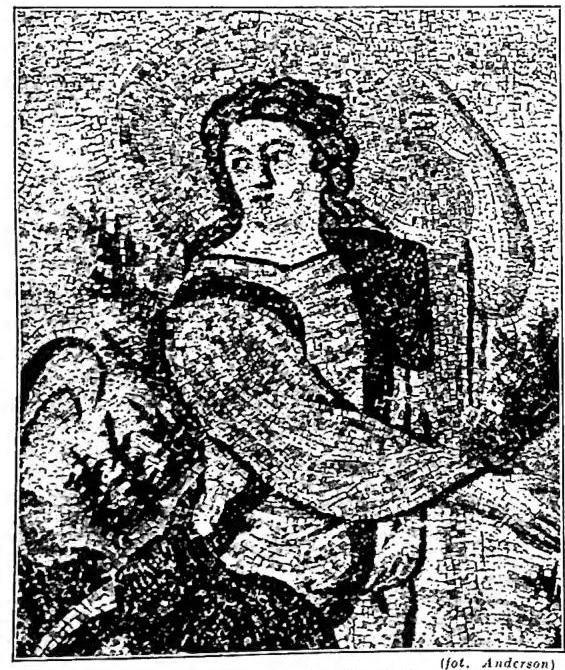
It should be noted, however, that the prohibition against wearing a beard did not require that it be shaved; in fact, the practice of cutting the beard with scissors on the cheeks and chin continued even in the seventeenth century, as can be seen, for example, in the portraits of s. Filippo Neri and s. Vincenzo de' Paoli.
During the sixteenth century, by contrast, there was a tendency to wear a beard; Giulio II and Clemente VII followed this custom intermittently, until the latter prohibited it in the Curia, provoking the complaints of the elegant men of the time. But this was of no avail: the custom of wearing a beard continued, including among the popes, until the end of that century. During the seventeenth century, everyone, including the popes, followed the common fashion of moustaches and a small goatee, until under Clemente XI shaving the beard became fashionable. From that time onward, papal and episcopal prescriptions to this effect followed one another uninterruptedly until the reply given on 10 January 1920 to the bishop of Breslavia (AAS, 12 [1920], p. 43 ff.), which prohibits secular clerics from wearing a beard; this has led some to believe that