Machine translation of the 1948–1954 Italian original. The original text is authoritative.
RIGNANO FLAMINIO. – At the twenty-sixth mile of the Via Flaminia, lying at the foot of Soratto, extends R. F., which, under the name Castrum Rinianum, is mentioned in a document of 962; in 1116 it appears as territory belonging to the church of S. Cecilia in Trastevere.
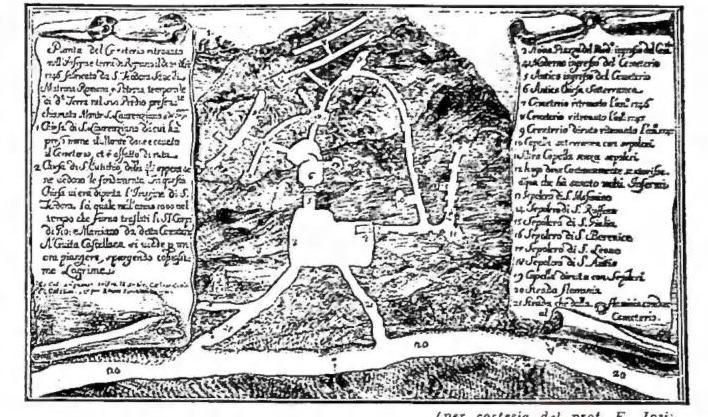
R. F. has two notable early Christian monuments: an underground cemetery west of the settlement and an ancient church to the east. The Christian cemetery came to light in 1651 on the left of the Via Flaminia, in an area called S. Laurenziano, belonging to the collegiate church of R., dedicated to ss. Vincenzo and Anastasio. Three Christian cemetery galleries with intact tombs were discovered there at that time, as is shown by a manuscript in the Archive
(courtesy of Prof. E. José) RIGNANO FLAMINIO – Plan of the underground cemetery (4th century). From an 18th-century drawing preserved in the Archive of R. F.of the said collegiate church. In 1702 the custodian of the relics, Mons. M. A. Boldetti, went there and observed “a round chapel full of tombs and... some sacred paintings.” The cemetery was subsequently excavated in 1745 by the vicar forane G. B. Tomai and in 1746 by the gravediggers of the Sacrista. At the end of the 18th century, part of the cemetery was sacrificed in order to build an oratory in honour of s. Teodora, patroness of the Savelli family, and a square in front of II. In 1857 G. B. De Rossi went there and transcribed and published the dated inscriptions, scratched onto the loculi, which had by then been opened and violated; they contained dates ranging from 336 to 424. A report by the Sacrista is in cod. Vat. lat. 9023, f. 38. In 1908 and 1946 the cemetery was restored by the Pontifical Commission of Sacred Archaeology. To the east of the inhabited area, on the steep slopes of a hill, stands the church in honour of the ss. Abbondio and Abbondanzio. The building consists of two distinct parts: the first is made of large squared blocks of tuff taken from an earlier building; the second is built in curtain masonry. Fragments of marble, cippi, bases, capitals, and a tabernacle arch with the characteristic braided decoration of the 8th century are incorporated into both parts. A cippus erected by an Atilia Marcella in memory of her husband C. Clodius Fabatus (CIL, XI, 1, 3963) contains three hexameters of unusual conception, which some have regarded as Christian and which are seen repeated on a cippus found at Niebla, near Seville in Spain (CIL, II, suppl., p. 856, n. 591). At the junction of the two parts rises a tall three-storeyed bell tower with bifora windows, dating from the 11th century. The interior has a single nave; three pillars with capitals decorated with a Greek cross support three pointed arches; the walls were covered with paintings.
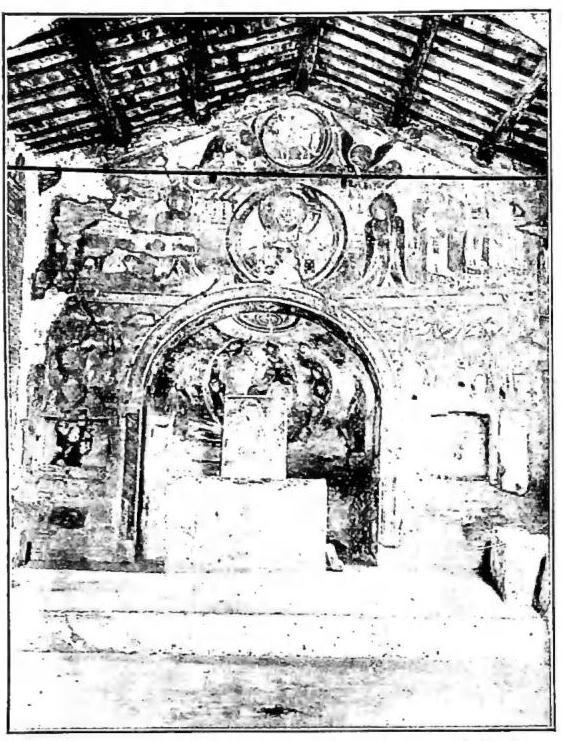
In the elevated presbytery are the altar table and stone seats. In the arch, the divine Lamb with a cruciform halo is painted in the centre, between the symbols of the four Evangelists and the seven candelabra. Below, in the middle, is the bust of the Redeemer among winged cherubim and choirs of angels. In the lower zone, on either side, the 24 elders of the Apocalypse approach, twelve on each side, according to the type already established in the arch of S. Paolo and repeated in S. Prassede, at Ferentillo, at Castel S. Elia, and at S. Giovanni a Porta Latina, to which they are related, particularly in their dating to the end of the 12th century. Beneath it is a crypt. As for the martyrs Abbondio and Abbondanzio, they do not appear in the ancient calendars and martyrologies; they are listed under 26 August in the Cologne edition of 1515 of Usuard’s Martyrology.
The Bollandists indicate (Acta SS. Septembris, V, Paris 1868, pp. 293 ff.) a first Passio from a Budacense manuscript and a second, printed in 1584 by the Jesuit F. Cardolo, who made use of three manuscripts, the oldest of which, dating from the 12th–13th century, is in the Liberian Archive. The martyrs Abbondio, a priest, and Abbondanzio, a deacon, are said to have been beheaded at the fourteenth mile of the Via Flaminia and buried by Teodora on her property at the twenty-eighth mile of the same
RIGNANO FLAMINIO - Oratory of SS. Abbondio and Abbondanzio with frescoes from the 12th century, before the restorations.road. The Passio seems to have been composed before 1000; it makes no mention whatsoever of the cemetery, but recalls only the « ecclesia quae est iuxta montem Soractis ». Its provenance from this group or from the cemetery of the inscription « Abundio prb. martyri sancto dep. VII idus dec. », now in the Lateran Museum, is uncertain (CIL, XI, 4076).
BIBL.: M. A. Boldetti, Osservazioni, Roma 1720, p. 577; G. B. De Rossi, Inscr. christ., I, Roma 1857-61, nn. 55, 58, 75, 76, 77, 81, 86, 90, 165, 166; id., I monum, antichi crist. e loro distribuz. geograf. nel territorio dei Capenati, in Bull. arch. crist., 4ª serie, 2 (1883), pp. 115-59; CIL, XI, 1651, 4012, 4028-32, 4043, 4036, 4038-39, 4042-47, 4076; G. Tomasetti, La campagna romana, III, Roma 1913, p. 344; P. Toesca, Stor. dell'arte ital., Torino 1927, pp. 928 e 1025; A. Serafini, Torri campanarie di Roma e del Lazio nel medio evo, Roma 1927, p. 108 agg.
Enrico Josi
Cite this article
“RIGNANO FLAMINIO.” Enciclopedia Cattolica, vol. X (1953), p. 537. Azione Romana digital edition, https://azioneromana.com/article/rignano-flaminio.