
One might say that, beginning with the eighteenth-century Enlightenment movement, sacred art no longer achieved the expression and triumph that constituted the greatest glory of the figurative arts, not only of the Middle Ages but also of the Renaissance and the Baroque. And this is understandable: subtle rationalism could not foster the surge of faith, which was then increasingly challenged during the nineteenth and twentieth centuries by new philosophical and political currents—materialism, socialism, positivism, modernism, communism (to name only the principal ones)—to which were added, in recent decades, the horrors of two world wars and the grave hardships that followed. Yet it would be unjust to deny that, both in the nineteenth century and today, the problem of sacred art has been felt, even if it no longer dominates the minds of artists, and that alongside mediocre or unfortunate solutions, there have also been notable and even admirable ones.
Certainly, architecture did not assert itself in the nineteenth century; indeed, of all the arts, it was the least successful, oscillating between continuous imitations, now of classical models, now of Romanesque, Gothic, or Renaissance ones. In Italy during the Neoclassical era, Giuseppe Valadier (1762–1839) stands out among others, the author of the splendid Piazza del Popolo in Rome and the designer, for example, of the measured façade of S. Pantaleo in the same city and the imposing interior of the cathedral of Urbino. In Rome, the most significant Neoclassical construction remains undoubtedly the reconstruction, by Luigi Poletti (1792–1869), of the basilica of S. Paolo fuori le mura after the fire of 1823; but while the interior of this basilica is notable for its luminous and severe grandeur, the exterior and the bell tower reveal the worst of academicism.
In Naples, which had experienced the reigns of Giuseppe Bonaparte and Gioacchino Murat, the church of S. Francesco di Paola was built, by order of Ferdinando I and under the direction of Pietro Bianchi (1787–1849), modeled after the Pantheon, between the wings of a Doric portico with an elliptical plan, which had already been begun under Murat based on a design by Leopoldo Laperuta.
In Milan, capital of the Cisalpine Republic and the Kingdom of Italy, Neoclassicism triumphed, continuing even after the fall and death of Napoleon. Among the most significant churches of this period is S. Carlo, erected between 1836 and 1847 by Carlo Amati (1776–1852), a pupil of Albertolli and Zanoia. In the Veneto, where classicism remained ever alive through the Palladian tradition, a perfectly Neoclassical church modeled after the Pantheon had already appeared in the early eighteenth century: S. Simeone Piccolo in Venice (1718), by Giovanni Scalfarotto. The scheme of the pronaos with Ionic or Corinthian columns, surmounted by a triangular pediment, gained increasing favor not only in the Veneto but throughout Italy and abroad, and it suffices to recall, limiting ourselves to the Veneto, the façade of the cathedral of Cologna Veneta by Giannantonio Selva (1751–1819), that of the cathedral of Schio by Antonio Diedo (1772–1847), and the other of the cathedral of Treviso, designed in 1836. Selva also designed the otherwise simple façades of two small churches in Venice, S. Maurizio and S.mo Nome di Gesù. In Possagno, the celebrated temple designed by Canova himself and completed after his death in 1830, imitates the Parthenon in the pronaos and the Pantheon in the round body of the structure. In Trieste, one of the most notable centers for Neoclassical architecture in Italy, the beautiful church of S. Antonio Nuovo (1826–49), built by Pietro Nobile (1774–1854) after the model of the Pantheon, is worth mentioning.
Still in this period, Turin can boast above all the church of the Gran Madre di Dio (1818–41), well-proportioned and well-integrated into the landscape, the work of Ferdinando Bonsignore (1767–1843). In Genoa, the elegant pronaos erected by Carlo Barabino (1767–1835) for the façade of the S.ma Annunziata is worthy of note. In Tuscany, civil buildings prevail; nevertheless, the parish church of Montecatini Terme (1833) and that of SS. Pietro e Paolo in Livorno, both by Luigi de Cambray-Digny (1779–1843), may be recalled. With the decline of the Napoleonic era, the winds of Romanticism also swept across the peninsula, bringing with them an increasingly passionate study of national history, especially of the Middle Ages and the Renaissance, further encouraged by new aspirations for freedom and independence. All this naturally had a vivid reflection in art as well, determining new directions; unfortunately, however, this movement was not felt in architecture. The forms of a national past were adopted more out of study and application than from an urgent demand of taste or imaginative reworking. Thus, a classical imitation from the Napoleonic period and its immediate aftermath was replaced by another, with far less successful results, as the new imitations soon degenerated into facile eclecticism and a mixture of hybrid forms. In Rome, which had become the capital of Italy, there was great building activity in the last decades of the century, including in the field of sacred architecture, and it may perhaps be said that here more than in other Italian cities, that imitation of past forms and that eclecticism which clearly indicate creative poverty and bad, academic taste were fully expressed. Generally, Romanesque and Gothic styles were chosen for churches, while Renaissance and Baroque were preferred for private palaces, and more rarely for sacred constructions. One of the first examples is the church of the S. Cuore in Via Marsala (1879–1887), of Renaissance type and the work of Francesco Vespignani (1842–99). Luca Carimini (1830–90) designed S. Antonio on Via Merulana (1886), of Paleochristian scheme, and the Renaissance façade of S. Chiara. Both Paleochristian and Renaissance in style is S. Gioacchino (1890–98) by Raffaele Ingami; Romanesque is S. Anselmo (1900), built by Francesco Vespignani based on designs by P. Ildebrando de Hemptine; entirely Gothic are the church of the S. Cuore in Via Piave by Aristide Leonori and the other, also dedicated to the S. Cuore, on Lungotevere Prati, by Giuseppe Gualanini (1870–1942); Romanesque are the two churches of S. Teresa on Corso d’Italia and S. Camillo, both by Tullio Passarelli (1869–1941), and that of S. Giuseppe on Via Nomentana (1905–1906), the work of Carlo Busiri Vici (1856–1925); a compromise between Paleochristian and Romanesque is the church of S. Croce in Via Guido Reni (1913), by Leonori.
Thus outside Rome: one may recall the façades in Florence of S. Croce and of S. Maria del Fiore, the first (1857-63) of Renaissance type and crowned with three Gothic spires, by Niccolò Matas (c. 1898-1872), the second, imitating the forms and polychromy of the sides of the same church, with Romanesque-Gothic elements, the work of Emilio De Fabris (1808-83) and completed in 1887 by his assistant Luigi Del Moro. Still in Florence is the bell tower of S. Croce (1865), in the fourteenth-century manner, by Gaetano Baccani (1782-1867). In Milan, the two Gothic façades of S. Marco (1871) and of S. Maria del Carmine (c. 1879) by Carlo Maciachini (1818-99). In the Veneto, the cathedral of Lonigo (1877-95) by Giacomo Franco (1818-1895), derived from Romanesque models. In Turin, one sees, by the same architect Edoardo Arborio Mella (1806-84), the Gothic S. Cuore di Gesù (1873-76) and the Romanesque S. Giovanni evangelista (1878-82); by Carlo Velasso, the Renaissance church of SS. Pietro e Paolo (1863-65). Perhaps the most significant eclectic architect in Turin is Carlo Ceppi (1829-1921), of whom the S. Gioacchino (1876-82), of paleo-Christian type, and the S. Cuore di Maria (1890) are of interest. But a work of genius is found in Novara with the dome of S. Gaudenzio, extremely slender and soaring, by Alessandro Antonelli (1798-1888), a work even more organic than the famous Mole Antonelliana in Turin. In Genoa, the church of the Immacolata Concezione, with a Greek cross plan and a rich façade (1856-73), is imprinted with Ligurian and Lombard Renaissance forms, by Domenico Cervetto, Maurizio Dufour (1837-97), and Gioacchino Zandomeneghi (1837-1902), while in Savona the façade of the Cathedral (1886), imitating the late Renaissance, is by Guglielmo Calderini (1837-1916). A blend of Romanesque and Gothic reappears in the S. Cuore di Gesù in Bologna (1901-12), by Edoardo Collamarini (1863-1928). Finally, for Campania, one may recall the restorations of the façade of the cathedral of Naples (1877-1905), of Gothicizing design, by Enrico Alvino (1810-76) and Giuseppe Pisanti (1826-1913), and of the cathedral of Amalfi (1891), of thirteenth-century Arab-Sicilian type, by the same Alvino, L. Della Corte, and Guglielmo Raimondi.
Already in the second half of the nineteenth century, the need was felt to react against this confused eclecticism, which indicates nothing other than a lack of creative spirit. However, the first attempts at renewal, which occurred in foreign countries, should not be sought in the use of new materials—iron first, then reinforced concrete and glass—nor in the presuppositions of functionalist and rationalist theories, because a work of architecture must above all be a work of art, and because the values of a work of art do not reside in particular techniques or theories. The first attempts at renewal are discerned more in the writings than in the works of certain foreign architects, especially the Frenchman Viollet-le-Duc (1814-79). But the first works of the new architecture appeared in Holland, Sweden, Germany, and Austria with architects such as H. P. Berlage (1856-1935), G. F. Boberg (b. 1860), P. Behrens (1868-1938), O. Wagner (1841-1918), with the suppression of ornament, the simplification of forms, the highlighting of structural elements and materials, albeit based on the reworking of national elements, until the Belgian Van de Velde (b. 1863) and the American Wright (b. 1869) initiated today’s architecture, which would assert itself especially in Holland, Germany, Austria, and France, not so much on principles of functionality and rationalism or on a proper tradition, but by concealing structural elements behind broad and luminous planes cut at right angles and displaying a common, international character. In Italy, bound to tradition, this vast movement had a later resonance. After what Antonio Sant’Elia (1888-1916), an idealist and theorist, wrote in 1914—who merits recognition for having understood that architecture is not “an arid combination of practicality and utility, but remains art, that is, synthesis, expression” and that it must represent “the effort to harmonize the environment with man with freedom and great audacity”—one must arrive at the years preceding and following the Second World War. But in Italy, there are no forms as strongly individual as abroad, although in the main cities and in the new centers that arose in the Agro Romano, there are works worthy of admiration, especially in the field of civil construction. Modern and beautiful churches are fewer in number. Among others, one recalls those of S. Antonio in Cremona (1936) by Giovanni Muzio (b. 1893), the churches of S. Michele Arcangelo in Aprilia (1936-38) by Concesio Petrucci (1902-46) and Mario Tufaroli, and of S. Marco in Latina (1932) by Oriolo Frezzotti, and finally that of Cristo Re in Rome (1927-34), by Marcello Piacentini (b. 1881), especially for its façade opened by three arches and flanked by two square towers, while the exterior of the apse and the dome is poor in appearance and without logical development. In Italian churches, traditional elements, above all the arch, easily appear, as can be understood, but in the best constructions, the taste for simplification and for large surfaces, the bold thrust and precise cut in the arch itself, lead to an expression of art completely new (cf., for example, the façades of the churches of Aprilia, Latina, Cremona). In the latter, Muzio ingeniously reduced the arch to a small lunette for the crowning, to give bold development to the large pilasters, which confer on the whole a grand and severe aspect.
Also in other art forms, one can naturally follow the evolution of taste and forms, from Neoclassicism to today. In sculpture, the greatest representative of the Neoclassical age was—as is well known—Canova (v.), a genuine artist, even if not always free from mannerism. Turned toward the most rigid abstraction from any pulse of life for the triumph of the purest formalism is the Northerner Alberto Thorvaldsen (1770-1844), as his monument to Pius VII in the Vatican Basilica (1831) demonstrates. From the models of Canova and Thorvaldsen, who exerted a broad influence in Rome, works of a more or less monotonous academism soon derived. It suffices to recall some: the statues of St. Peter and Paul on the sides of the staircase of St. Peter’s, by Giuseppe de Fabris (1710-1860) and Adamo Tadolini (1789-1868); the statue of St. Stephen by Rinaldo Rinaldi (1793-1873) in the Ostian Basilica; the statue of St. Francesco Caracciolo by Alessandro Laboureur (1796-1861) in St. Peter’s; the monuments to Pius VIII by Pietro Tenerani (1789-1869) and to Gregory XVI by Luigi Amici (1813-97) in the same basilica; the group of the Kiss of Judas by Ignazio Jacometti (1819-83) at the Scala Santa; the statue of the Immaculate Conception by Giuseppe Obici (d. before 1865) on the column in Piazza di Spagna. In Milan, another important center of this period, sculptures of character and value not too different from those of Rome or other cities are observed. The most celebrated sculptor is Pompeo Marchesi (1789-1858), to whom are owed, among other things, a Pietà and the Communion of St. Louis Gonzaga in the Neoclassical church of S. Marco, and various statues on the façade of the Duomo. In Genoa, there is the St. Agnes in Glory by Nicola Traverso (1745-1823) in S. Maria del Carmine; in Florence, the Penitence and Faith by Innocenzo Spinazzi (d. 1798). Against these forms, tired repetitions of classical models, BARTOLI, DANIELLO (v.) reacted by rejecting the study of the antique in favor of that of nature and of fifteenth-century Florence, but in practice, especially in his later years, his work often fell into a cold and affected naturalism.
BIBL.:
For architecture: G. Giovannoni, Architettura e arte decorativa in Italia nell’età contemporanea, Rome 1930; id., L’architettura in Italia nell’Ottocento, in Storia dell’arte italiana, part V, vol. II, Turin 1938; A. Muñoz, L’architettura del sec. XIX in Italia, Rome 1941; M. Piacentini, Architettura d’oggi, Rome 1930; G. C. Argan, L’architettura italiana del Novecento, in Storia dell’arte italiana, part V, vol. III, Turin 1938; G. Cozzolino, L’architettura sacra in Italia nel sec. XX, Rome 1940; for sculpture: A. Venturi, Storia dell’arte italiana, vol. X, Milan 1937; U. Ojetti, La scultura italiana dell’Ottocento, Florence 1929; L. Callari, Storia dell’arte contemporanea italiana, Rome 1909; A. De Rinaldis, La scultura napoletana dell’Ottocento, Naples 1929.
G. Matthiae
It can be said that, starting from the eighteenth-century movement, the most vital currents of nineteenth-century sculpture increasingly distanced themselves from sacred subjects. In Tuscany, after the tired repetitions of classical models—such as the Penitence and Faith by Innocenzo Spinazzi (d. 1798)—BARTOLI, DANIELLO (v.) reacted by rejecting the study of antiquity in favor of nature and fifteenth-century Florentine art. In practice, however, especially in his later years, he did not stray far from a Canovan taste for forms, caressing his images with the most attentive care. His example was followed by another Tuscan, Dupré (v.), in whom the study of truth was tempered by a sense of Renaissance composure. A freer form of realism is found in the work of a Lombard, Vincenzo Vela (1820-91), who also began with Bartolini’s teachings. One of his works worth mentioning is the Mater Dolorosa in the Dadda Chapel at Arcole. However, it must be immediately noted that sacred subjects became increasingly rare among those sculptors who represented the liveliest currents of the nineteenth century. In Lombardy, where Romantic sculpture, in contact with a Cremona and a Ranzoni and with French Impressionism, assumed an ever more pronounced pictorialism—culminating in a Medardo Rosso and a Trabetzkov—after Giuseppe Grandi (1843-94), a pupil of Vela and himself a master, other artists emerged, including Enrico Butti (1847-1932), who in 1894 modeled a highly expressive Crucifix for the tomb of the sculptor Vincenzo Tantardini in the Monumental Cemetery of Milan. Of Rosso (1858-1928), one of our greatest nineteenth-century sculptors, only an Ecce Puer (1906) in the Galleria Nazionale d’Arte Moderna in Rome can be cited. In Turin, Carlo Marochetti (1805-1867) had managed to react against academism; his works include two Adoring Angels in the church of La Madeleine in Paris. From the second half of the century to the beginning of the twentieth, the works of David Calandra (1836-1915) and Leonardo Bistolfi (1859-1933) stand out. Both Romantics, at least in their youth, the former was a passionate lover of nature and a master of technique (cf. Resurrection of the Widow of Nain’s Son [1914] for the Molli tomb in the cemetery of Borgomanero); the latter, through a subtle pictorialism, expressed an almost mystical poetry (cf. The Funeral of the Virgin).
In Genoa, Giulio Monteverde (1837-1917) is particularly noteworthy. Like many of his contemporaries at the turn of the century, he struggled between realism and academism, and his Madonna and Child (1889) for the Balduino tomb in the Staglieno Cemetery in Genoa reflects these characteristics. In Florence, a strong personality fiercely opposed to all academism emerged: Adriano Cecioni (1836-86), theorist of the Macchiaioli. However, his sculptures show no interest in sacred subjects. Later, the Palermitan Domenico Trentacoste (1859-1933) settled in the city; in his Dead Christ, executed for the De Asarta tomb in Fraforeano (Udine), he demonstrates not only a sure interpretation of nature but also a profound sentiment that ennobles form. In Rome, the capital of Italy, artists of various tendencies were highly active. Ernesto Biondi (1855-1917) revealed a fiery spirit in his St. Francis in Ecstasy (1898-1900), now in the Biondi Collection in Rome, which can be considered his masterpiece and which, through a lively pictorialism, shows a deep interest in nature. Conversely, Enrico Quattrini (1863-1930) was a sensitive modeler and a sincere, refined interpreter of sacred themes in an Annunciation (c. 1903), in Rome, owned by his son Carlo, who continued his father’s art. Eugenio Maccagnani (1852-1930) imbued a strong plasticity into a secure perspective and a calm, solemn character in a bas-relief depicting The Transport of the Body of St. Cyril (1908), now in the collection of Monsignor Leccisi in Rome. The eclectic Ettore Ximenes of Palermo (1855-1926; Rome, Ugo Ximenes Collection) produced works of refined but noble forms. The most vivid naturalism is found in Naples with Filippo Cifariello (1864-1936), a highly skilled and powerful modeler, whose monumental bronze group Dead Christ and the Magdalene (1895) in the Gallery of the Academy of Fine Arts in Ravenna remains one of the greatest works of the period for its plastic robustness and dramatic effect. Vincenzo Gemito (1852-1929) was another brilliant interpreter of life. In our century, new generations have continued the nineteenth-century tradition. It is sufficient to recall, in Rome, Amleto Cataldi (1882-1930), with the marble group Madonna and Child (1921) in the possession of his widow in Rome. Still active was Duilio Cambellotti (b. 1876), whose work in sacred art—though not exclusively—deserves particular mention.
BIBL.:
G. Nicodemi, La scultura lombarda dell’Ottocento, Milano 1938; A. Venturi, Storia dell’arte italiana, XI, Milano 1939, pp. 567-980; M. Tinti, La scultura italiana dell’Ottocento, Roma 1949; G. Castelfranco, La scultura italiana dell’Ottocento, Milano 1951; L. Servolini, Dizionario illustrato degli incisori italiani moderni e contemporanei, Milano 1955; inoltre V. le singole voci relative agli artisti citati.
A. M. R.
It can be said that, starting from the eighteenth-century movement, the nineteenth century saw the continuation of a tradition that, while not entirely devoid of merit, often remained anchored to academic conventions. In our century, new generations have not been lacking who have carried on the nineteenth-century tradition. It suffices to recall in Rome Amleto Cataldi (1882-1930), with the marble group Madonna and Child (1921) at the widow’s residence in Rome, and still active artists such as Duilio Cambellotti (b. 1876; Good Shepherd, 1946, with interesting stylizations), Aurelio Mistruzzi (b. 1880; Regina Pacis, 1948), and Alfredo Biagini (b. 1896; winning sketch for one of the doors of St. Peter’s Basilica, 1949). Others, and they are the majority, have sought renewal by emphasizing form, simplifying, and focusing on characters and emotional states. Among these, one of the most compelling figures, still awaiting a just evaluation, is Ermenegildo Luppi (1877-1937), who created works of the highest order (cf. Pietà, a grand marble group formerly in the Galleria Nazionale d’Arte Moderna in Rome: a small bronze with the busts of the Virgin and Christ, property of Barluzzi in Rome). Others, though not reaching the level of intense poetry achieved by Luppi, have produced fine works: Giovanni Prini (b. 1877), for example, with The Baptism of Christ (1951) in S. Eugenio in Rome, or Antonio Marini (b. 1886), with the Door of S. Paolo fuori le mura (1891), or Attilio Selva (b. 1888) with the bronze group Regina Pacis (1948). Of a younger generation, and thus more modern in their simplification of form, are Francesco Nagni (b. 1897), author of a Dormitio Virginis (1939, in the artist’s possession), remarkable for its sense of measure and sentiment; Alessandro Monteleone (b. 1897) with a severe Deposition in the Tomb (1948); Venanzio Crocetti (b. 1913), winner of the competition for one of the doors of St. Peter’s (1949); Pericle Fazzini (b. 1913), to whom we owe the group St. Francesca Saverio Cabrini Crowned by an Angel (1951) in S. Eugenio in Rome. In Florence, the artist who most renews tradition by drawing on fourteenth-century and Romanesque examples is Libero Andreotti (1875-1933): see the Pietà (1926) in S. Croce in Florence, another fine Pietà (1928-29), notable for its severe stylization, in the Stauropulos collection in Grignano near Trieste, or the Christ Displaying His Wounds and Blessing (1928) for the Victory Monument in Bolzano. Giuseppe Graziosi (1879-1942) follows the same path, as demonstrated by the Crucifix (1942) for the church of SS. Pietro e Paolo in Rome. Romano Romanelli (b. 1882), on the other hand, is inclined toward a grand and severe form, as seen in the Pietà (1924) in the Casa Madre dei Mutilati in Rome, while Antonio Berti (b. 1904) indulges in a more refined elegance, as in the bronze statue of St. Catherine of Siena (1938). The most decisive renewal, marked by the affirmation of new and authentic artistic values, undoubtedly occurred in Milan, the city where the movement known as "Novecento" formed in 1922. Even earlier, Adolfo Wildt (1868-1931) had imposed himself with a new yet deeply personal vision, expressing the most passionate and tragic aspects of the human soul in broad, stylized, refined, polished, and luminous forms, evoking images such as St. Francis (Rome, Galleria Nazionale d’Arte Moderna) and St. Lucy (Forlì, Museo Civico). Conversely, using precise forms animated by a vibrant pictorialism, Arturo Martini (1885-1947) lends his images a dreamlike and legendary tone, of high lyrical value (with some reservations regarding certain sculptures): thus in the group The Prodigal Son (1927) in the Ottolenghi Hospice in Acqui. Francesco Messina (b. 1900) is different, whose bronze statuette of St. Sebastian reveals a fundamentally classical character with its precise, though animated, plasticity. Of a livelier spirit, continuing a distinctly Lombard pictorial taste without sacrificing form—as Medardo Rosso had done—is the Bergamasque Giacomo Manzù (b. 1908), also a winner of the competition for one of the doors of St. Peter’s in the Vatican (1949). However, this sketch, though notable for its graphic quality and flattened, schematized form, does not reveal the artist’s best qualities, as do, for example, some stations of the Via Crucis in bronze in S. Eugenio in Rome (1951), remarkable for their dramatic power.
Neoclassical painting in Rome can be said to have had a master in the Frenchman J.-L. David (v.), who painted in Rome in 1784 the famous Oath of the Horatii, now in the Louvre in Paris and considered the first official painting of the new era.
However, the concern for exact historical reconstruction, the absolute prevalence of a well-defined form, and the taste for line easily generated cold and monotonous compositions.
This is immediately evident in the leading figure Vincenzo Camuccini (1771-1844), author of a Conversion of St. Paul in the Ostian Basilica, and likewise in other artists active in Rome, such as Gaspare Landi (1756-1830), to whom we owe, for example, the Immaculate Conception in S. Francesco di Paola in Naples, and in Camuccini’s pupils or followers, such as Filippo Agricola (1776-1857) with the Assumption in S. Paolo fuori le mura, and Francesco Coghetti (1804-73) with a St. Stephen in the same basilica, then under reconstruction.
Similar general characteristics are found in the other principal artistic centers of this period, namely Milan, Florence, and Naples. In Milan, where little was produced in the field of sacred art, the leading figure was Andrea Appiani (1754-1817), who left the Evangelists and Doctors of the Church in S. Maria presso S. Celso; in Florence, Pietro Benvenuti (v.) and Luigi Sabatelli (1772-1829) were active, and works by both are preserved in the cathedral of Arezzo; finally, in Naples, a pupil of Costanzo Angelini, we recall Giuseppe Mancinelli (1813-75) with the Agony in the Garden in S. Lucia in Naples, and Camillo Guerra (1797-1874) with the Death of St. Joseph in the aforementioned Neapolitan church of S. Francesco di Paola. In various Italian centers, new trends emerged in reaction to Neoclassicism, but often these, from a formal standpoint, continued the earlier academism.
In Rome, the so-called "school of the Nazarenes" (v.) formed, led by Friedrich Overbeck (1789-1869), who sought to replace the classical world with the Christian one and reduce images to abstract forms. From the movement of the Nazarenes and, more so, from the literary discussions of the time, "Purism" (v.) emerged, Minardi (v.) and accepted even by Overbeck himself. Yet even this new trend, which proposed moral and religious aims and drew inspiration from the primitives, was not immune to academism: the word of faith fades into studied and weary works (cf., for example, the Vision of St. Stanislaus Kostka in S. Andrea al Quirinale, by Minardi). Soon, interest in truth manifested itself, but this study, in vast historical and religious compositions, often congealed into forms no less conventional than before. This is the so-called historical realism, of which there are numerous examples in the Rome of Pius IX in churches then being renovated. It suffices to recall a few: the frescoes with Scenes from the Life of St. Paul in the central nave and transept of the Ostian Basilica, by several artists, including Francesco Podesti (1800-95) and Pietro Grandi (1831-91); the frescoes with Scenes from the Lives of St. Lawrence and St. Stephen in S. Lorenzo fuori le mura, by Cesare Fracassini (1838-68), Mariani, and Grandi, almost all now lost due to the bombing of 1943; the decorations in S. Agostino by Gagliardi; the Hall of the Immaculate Conception in the Vatican, by Podesti. Later, the same tradition continued, albeit with its own qualities, in the Sienese Cesare Maccari (1840-1919), whose principal work is the Litany of the Virgin in the dome of the Sanctuary of Loreto (1888-95), while his contemporary, a Roman of German origin, Ludovico Seitz (1844-1908), carried on the Nazarene current with the Scenes from the Life of the Virgin in the German Chapel of the same Sanctuary of Loreto (1892-1902). The other artists of the Roman school in the second half of the nineteenth and early twentieth centuries rarely engaged with sacred themes, except occasionally and episodically.
BIBL.:
For sculpture: A. Muñoz, La scultura italiana moderna, Roma 1942; C. Maltese, Storia dell'arte italiana 1785-1943, Torino 1960; L. Servolini, Dizionario illustrato degli incisori italiani moderni e contemporanei, Milano 1955; G. Nicodemi, La scultura lombarda del Novecento, Milano 1952; M. Valsecchi, Scultura italiana moderna, Milano 1958.
For painting: A. Venturi, Storia dell'arte italiana, voll. IX-X, Milano 1929-39; P. D'Ancona, La pittura italiana dell'Ottocento, Milano 1942; E. Lavagnino, L'arte moderna dai neoclassici ai contemporanei, Torino 1956; G. C. Argan, Storia dell'arte italiana, Firenze 1968; M. Calvesi, La pittura dell'Ottocento, Torino 1992.
A. M. ROMANINI
In Milan, as a reaction to Neoclassicism, Romantic painting asserted itself, but its leading figure, Hayez (v.), despite his refined qualities (especially in portraits), continued to produce mannerist works. However, some artists who emerged shortly afterward revealed a far more genuinely Romantic temperament, not only in their painting style but also in their interpretation of subject matter. Among these—excluding those who did not engage with sacred themes—were Giovanni Carnevali, known as il Piccio (v.), author of an Hagar in the Desert (in the Farina Collection, Milan); Luigi Galli (1820–1900), active in Rome but essentially Lombard in spirit, mindful of il Piccio's painting, to whom we owe the beautiful Holy Family in the Galleria Nazionale d’Arte Moderna in Rome; and Mosè Bianchi (1840–1904), with The Baptism of Christ in the Civic Museum of Lugano and The Word of God in the aforementioned Roman gallery.
At the same time, Divisionism took hold in Lombardy, as it did in France. Despite much of today’s criticism, it must be acknowledged that its finest exponents often created masterpieces marked by sincerity of inspiration, refined sensitivity in handling form, light, and color, and purity of line. Sacred themes and religious sentiment found evocative interpretations in their work. Consider, for example, without prejudice, Giovanni Segantini’s (1858–99) Ave Maria at the Stern (1887, private collection, Cologne), so intensely lyrical, or his Angel of Life (1894, Galleria d’Arte Moderna, Milan); Pellizza da Volpedo’s (1868–1907) Procession (1892–1895), imbued with pure, delicate religious poetry (now in the Rossi Collection, Milan); and among Gaetano Previati’s (1852–1920) many works, the Annunciation, The House of the Virgin (Lugano, Thomy Collection), or—powerfully expressive—the Marys at the Foot of the Cross (Rome, Galleria d’Arte Moderna) and the series of the Via Crucis (Milan, Benni Collection).
In Genoa, the BARABINO, CARLO (v.), whose work was certainly academic in its naturalism but succeeded in presenting a noble image of the Virgin in her humanity, though conventional in composition, as seen in his well-known Madonna of the Olive Tree. In Bologna, Luigi Serra (1846–88), a skilled draftsman and an epigone of Purism, produced St. Bonaventure and St. Francis (Galleria Nazionale d’Arte Moderna, Rome). However, it was in MESSINA (v.), a Franciscan tertiary, held a particularly notable place in sacred art.
In Florence, and later in Siena, one encounters the work of a Purist who sought to react against academism, though only partially succeeding: Luigi Mussini (1813–88), to whom belong, among others, the cartoons for the mosaics on the façade of Siena Cathedral, including The Coronation of the Virgin and The Nativity. Mussini’s art was continued by his pupil Alessandro Franchi (1838–1914), whose Visitation in the church of the same name in Siena is significant. In Florence, painters such as Antonio Ciseri (1821–91), with The Martyrdom of the Maccabees in San Felicita, represented more or less the same position, while others, like Antonio Puccinelli (1822–97), prepared the way—especially in sketches and portraits—for the advent of the Macchiaioli (v.), one of the most important schools of 19th-century Italian painting, which unfortunately remained detached from the complex problem of sacred art.
Naples was another highly vibrant and multifaceted artistic center. After the School of Posillipo, led by Giacinto Gigante, which could rightly be called Romantic, a form of realism increasingly asserted itself through the work of artists often of diverse origins but all schooled in Naples. This realism found brilliant interpretations, faithful to its time, even in sacred themes: for example, in Teofilo Patini’s (1840–1906) Mater Dolorosa (c. 1870; Sulmona, Sardi Collection), his more famous Corpus Domini (1877; Rome, Crispini Collection), or Francesco Paolo Michetti’s (1851–1929) The Vow (1880–83; Rome, Galleria Nazionale d’Arte Moderna), and Gaetano Esposito’s (1858–1911) Christ Among the Children (1880; Naples, Accademia di Belle Arti). However, two masters stand out above all: Gioacchino Toma (1856–91) MORELLY (v.).
The former was perhaps the greatest of the Neapolitan school, having revealed a lofty world of faith and sorrow by transforming reality into authentic poetry without ever resorting to mere illustrative devices. His masterpiece is The Viaticum for the Orphan Girl (1877, Galleria Nazionale d’Arte Moderna, Rome). The latter, at times Romantic, at times devoted to truth, at times academic, dedicated much of his career to sacred subjects, which he undeniably loved and felt deeply. Among his finest works are Christ Laid Down and Embalmed (1871) and Christ Served in the Desert.
It can be said that, starting from the eighteenth-century movement, alongside the activity of artists who, though great and highly individual, remain tied to one or another current of the 1800s, new directions and tendencies have emerged in clear opposition to those of the past century. Yet, amid such fervor, so many battles, and naturally in relation to social and political life, the highly complex problem of sacred art is often neglected. Among the works of many artists who remained outside of innovative ideas, Antonio Mancini (1852-1925) stands out as a superb exaltation of color, and Armando Spadini (1883-1925) as a fanciful interpreter of luminous, joyful hues. However, of the former, only a Holy Family (1918) in the Alfredo Mancini Collection in Venice and a few other sacred subjects are known, while of the latter, the well-known Finding of Moses (1920) in the Galleria d'Arte Moderna in Milan serves the artist as a pretext for depicting a festive world. Far more numerous are the artists tied to a tradition based on drawing and often academic, who, well into the twentieth century, continue that nineteenth-century sacred iconography which retains interest only when it still manages to express a sincere accent: thus Ubaldo Oppi (1889-1942; frescoes in the Chapel of St. Francis in the Basilica of St. Anthony in Padua), Corrado Mezzana (b. 1890; St. Benedict, Patron of Labor, 1945, at the National Federation of Knights of Labor in Rome), etc. Not without formal strength, Ettore Tito (1859-1941) executed the ceiling of the church of the Scalzi in Venice (1929-33), and even more so in the sketch preserved by his son. Only in a very fragmentary way can we trace the sacred theme in the expressions of the most modern currents. Nothing in Futurist painting, almost nothing in the work of that group of Italian artists active in Paris—Modigliani (1884-1920), De Chirico (b. 1888), Severini (b. 1883), Campigli (b. 1895), Tozzi (b. 1895), De Pisis (b. 1896), and others—who hold such importance in the development of contemporary art. One might cite, for example, the frescoes by G. Severini in the churches of Semsales-en-Gruyère and La Roche-en-Gruyère in Switzerland, or a small and delightful Nativity by Mario Tozzi in the collection of Monsignor Fallani in Rome. In Turin, F. Carena (b. 1879), after various experiences, arrived at a monumental, simple form made of color, thus renewing tradition, as seen in the beautiful canvases of The Apostles in the Galleria d'Arte Moderna in Florence and the Pietà in the Cini Collection in Venice. In a rare Crucifixion (1944) by F. Casorati (b. 1886) in the Cologno Collection in Biella, one can appreciate the compositional balance and the juxtaposition of unified tones, not without a subtle taste for primitivism that may be traced back to Gauguin. In Milan, the so-called Novecento group formed in 1922, now dissolved, and one of its major members, Piero Marussig (b. 1889), produced a recent work, truly suggestive, the Holy Sepulchre (1949). Among others active in Milan, we recall Carlo Carrà (b. 1881) with a Deposition (1948), which does not reveal the painter’s highest qualities; Aldo Carpi (b. 1886) with a Nativity (1942) that is merely decorative; and among the lesser-known, Augusto Colombo (b. 1902), who in his Jesus and the Blind Child (1947) shows a far greater commitment, seeking a dramatic moment with the utmost simplicity of means. Even in Florence, the sacred theme is rarely treated. Of one of the most significant painters, Ottone Rosai (b. 1895), there is a Crucifixion (1943) that is beautiful primarily for its tonal harmonies and glazes. Following fourteenth-century Tuscan models, Gisberto Ceracchini (b. 1890) seeks to simplify and ennoble, as in a Holy Family (1946), certainly noble but with a patina that gives it a falsely archaizing appearance. In Rome, Ferruccio Ferrazzi (b. 1892) has interpreted evangelical themes in his own style: we see this in The Word of Christ (1943-45), full of fantasy, in the Cardarelli Collection in Milan. Also interesting for formal problems are the compositions of Antonio Achilli (b. 1903; The Virgin Appearing to a Group of Saints, 1949) and, for the beauty of color and modernity of approach, certain Crucifixions by S. Monachesi (b. 1910). Neapolitan is Giovanni Brancaccio (b. 1903), to whom we owe, among other works, a vast sketch of the Triumph of the Cross (1940) for the church of SS. Peter and Paul in Rome, with evident echoes of the past in a new vision.
Outside Italy, during the last century and the first fifty years of our own, new currents of art have emerged which, even when they did not create masterpieces, have had a remarkably significant impact both on the history of taste and on the influence they exerted everywhere, including in Italy. Yet in the field of sacred art, one could repeat what has already been observed: this was not a triumphant age, though it did not lack even very significant expressions. The Neoclassical movement, which had formed in Rome (mid-eighteenth century) and had been able to create ingenious forms in its early decades, continued its course at the beginning of the 1800s and even after the Napoleonic era, but no longer with the same freedom of vision. Often, a creative spirit was replaced by an applied study of models, easily leading to academicism. Nevertheless, Neoclassical architecture left works of undeniable nobility even at the end of the 1700s and in the 1800s.
In France, one of the greatest monuments of the time remains the Church of the Madeleine in Paris, built by Barthélemy Vignon (1762-1846) on the model of the Maison Carrée in Nîmes. In England, where Neoclassical architecture had asserted itself in the eighteenth century in a truly ingenious manner, particularly through the work of Robert Adam (1728-92) and his brothers, churches with elegant Ionic porticoes of Greek type and bell towers were built, such as that in London by William and Henry William Inwood (St. Pancras, 1819-22), by C. R. Cockerell (1788-1863; St. George, 1823-25, demolished in 1897), by Robert Smirke (1781-1867; St. Mary, 1823-24), by John Soane (1753-1837; Holy Trinity, 1824-25), and by J. Savage (St. James, 1827-1829). In Germany, another country where sacred art is often not Catholic, one of the greatest architects of the time, Karl Friedrich Schinkel (1782-1841), designed the Church of St. Nicholas in Potsdam (1830-49), adopting a Greek-cross plan inscribed in a square, while Friedrich Weinbrenner (1766-1826), who gave Karlsruhe its Neoclassical appearance, built the Evangelical Church (1807-1815) and the Catholic Church (1814) there. In Denmark, in Copenhagen, the Church of Our Lady (1811-29) by Christian Frederick Hansen (1756-1845) is notable for the purity of its form, and in Russia, the Cathedral of Our Lady of Kazan in Leningrad (1801-11) by Andrej Nikiforovič Voronichin (1759-1814), with its high dome and colonnade, and the Cathedral of Kronstadt (1806-11) by Adrian Dmitrievič Zacharov (1761-1811) are remembered. But in Russia, great importance was held by the work of celebrated Italians, such as Giacomo Quarenghi (1744-1817), Luigi Rusca (1758-1822), Carlo Rossi (1775-1849), and Frenchmen, among whom Augusto Ricard de Montferrand (1786-1858), author of the Cathedral of St. Isaac in Leningrad, which recalls the Pantheon in Paris and St. Peter’s in Rome.
BIBL.:
For Italian artists, see the general works on modern art and the monographs on individual artists; for foreign artists, see the histories of art in the respective countries. For sacred art in particular, see: M. Vloberg, L'art sacré moderne, Paris 1938; G. Marchini, L'arte sacra in Italia, Firenze 1942; A. Venturi, Storia dell'arte italiana, voll. X-XI, Milano 1939-40; E. Lavagnino, L'arte moderna dai neoclassici ai contemporanei, Torino 1956; and the periodicals Arte cristiana, Milano, and L'arte sacra, Roma.
G. MATTEUCCI
It was in England that the first reaction against Neoclassicism took shape. Even during the Neoclassical period, Gothic-style buildings had been erected, and when the Romantic era turned its gaze to the Middle Ages, England deepened its knowledge of Gothic architecture, giving rise to the fascinating phenomenon of the Gothic Revival, which here more than elsewhere assumed a unified character. Augustus Welby Northmore Pugin (1812-52) designed the refined churches of St. George and St. Giles in London, as well as St. Augustine in Ramagate. Even more renowned was the work of Gilbert Scott (1811-78), who, unfortunately, also restored several medieval monuments, distorting them. Soon, interest in Gothic spread to its land of origin, France, which found its foremost theorist in E. E. Viollet-le-Duc (1814-79), to whom many ill-conceived restorations of famous cathedrals are owed. Romantically, several architects adopted Gothic forms, resulting in, among other constructions, some characteristic churches in Paris: St. Clotilde (1846) by François Chéé, Gau (1790-1853); the Trinity (1867) by Théodore Ballu (1817-85); and Sacré-Cœur (1875) by Paul Abadie le Jeune (1812-84). Outside France, the movement did not achieve comparable significance; the Votive Church in Vienna by Heinrich von Ferstel (1828-83) is worth mentioning. As already observed in Italy, the transition to Eclecticism—the imitation and hybrid mixing of various past styles, with a decorative excess verging on tedium—was effortless. This was undoubtedly the most dismal period of 19th-century architecture, as evidenced by famous civil buildings such as Charles Garnier’s Paris Opera (1825-98), Gottfried Semper’s Dresden Museum (1803-1879), or Gabriel Seidl’s Munich Museum (1848-1913). Among the numerous churches built everywhere, even in recent times, a few examples of the most disparate "styles" include: Notre-Dame in Marseille (1855) by Léon Vaudoyer (1803-72); Westminster Cathedral (1895-1903) in London by John F. Bentley (1839-1902), pseudo-Byzantine; the Sagrada Família in Barcelona by Antoni Gaudí (1852-1926), a true Gothic pastiche; St. Henry in Bamberg (exterior) by Michael Kurz (1876-living); the church in Boendael (Brussels) by Van den Nieuwenborgh (b. 1890); and the Église du Saint-Esprit in Paris (1934) by Paul Tournon. Nor did the use of new materials (reinforced concrete, iron, glass), subservient to old schemes and decorative effects, mark a renewal: consider St. John the Evangelist in Paris (1894-1904) by Anatole de Baudot (1834-1915), the first reinforced concrete church, and others by Auguste (b. 1874) and Gustave (b. 1876) Perret (Notre-Dame du Raincy, Seine-et-Oise, 1923, etc.).
At the end of the last century, a reaction to erudite Eclecticism emerged in the form of the floral style known as liberty (v.), which displayed a persistent taste for ornamentation rather than an interest in clear and logical architectural structure.
As previously mentioned, Viollet-le-Duc, Semper, and various English theorists had already reacted in their writings against Eclecticism and decorative excess in the mid-19th century, though they insisted on principles of rationalism and functionalism that, in themselves, could not bring about renewal—possible only with the formation of a new consciousness and the emergence of an authentic sensibility. And indeed, these conditions began to materialize, as noted earlier, with the works of Berlage in Holland, Boberg in Sweden, Behrens in Germany, and Wagner in Austria. In sacred architecture, the church of Saltsjöbaden near Stockholm by Boberg, the Peace Church in Linz by Behrens, and the Steinhof Church in Vienna by Wagner are noteworthy. During this preparatory phase of renewal, the role played by the Vienna Secession, founded by Wagner himself and Joseph Maria Olbrich (1867-1908), should be remembered. It sought a somewhat precious sobriety and emphasized furnishings. However, it was opposed by Adolf Loos (1870-1933), who railed against all refinement and ornamentation, often designing simple, stark buildings. Nevertheless, the first to present a wholly new vision and definitively open the way to modern architecture were the Belgian Henry Van de Velde (b. 1863) and the American Frank Lloyd Wright (b. 1869). Despite their rationalist and functionalist principles, they demonstrated an entirely new vision in both plans and elevations, creating clean volumes and broad, luminous surfaces inside and out, without any reference to national traditions. Their work exerted widespread influence. The most brilliant aspects of contemporary architecture are undoubtedly found in the Nordic countries. Thus, in Holland, after Berlage’s work, the so-called Amsterdam School emerged, which erred in adhering too closely to tradition and decorativism. Yet among these architects, some sought simplification while adopting Gothic schemes, such as A. J. Kropholler (b. 1881) with the interiors of Our Lady of Good Counsel in Beverwijk and St. Anthony the Hermit in Rotterdam, and Jan Van Donge with the exterior of St. Francis in Steenwijksmoer and that of SS. Fabian and Sebastian in Apeldoorn. However, the Amsterdam School was countered by the more decisively innovative De Stijl group, until the new Rotterdam School emerged with J. A. Brinkman (b. 1902), L. C. Van der Vlugt (b. 1894), and others, who, on an international plane, exalted clean volumes and broad, luminous surfaces with sharp edges, achieving an almost aerial, fantastical vision through projecting masses, large openings, and the use of glass—especially in civil buildings. Among churches, an interesting example is St. Augustine in Amsterdam by K. P. Tholens, notable for its daring verticality and the superimposition of white cubic masses. Similarly, in Germany, a new art emerged after a preparatory phase. Without the rigorous cubism of a Walter Gropius (b. 1883) in civil constructions, artists such as Fritz Fuchsenberger (1876-1945) with St. Boniface in Erlangen, Dominikus Böhm (b. 1880) with St. Engelbert in Köln-Riehl (1930)—featuring a compact semi-ovoid façade and bold vaults and arches in the interior—as well as the Catholic church for foreigners on the island of Norderney, with an even more modern structure in its cubism; Martin Weber (1890-1941) with Holy Cross in Frankfurt am Main, whose open exterior features a series of slender, narrow arcades; and Hans Herkommer (b. 1887) with Our Lady of Peace in the same city, have given us churches of our time. In Sweden, the church of Högalid near Stockholm by Ivar Tengbom (b. 1878) is worthy of mention, creating simple masses without departing from national forms, as is typical of Swedish architects. In Austria, one of the leading figures is Clemens Holzmeister (b. 1886), whose church on Linienstrasse in Berlin is notable for its measured juxtaposition of volumes. Among others, Karl Holey (b. 1879) and Karl Raimund Lorenz (b. 1909) should be remembered. In Czechoslovakia, Jaroslav Čermák (b. 1901) stands out for his truly modern vision, as seen in the church of St. John Nepomuk in Prague (1938). For Slovenia, Jože Plečnik and his school are notable; for Hungary, Lajos Kozma (b. 1884).
BIBL.:
For general orientation: H. R. Hitchcock, Architecture: Nineteenth and Twentieth Centuries, Harmondsworth 1958; N. Pevsner, An Outline of European Architecture, London 1943; id., Pioneers of Modern Design, London 1936; S. Giedion, Space, Time and Architecture, Cambridge (Mass.) 1941; A. Choisy, Histoire de l'architecture, Paris 1899; E. Kaufmann, Architecture in the Age of Reason, Cambridge (Mass.) 1955; W. Herrmann, The Theory of Claude Perrault, London 1973; on the Gothic Revival: K. Clark, The Gothic Revival, London 1928; C. L. Eastlake, A History of the Gothic Revival, London 1872; on Eclecticism: M. Ragon, Histoire de l'architecture et de l'urbanisme modernes, Paris 1986; on the liberty style: S. Tschudi Madsen, Sources of Art Nouveau, Oslo 1956; on modern sacred architecture: L'Art sacré, Paris 1935-1969; Das Münster, München 1948-; Arte cristiana, Milano 1913-; R. Pane, Architettura e arti figurative, Roma 1948; G. C. Argan, L'architettura protocristiana, preromanica e romanica, Firenze 1936; on individual architects: monographs and articles in periodicals such as L'Architecture d'aujourd'hui, Architectural Review, Casabella, Domus, etc.
G. MATTEUCCI
Important is the place occupied by Switzerland, where contemporary architecture has been perfectly understood and felicitously applied. The first truly modern church can be identified as St. Anthony in Basel (1927) by Karl Moser (1860-1936), characterized by its squared forms, large stained-glass windows, and an immense, deep portal with five rectangular recesses. Less ambitious but notable are St. Charles in Lucerne (1933-34) by Fritz Metzger (b. 1898), simple, light, and luminous; and the rural church in Döttingen (1944) by Hermann Baur (b. 1894). Others worth mentioning include Otto Dreyer, Joseph Schütz (b. 1898), and others. In Belgium, attempts at renewal generally remain within traditional schemes and decorative tendencies, as seen in the churches of Albert Van Huffel (Sacred Heart in Brussels, 1921), Henry Vaes (abbeys of Our Lady in Clairfontaine and Orval), Henry Lacoste (churches in Beringen and Bléharies), Joseph Diongre (St. John the Baptist in Molenbeek near Brussels), and many others. Of some interest is the church of Our Lady of the Seven Sorrows in Dienghem-Loo (Brussels) by H. Julien de Ridder (b. 1891), and the chapel of the College of the Immaculate Conception in Héverlé (Leuven) by Florent Van Reeth, luminous and with clear, squared forms. In France, the work of Le Corbusier (b. 1887), Swiss by birth and active in civil architecture, stands out for introducing a completely new, highly personal vision of abstract tendency, with his light, almost suspended structures, sharp lines, white and slender walls that define space. Overall, apart from his creations, France’s contribution, with other minor architects, is certainly not comparable to that of Northern European countries. This is even more true in the field of sacred architecture, where eclecticism often persists, albeit with a tendency toward modernity, and where a clear, organic vision is generally lacking. For example, the interior of St. Joan of Arc in Nice, by Jacques Droz, is notable for the soaring vaults and arches and its austerity, but the exterior features a strange system of ovoid domes and semi-domes, not without Oriental reminiscences and poor taste. Somewhat interesting are the churches of St. James in Neuilly and St. Mary of the Flowers in St-Maur-des-Fossés (Seine) by Henri Vidal (b. 1896). More modern in tendency is Our Lady of the Trinity in Blois, by Paul Rouvière and Michel-Yves Froidevaux, with large stained-glass windows, and the church in Assy by Pierre Navarina, which takes into account the surrounding mountainous landscape.
A mention is deserved for the architecture of the two Americas, though it generally reflects European trends, both in eclecticism and modernity. As simple examples, for Canada, the church of St-Bruno (Montreal) by Tourville and the one in Matane (Quebec) by Paul Rousseau, the first two modern churches (1933) in the country, where they exerted considerable influence, and the baptistery (1946) in St-Charles-de-Limoilou (Quebec) by A. Henry Tremblay (b. 1901); for the United States, the church of Christ the King in Seattle (Washington) by Paul Trivy (b. 1904), one of the most original with its central plan and light, simple, luminous forms. Particularly bold in design are the cathedral of Chillán (Chile) by Hernán Larraín Errázuriz and the winning project for the basilica of St. Mary of Grace in Higuey (Santo Domingo) by the French architects André Dunoyer de Segonzac (b. 1915) and Pierre Dupré (b. 1913).
Nineteenth-century European sculpture, initially neoclassical-academic under the strong influence of Canova, then vividly Romantic, especially in France with François Rude (1784-1855), Pierre-Jean David d'Angers (1788-1856), and Antoine Barye (1795-1875), later often rhetorical in its eclecticism and facile naturalism, and finally turning toward formal and pictorial research with Jean-Baptiste Carpeaux (1827-75) and Auguste Rodin (1840-1917), or ideological illustration with the Belgian Constantin Meunier (1831-1905), or abstract formalism with the German Adolph von Hildebrandt (1847-1921)—to mention only the most salient aspects—remained substantially foreign to sacred themes. Nor have the major masters of this century, such as the French artists Aristide Maillol (1861-1944) and Charles Despiau (1874-1946), who restored to sculpture a new beauty with full, precise forms finely rendered and adapted to serene rhythms, or certain German artists, expressive to the point of paroxysm, engaged with religious subjects. Nevertheless, sacred sculpture from the late nineteenth century to today is not absent, and without detailing its characteristics, some significant works of modern accent can be noted for various European regions.
In France, particularly notable for its expressive force is the monumental Virgin of the Offering (1920-22) in Niederbrück (Alsace) by Émile-Antoine Bourdelle (1861-1929); numerous works are conventional in character, whether eclectic, banally naturalistic, or falsely modern. Among the more recent, however, some interest lies in the sober stylization and severe expression of a Pietà in bas-relief (1943) by Raymond Delamarre (b. 1890), and some delightful bronzes by Jean Lambert Rucki (b. 1888), of Polish origin. Among Belgian artists, George Minne (1866-1941; Pietà, 1938) stands out; Oscar Sinia (Pietà, in the Museum of Ghent); Oscar de Clerck (b. 1892; baptismal font, 1937); Camille Colruyt (b. 1908; paschal candle holder, 1948), etc. In the Netherlands, Charles Vos (b. 1888; Deposition in the Tomb, in stoneware, in the Municipal Museum of The Hague), Herman Van Remmen (b. 1889; Pietà in St. Francis in Groningen), Albert Termote, Belgian by birth (b. 1887; Pietà of 1948 in St. Adrian in Naaldwijk), Wim Harzing (b. 1898; Crucifixion and other reliefs in St. Lawrence in Voorschoten), P. Renald Rats (b. 1900; various Pietà in ceramics), Wim Nijs (b. 1902; baptismal font, in stoneware, with bas-reliefs, 1949). For Germany, Peter Ferkatz (Madonna and Child, bronze group), Heinrich Baenmer (Wooden Crucifix),
Strongly expressive), Karl Baur (Pentecost, marble relief in St. Anthony’s in Augsburg), Emil Sutor (Christ Fallen beneath the Cross), C. Dell’Antonio (wood sculptor, Pietà, etc.), Berthold Müller (b. 1893; The Marys at the Sepulchre). In Denmark, Chresten Skikkild (1927) and Aksel Theilmann, Eigil Vedel Schmidt, both living, have distinguished themselves; in Sweden, Nils Sjögren. In Austria, traditional wood sculpture is characteristic: Madonna and Child in St. Othmar in Vienna by Franz Barwig senior (1868-1931), Nativity (1949) in St. Stephen’s in Vienna by Josef Troyer (b. 1908), Christ the King by Josef Staud (1949), Last Supper (1950) by Sepp Kals (b. 1911). In Switzerland, by contrast, modernity is evident in the Assumption in the church of Echarlens (Vaud) and the reliefs on the door of Our Lady in Bern by François Baud, The Annunciation, a terracotta group by Hans von Mart, of an almost popular naive grace, the Resurrexit (1949) by Albert Schilling (b. 1904), etc. The pride of Croatian sculpture is the celebrated Ivan Meštrović (b. 1883), creator of particularly energetic and expressive forms (Stigmata of St. Francis in the church of the General Curia of the Friars Minor in Rome). Among the Czechs, Ignác Weirich (1856-1916) with his severe Pietà (1914) in the Palace of Propaganda Fide in Rome. Finally, interesting interpreters of sacred themes in Catholic Poland are Pius Weloński (Way of the Cross around the fortifications of the Sanctuary of Częstochowa), Konstanty Laszczka, Jan Szczepkowski, Jadwiga Bohdanowicz (1887-1943; Christ in Limbo), Zygmunt Wolf (b. 1912; The Marys at the Sepulchre), Tadeusz Adam Zieliński (b. 1907; Pietà, wooden bas-relief of 1950, full of character in the most modern stylization), Maciej Piotrowski (delightful Annunciation in wooden bas-relief), and several others.
The sacred theme in painting developed differently in the 19th and 20th centuries, though strongly contested by interest in man and nature. Between the 18th and 19th centuries, Spain produced one of the greatest masters of color, and thus of modern painting, Francisco José Goya y Lucientes (v. 1746-1828), who in the Crucifixion of the Prado Museum in Madrid reveals himself as a superb interpreter of the theme. Neoclassical painting of the Napoleonic period, however, remained distant from all emotion, concerned primarily with reconstructing the ancient, and sacred scenes, like profane ones, generally resolved into vast and cold compositions: a typical example is The Resurrection of the Son of the Widow of Nain (1816) in the Museum of Lille by Jean-Baptiste-Joseph Wicar (1762-1834). In France, a reaction to Neoclassicism began to INGRES, JEAN-AUGUSTE-DOMINIQUE (v.), who in a later phase, pursuing an intellectualistic search for form and line under the influence of Raphael, became the proponent of an abstract Neoclassicism DELACROIX, EUGÈNE (v.), the ardent herald of the Romantic creed with his robust deformations and rich color palette.
Belonging to Ingres’ current, though with their own characteristics, are his pupil Hippolyte Flandrin (1809-1864) with numerous works of sacred subject (in St-Séverin, St-Germain-des-Prés, and St-Vincent-de-Paul in Paris); Ary Scheffer (1795-1858), of Dutch origin, with the celebrated painting St. Augustine and St. Monica in the Louvre Museum in Paris, Romantic despite its formal academism; Pierre Puvis de Chavannes (1824-1898), admirer of the Italian Renaissance and creator of calm, pure, sentimental compositions, such as the Stories of St. Genevieve in the Panthéon in Paris. Works of a freer and franker Romanticism, derived from Delacroix, are those of Alexandre-Gabriel Decamps (1803-1860), characterized by strong contrasts of masses and colors (Stories of Samson in the Museum of Decorative Arts in Paris; Eleazar and Rebecca, 1850-51). The highest poetry is achieved in the paintings of one of the greatest French Romantics, J.-B. Corot (v.), through the representation of landscape, even when the subject is drawn from the sacred world: Hagar in the Desert, St. Jerome in Penitence, Flight into Egypt, etc. In Germany, the first Romantic manifestation appeared Nazarenes (v.), who formed in Rome, as already mentioned. Among the first and most typical expressions of this school are the Stories of Joseph (1916), frescoes once in the Casa Bartholdy in Rome and now in the National Gallery in Berlin, by Overbeck, Peter Cornelius, Philip Veit, and Wilhelm von Schadow; in Munich, in the church of St. Louis, the Last Judgment by Cornelius, who became the head of that school; in Düsseldorf, paintings by Schadow; in Hamburg, in the Kunsthalle, the Rest on the Flight into Egypt by Philip Otto Runge (1777-1810), father of Romanticism in Germany. Other artists, such as the representatives of the Dresden school, with landscapes and interiors, and those who in the second half of the century continued, each in their own way, Romantic painting, hardly ever treated the sacred theme: Anselm Feuerbach (1829-1880), Hans von Marées (1837-1887; St. Martin and the Poor Man in the Reinhart Collection in Winterthur), Max Klinger (1857-1920), and others. In England, the most notable expressions of Romanticism are represented by the great landscape painters of the early 19th century, Joseph Mallord William Turner (1775-1851), John Constable (1776-1837), and Richard Bonington (1801-1828), who did not cultivate sacred art, and by the Pre-Raphaelites, who instead dedicated themselves to it with fervor. Like the Nazarenes, they looked to the Italian primitives and the masters of the Quattrocento, and sought to restore the Christian purity of the Middle Ages and its mysticism: in their works, the reflection of a literary culture is evident, though at times the expression of a felt sentiment, which today’s criticism does not always recognize. This school, prepared by William Dyce (1806-1864; St. John and the Virgin at Christ’s Tomb, 1844) and Ford Madox Brown (1821-1893; Christ Washing the Feet of St. Peter in the Tate Gallery in London), was founded in 1848 by Dante Gabriele Rossetti (1828-1882), William Holman Hunt (1827-1910), John Everett Millais (1829-1895), and the sculptor Thomas Woolner (1825-1892). The high poetry of Rossetti’s Annunciation (1850) in the Tate Gallery in London is undeniable. Perhaps more intimately a painter, though not always so inspired, is Millais, as shown by the naturalistic character rather than the sentiment of his main work, The Carpenter’s Shop in the Tate Gallery in London. The greatest of the followers is perhaps Edward Burne-Jones. Against so many rhetorical manifestations, both of Neoclassical and Romantic type, against the false painting of historical subjects and facile genre scenes, the so-called Realist painting asserted itself in France around the middle of the century, led by Gustave Courbet (1819-1877). Millet (v.), who created scenes of moving religiosity. Otherwise conventional, though with a certain sense of truth, are William Bouguereau (1825-1905) with the Apotheosis of Martyrdom, formerly in the Luxembourg Museum in Paris; Léon Bonnat (1833-1922) with the Martyrdom of St. Denis in the Panthéon in Paris; Théodore Ribot (1823-1891) with St. Sebastian Cared for by the Holy Women in the Luxembourg Museum.
BIBL.:
For sculpture: A. Venturi, Storia dell’arte italiana, X, Milan 1937, pp. 1001-1012; G. Nicodemi, La scultura italiana moderna, Milan 1942; L. Réau, L’art religieux après le Concile de Trente, Paris 1932; H. Vollmer, Allgemeines Lexikon der bildenden Künstler, Leipzig 1907-1950; for painting: E. Mâle, L’art religieux du XIIIe au XVIIIe siècle, Paris 1945; L. Venturi, Storia della critica d’arte, Turin 1945; G. Bazin, Histoire de l’art de la cathédrale à nos jours, Paris 1953; R. Longhi, Pittori moderni, Florence 1944; H. Focillon, La peinture aux XIXe et XXe siècles, Paris 1927-1928; U. Ojetti, La pittura italiana dell’Ottocento, Milan 1929; A. Scharf, Arte e fotografia, Turin 1950; for the Nazarenes: J. Schnitzer, Die Nazarener, Munich 1924; for the Pre-Raphaelites: F.G. Stephens, The Pre-Raphaelites, London 1905; W. Gaunt, The Pre-Raphaelite Tragedy, London 1942.
G. MARCHINI
In Germany, where art was not always devoted to the Catholic religion, realism enjoyed particular success and endured for quite some time, having penetrated through the influence of Courbet: in Munich, above all, with Wilhelm Leibl (1844-1900) at its head. Hans Thomas (1839-1924), of the same movement, also executed sacred paintings (scenes of Christ in the church of St. Peter in Heidelberg). Much fame was gained by another master, Fritz von Uhde (1848-1911), who pushed his naturalism to the point of representing Christ amidst the contemporary society of his time (Christ Among the Peasants, formerly in the Musée du Luxembourg in Paris, etc.). In Finland, a master corresponding to this, though with his own characteristics, is Albert Edelfelt (1854-1905), with his Christ and the Magdalene in the Ateneum of Helsinki; and others linked to naturalism include: Magnus Enckell (1870-1925) with the Resurrection in the cathedral of Tampere, Eero Järnefelt (1863-1937) with Christ and the Adulteress (1908) in the church of Lieto, Pekka Halonen (1865-1933) with the Adoration of the Magi (1900) in the church of Kotka, Verner Thomé (b. 1878) with the painting Christ Healing a Circus Performer (1907), of robust realism. In Austria, Albin Egger-Lienz (1868-1926) excels in the same current: profoundly religious is his Panem nostrum quotidianum in the Ferdinandeum of Innsbruck. The Impressionist movement, which followed realism and profoundly renewed French painting before later reaching other countries, such as Germany with Max Liebermann (1847-1935), could not engage with the problem of sacred art, being entirely absorbed in rendering the most fleeting moments of the day through the continuous vibration of light. But at the same time, France—and far more successfully than Germany with the school of the Benedictines of the Beuron monastery, so decorative and academic in character—knew how to open the way to the renewal of sacred art with the establishment of the Société St-Jean (Paris, 1872).
And when, later, during the neo-Impressionist experiment with Georges-Pierre Seurat (1859-91), Symbolism emerged between 1886 and 1890, one of its most notable representatives, Maurice Denis (v.), accepting the influence of Puvis de Chavannes and pointing to the primitives, brought sacred painting into honor through a stylized form, with sharp contours and flat, juxtaposed colors. Of a very different temperament but formed in the same environment is another important master of sacred painting, Georges Desvallières (b. 1861), powerfully expressive through a robust and tormented form: one recalls his tragic Sacred Heart. To these two artists, active until recent times, we owe the founding of the Ateliers d'art sacré (1920), which still exist today.
In vain would one seek sacred themes in the works of the three great masters who, by very different paths but all three seeking synthesis and intense color, renewed painting once more, exerting a most notable influence on that of our century: Paul Cézanne (1839-1906), Paul Gauguin (1848-1903), the greatest of the Symbolists, and Vincent Van Gogh (1853-90). The same can be said for others, such as Pierre Bonnard (1867-1947) and Edouard Vuillard (1868-1940), who, starting from Symbolism, arrived at a new and most felicitous form of Impressionism. Even for the painting of the 20th century, the great center is France, and precisely Paris, but the movements that dominate all international painting—first Fauvism with Henri Matisse (b. 1869) and Cubism with Pablo Picasso (b. 1881), born as if from the need to start anew to arrive at a painting in and of itself, and then others such as Surrealism (with Mark Chagall [b. 1887], Salvador Dalí [b. 1904], etc.) and Abstractionism—gave nothing, nor could they have given anything, given their premises and limitations, in the lofty field of sacred art. And in general, even the painters, French and foreign, of the most diverse tendencies who constitute the so-called School of Paris, have remained extraneous to II. Nevertheless, some have distinguished themselves with works, even very important ones, of sacred painting. Above all stands the work of Georges Rouault (b. 1871), an artist who more than any other has known how to give a truly modern and suggestive interpretation of the Gospel world through essential and robust forms and deep, splendid colors like enamels: for example, Christ Crowned with Thorns. Very beautiful are also his stained glass and engravings. One also recalls Christ Mocked by Marcel Gromaire (b. 1892), an Impressionist; the Crucifixion by Edouard Goerg (b. 1893), to whom we also owe a fine series of lithographs illustrating the Apocalypse; and various scenes by the celebrated Japanese artist Foujita, not without the influence of Italian primitives (Annunciation, Madonna and Child, Crucifixion, etc.). Finally, it is interesting to note that today, at over eighty years of age, Henri Matisse, one of the greatest masters of contemporary painting, has wished to tackle the sacred theme by working on the chapel of the Dominican Sisters in Vence (Alpes-Maritimes). Following these great names are many lesser ones, such as Albert Gleizes (Deposition), Hébert-Stevens (Pietà), Pauline Peugni (b. 1890; The Primitive Church in St. Esprit in Paris; Christmas Among the Ruins [1950]); André Osterlind (b. 1887; Deposition [1944]), and so many others, whose works are very often debatable. Let us now briefly examine the most significant representations of sacred painting in our century in other European countries. In Belgium, after Jacob Smits (1855-1928; Love One Another) and Auguste Donnay (1862-1921; The Flight into Egypt, in the Museum of Liège), still traditional, Gustave Van de Woestijne and Albert Servaes (b. 1883) succeeded in creating a truly modern sacred painting, the latter of whom is remembered for his Way of the Cross in the Museum of Modern Religious Art in Utrecht, with somber colors, rapid brushstrokes, and such a tragic effect. Armand Jamar (1870-1946) also reveals a dramatic nature in the interesting Deposition (1938) in the De Winter collection in Bruges.
BIBL.:
For Germany: H. Vollmer, Allgemeines Lexikon der bildenden Künstler, Leipzig 1907-50; for France: M. Denis, Nouvelles théories sur l'art moderne, Paris 1922; id., Histoire de l'art religieux, Paris 1939; G. Desvallières, La peinture chrétienne, Paris 1920; L. Gillet, Histoire artistique des ordres religieux, Paris 1912-19; for Belgium: P. Fierens, L'art en Belgique, Brussels 1939; for the Netherlands: A. M. Hammacher, Moderne religieuze kunst in Nederland, Amsterdam 1947.
In Holland, sacred painting remains dominated by tradition, even when renewal was sought. Between the nineteenth and twentieth centuries, under the influence of fifteenth-century Italian artists, the English Pre-Raphaelites, and the Frenchman Puvis de Chavannes, a taste for line and stylized form developed, and during this period, among others, a truly personal artist emerged: Jan Theodor Toorop (1858-1928). Notable for the energy of his composition and line are his charcoal studies for figures of the Apostles (1910) in the Municipal Museum of Amsterdam. A reaction to this approach came in the form of a Baroque-inspired manner, based on sinuous and dynamic lines, exemplified by the painting of Henri Jonas (1878-1944), who sought delicate color harmonies (Magnificat, 1938, in the church of Genhout-Beek), or that of Joep Nicolas (b. 1897), who instead employed lean forms and intense, broken lines (Crucifixion, monochrome fired on opaline, 1932, in the Museum of Modern Religious Art in Utrecht). Other painters remained essentially traditionalist, such as Joseph Ten Horn (b. 1894; frescoes in St. Bartholomew’s in Nevenbergen), or even academic, like Joan Collette (b. 1889; frescoes in the churches of Reymerstock and Bois-le-Duc, 1926 and 1930). The same can be said of painters from subsequent generations, such as Max Weis (b. 1910), for example, with his more than ever Baroque colors and forms, though expressive (Deposition, fired on opaline), or Gérard H. C. A. Heman (b. 1914), who drew directly from Dutch Renaissance painting (Return from Egypt, 1930). To foster the development of sacred art, a Catholic Academy of Fine Arts was recently established in Maastricht.
In Germany, Impressionism (v.) was its opposite, typically Nordic, Expressionism (v.), which carried the violence of form to the point of exasperation and the troubled expression of the individual to the point of hallucination. The group known as Die Brücke ("The Bridge") was founded in Dresden, undoubtedly marking the renewal of German art, and later, after 1918, some of its leading representatives tackled sacred themes: Emil Nolde (b. 1867) in large altarpieces, Ernst Barlach (1870-1938) with scenes from the Old Testament. Of a different tendency and more measured spirit, yet achieving intensity of expression through patches of color and light, is Karl Caspar (b. 1879), author of a Passion triptych (1916-17) and frescoes in the apse of the western choir of Bamberg Cathedral. Others gave their sacred scenes a calm naturalism, though somewhat facile, through simple composition and robust forms (Ernst Bahn with a Rest During the Flight into Egypt; M. Ludwig Hotter with frescoes in the churches of Bad-Vöslau and Hallgarten), but there were also academic artists, either traditional or repeating modern forms.
In Denmark, a painter of taste in his modernity is Joakim Skovgaard (1856-1933; mosaics in the apse and ceiling paintings in Lund Cathedral). Also notable are Jais Nielsen (frescoes in St. Elisabeth’s Hospital in Copenhagen) and Brigitte West (b. 1901; frescoes in the Sacred Heart Church in Randers). In Norway, the foremost painter is Henrik Ingvar Sørensen (b. 1882), known for the strength of his figures’ character (paintings in the Protestant church of Linköping). Finland boasts Alvar Cawén (1886-1935), author of an altarpiece, The Prayer (1933) in the church of Simpele, which still echoes the realism and mysticism of Millet; Tyko Konstantin Sallinen (b. 1879), an Expressionist, with a Crucifixion (1939) and an Adoration of the Magi (1941); Lennart Segerstråle (b. 1892), on the other hand, is a traditionalist. Few Austrian painters stand out for their personal qualities, such as Anton Faistauer and Karl Pehatschek (b. 1910; Last Judgment). Instead, some interesting artists can be found in Switzerland: beyond Pietro Chiesa (b. 1876), with his calm, traditional naturalism (Quid ploras?), and Paul Monnier, who in St. Charles Borromeo During the Plague of Milan (in the church of Avusy, Geneva) harks back to the seventeenth century while presenting a lively scene through chiaroscuro. Also worth mentioning are Alexandre Cingria (b. 1879) for his particular sense of imaginative decoration (critic of Our Lady of Mercy in the church of Finhaut in Valais), Emilio Maria Beretta (b. 1907), with Spanish reminiscences and influenced by Cingria but with a loose brushstroke (Pietà in the memorial chapel of the cemetery of Muralto; various decorative frescoes), and Hans Stocker (b. 1896), the most modern in his schematic decorations (Universal Judgment, 1934-1938). In 1924, the Societas S. Lucae was founded to promote sacred art.
Hungary, which at the end of the nineteenth century had produced famous artists like Mihály Lieb, known as Munkácsy (1844-1909), author of the vast scene Christ Before Pilate (1881), now in Philadelphia, of illustrative realism, today has artists such as Pál Molnár C. (b. 1894) and the refined Gyula Rudnay (b. 1878), with his light and luminous touch (Salutatio Angelica, c. 1924, in the International Gallery of Modern Art in Venice).
In Poland, which in the second half of the last century had artists of undeniable quality, though overly concerned with history or followers of naturalism, such as Jan Matejko (1838-93; frescoes in the church of St. Mary in Kraków), his pupil Stanisław Wyspiański (1869-1907; frescoes and stained glass in the Franciscan church in Kraków, 1897-1902), Henryk Siemiradzki (1843-1902; Christ in the House of Martha and Mary in the Academy of Fine Arts in Leningrad), and Jan Styka (1859-1925; numerous representations of Quo Vadis), at the beginning of our fifty-year period, the most notable painters include Karol Frycz (b. 1876), Fryderyk Pautsch (b. 1877), Kazimierz Sichulski (b. 1879), and today Adam Bunsch (b. 1896) is appreciated for his modern simplicity, author not only of paintings (in the church of St. Mary in Katowice) but also of beautiful stained-glass cartoons (for the Polish national church in London).
Russia, too, has produced some painters who interpreted the sacred world: in the last century, above all, Aleksandr Andreevich Ivanov (1806-1858; Preaching of St. John the Baptist in the Desert in the Rumyantsev Museum in Moscow; Appearance of Christ to the People, etc., with reminiscences now more, now less accentuated of the art of the Nazarenes); in our century, Vasily Bakcheyev (Scenes from the Life of Christ, at the International Exhibition in Rome in 1911), Vladimir Komarovsky (The Virgin and the Angels, etc., in the same Exhibition), Ilya Efimovich Repin (1844-1930; sacred themes in his youth), and Alexei Issupov (various sacred subjects in his early period, figures of the Virgin and Christ later).
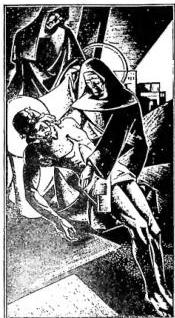
MODERN SACRED ART - Deposition, Woodcut by V. K. Jonynas (1933).