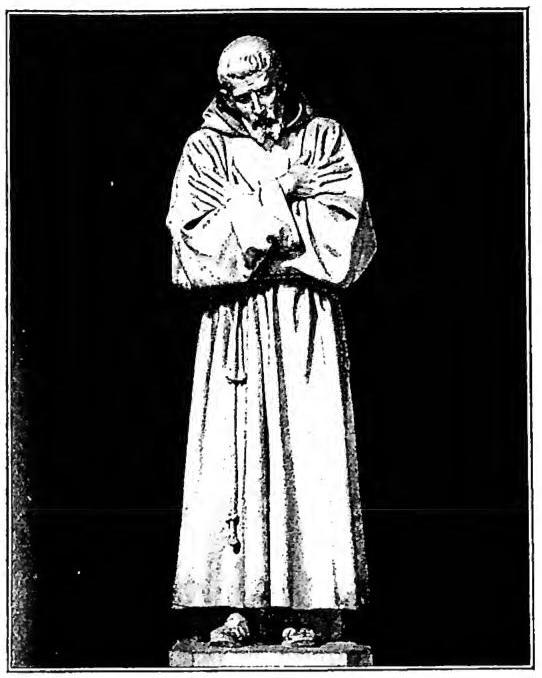
DUPRÉ, GIOVANNI
GIOVANNI DUPRÉ. — Born in Siena on 1 March 1817, died in Florence on 10 January 1882. A pupil in Florence of L. Magi and V. Cambi, he BARTOLI, DANIELLO (v.), whose programme, in opposition to Canova and Thorvaldsen, was to create images studied from life.
Among Dupré’s earliest works is *Abel*, carved in marble in 1842 for the Emperor of Russia (in bronze in the Galleria d’Arte moderna, Florence), one of his finest sculptures and distinguished by its intense naturalistic rendering of the subject. The following year he modelled *Cain*, decidedly inferior, and then in 1844 *Giotto* for the Uffizi loggias.
He then began a vast activity as a sculptor of funerary monuments in the cemeteries of Florence, Siena, Pisa, Bologna, etc., as well as honorary monuments and sculptures of various subjects, including portraits. Among his most famous works, in addition to those already mentioned, are *Sappho* in the Galleria d’Arte moderna in Rome, the *Addolorata* and *Exaltation of the Cross* for the façade of Santa Croce in Florence (1860–61), and above all the *Pietà* in the Bichi-Ruspoli chapel in the Camposanto of Siena. In this last sculpture, certainly one of the most significant of his time, the strong, deeply human characterization of the subject does not entirely obscure the quattrocento scheme of the composition. — See pl. CXXV.
Emilio Lavagnino
DUPUIS, CHARLES-FRANÇOIS
CHARLES-FRANÇOIS DUPUIS — From studies of some paintings by Titian (*The Offering to Venus*, *The Bacchanal*, and *Bacchus and Ariadne*), he derived his particular skill in representing putti; he executed in fact a great number of putti intended to be cast in bronze or silver, and modelled figures of angels for the baldachin of St Peter’s; sculptures much admired by his contemporaries. In 1626 he began work on *St Susanna* for the church of Santa Maria di Loreto, and in 1628 *St Andrew* for St Peter’s Basilica. In 1629 he executed the epitaph of Adriano Vryburg for Santa Maria dell’Anima, and in 1633 another for Ferdinand van den Eynde in the same place; later he carved the relief *Concerto di angeli* for the church of the SS. Apostoli in Naples. In Rome he must also have been in close contact with Ercole Ferrata, in whose studio there were numerous models of his works. Invited to go to France by Louis XIII as sculptor to the king, he hesitated for a long time; falling ill and advised to return home, he left Rome in 1643 but died during the journey at Livorno, where he was buried in the Franciscan church of the Madonna.
His finest work is the statue of *St Susanna*, which earned him from Urban VIII the commission for *St Andrew* in St Peter’s. Bellori, precursor of neoclassical ideals and a great admirer of antiquity, highly praised this work, saying it was an example left to modern sculptors. The colossal statue of *St Andrew*, less successful than the previous one, also shows in its measured expression—especially when compared with others adorning the piers of St Peter’s—the author’s love for classical sculpture. Notable too is the *Concerto d’angeli* for the Filomarino chapel in Naples.