
GOYA Y LUCIENTES, FRANCISCO JOSÉ. – Spanish painter, b. at Fuendetodos near Saragossa on 30 March 1746 and d. at Bordeaux on 16 April 1828.
He was a pupil in Saragossa of José Luzán y Martínez, who had also studied in Italy, especially in Naples, where he had been a fellow student of Solimena. He remained in Saragossa from 1760 to 1765, when he went to Madrid, that is, into an environment in which Mengs and G. B. Tiepolo had already been active for several years.
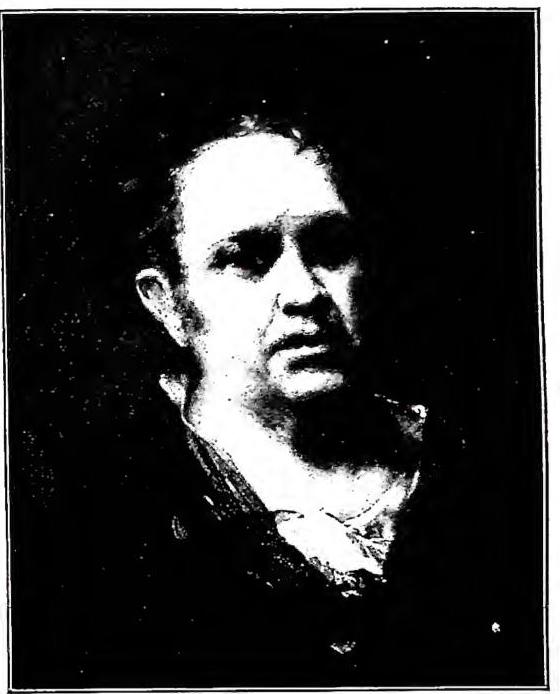
GOYA Y LUCIENTES, FRANCISCO JOSÉ - Self-portrait - Madrid, Prado Gallery.
Madrid, 1798), the Rembrandtesque Betrayal of Judas in the cathedral of Toledo, and the publication (1797) of the Caprichos, the famous engravings that reveal him as an attentive and caustic observer, a merciless critic of false traditions, superstitions, and fanaticism. The portrait of the family of Carlo IV (Prado), the two Maja, and the portrait of his new powerful protector, the prime minister Godoy, may be attributed to the early years of the nineteenth century; perhaps the six paintings in the Art Institute of Chicago depicting the Capture of the bandit Margato by the friar Pedro de Zaldivia should also be assigned to this period. In 1808, after the abdication of Carlo IV in favor of Ferdinando VII, the painter entered the service of the new sovereign and painted his equestrian portrait. Then the Napoleonic invasion threw Spain into turmoil; G. was at first among the sympathizers of the revolutionary movement, but his enthusiasm soon faded and he instead became one of the most tenacious opponents of the foreign master; from his embittered spirit arose the engravings of the Désastres de la guerre (published posthumously in 1863), a merciless indictment of French domination. After the French departed in 1814, with the intention of celebrating Spanish resistance he executed the equestrian portrait of General Palafox (Prado) and the famous 2 May and 3 May. In 1815 he published the series of engravings of the Tauromaquia, followed by that of the Proverbs, Disparates, many of which have an obscure meaning. Two of his most notable religious paintings date from 1819: the Communion of s. Giuseppe Calasanzio and the Agony in the Garden (Escuelas Pias, Madrid). Following the establishment of the absolutism of Ferdinando VII (1823), the artist preferred to leave Spain and in 1824, at the age of 78, moved to France, settling in Bordeaux, where he continued to draw and paint. Belonging to this final period are The Milkmaid of Bordeaux (Count of Muguiro, Madrid), S. Pietro (Phillips Memorial Gallery, Washington, 1827), and S. Paolo (Lilienfeld Galleries, New York, 1827).
G.’s art is truly, and not only for Spain, the announcement of a new age. The Spanish painter breaks away from the conformism of official and courtly art in order to realize fantastic yet profoundly human visions and therefore, in a certain sense, religious ones. For G. expresses his religious feeling—as L. Venturi noted—“not when he must represent a religious scene, but when he finds the motive of his own religion, the religion of independence, freedom, and humanity.” He was therefore not a skeptical Voltairian, as some have defined him, but a man sustained by a profound moral sense that led him to rebel against every form of corruption, hypocrisy, and abuse. His art, too, consequently appears in a new form, with an impressionistic technique based on contrasts of color.
From the outset, the designs for tapestries offered him the possibility of using a more spontaneous technique, because it was less finished and therefore less academic; and his vision was certainly profoundly influenced by the discovery of the art of Velásquez—of whom G. engraved several paintings in 1777–78—and later by the influence of Tiepolo, which at a certain point was replaced by that of Rembrandt. This was certainly his happiest period: it was the moment of the “Capricci,” an expression of feelings that came violently from the depths and demanded equally violent realization. A dynamism of form, which also determines, for example, the commemorative painting of the Executions of 3 May, one of the greatest masterpieces of G.’s art. As for his properly religious works, however, the artist succeeded in creating deeply felt works of art only toward the end of his life, as in the Communion of s. Giuseppe Calasanzio or the Prayer in the Garden (1819). In the works executed in France during his final years, his technique evolved further toward a more powerful synthetism, based on the elimination of contours and the darkening of colors: a vision in masses that represents the ultimate achievement of his agitated artistic imagination. - Vedi tav. LXXIII.