Machine translation of the 1948–1954 Italian original. The original text is authoritative.
CARDANO, GIROLAMO. – Physician and philosopher, b. in Pavia on 24 September 1501, d. in Rome on 21 September 1576. A typical representative of the versatility and curiosity of the Italian spirit of the sixteenth century. He devoted himself to mathematics, astrology, astronomy, physics, medicine, music, politics, and philosophy, often divining new truths, but often also approaching charlatanism or brushing against heterodoxy, particularly Averroism, which he had encountered in Padua. His algebraic contributions and his philosophical-political conceptions are noteworthy. To him, in fact, is partly owed the formula for solving cubic equations, which still bears his name today, as well as the method for the numerical solution of equations. His essentially scientific training influenced and was reflected in his philosophical system, intermediate between Aristotelianism and naturalism. His effort, however,
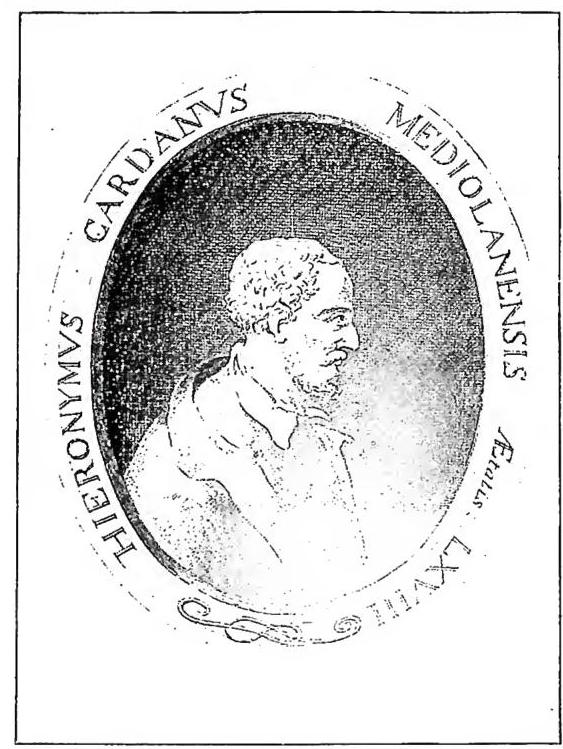
(from F. Buttrini, Saggio psico-biografico su G. C., Savona 1881) CARDANO, GIROLAMO – PORTRAIT. Copper engraving of the eighteenth century from a contemporary original.to explain phenomena through natural causality was vitiated by his frequent recourse to astrology. C. also endeavored to apply this experimentalism to political doctrine. He wanted every utopian and aprioristic organization of society to be banished: man must be studied in himself, in his nature, and in his historical evolution peculiar to individual peoples; and, according to their different characteristics, the forms of government were to be established and the laws promulgated. In psychology, his theory of pleasure is original: the pleasurable is enjoyed more intensely the more unpleasant what precedes it is, and vice versa; thus harmony is felt more deeply after dissonance, sweetness after bitterness. One must therefore seek, as far as possible, the causes of suffering in order to savor a more refined pleasure when they cease. If one gives credence to his autobiographical confessions, C. would have practiced this new form of Epicureanism.
Works: Hieronymi Cardani Mediolanensis philosophi et medici celeberrimi opera omnia cura C. Sponii (10 vols., Lyons 1663); the principal among them: Ars magna seu de regulis algebraicis (Nuremberg 1545); De subtilitate (Basel 1547); De vita propria (there 1542; Italian trans. V. Mantovani, repr. Milan 1922).
BIBL.: F. Buttrini, Saggio psico-biografico su G. C., Savona 1884; G. Vidari, Saggio storico-filosofico su G. C., in Riv. ital. di filos., 1893, 11; E. Rivari, La mente di G. C., Bologna 1906; id., I concetti morali del C., there 1914; G. Vacca, L'opera matematica di G. C., Milan 1932; A. Bellini, G. C. e il suo tempo, there 1947. Felicissimo Tinivella
Cite this article
“CARDANO, GIROLAMO.” Enciclopedia Cattolica, vol. III (1949), p. 466. Azione Romana digital edition, https://azioneromana.com/article/cardano-girolamo.