
SPIRITISMO. — In the attempt to metapsychics (v.), which had attracted considerable attention and a particularly strong following from the earliest period, after the revelations and “séances” of the Fox sisters (Hydesville, U.S.A., 1848), the spiritist hypothesis was notable. According to this hypothesis, paranormal phenomena, whether psychic or physical, were due to the disincarnate souls of the dead. The spiritist interpretation of metapsychic phenomena, particularly of those that depart most markedly from normality and that, if admitted as genuine, are more difficult to explain scientifically (ectoplasmy, telekinesis, premonitory clairvoyance [v.] of future events), was the first to be advanced chronologically, both because an anthropological explanation could more easily account for the purposeful and intelligent appearance of the phenomena, and because of the natural tendency of the human mind, when faced with the incomprehension of the darkest and most complex phenomena, to turn toward animistic and marvelous explanations.
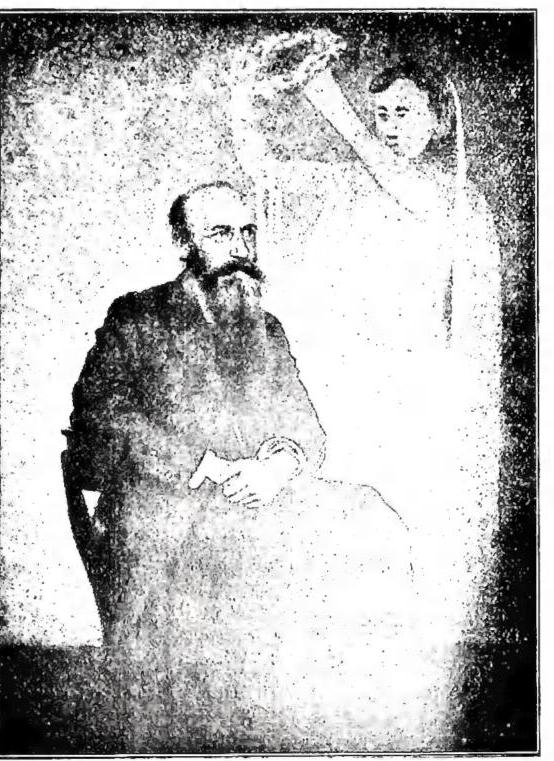
The principal source of assertions, and the richest body of information and foundations for the development of the spiritist hypothesis concerning metapsychic phenomena, is provided by the words of “mediums” in “trance,” or by their writings produced under the same conditions through the means of “automatic writing.” This is the field of so-called subjective metapsychics, a manifestation that includes many phenomena certainly belonging to the natural order (v. CHIAROVEGGENZA). The “messages from beyond the grave,” which spiritists claim to receive by the means mentioned above, have served, particularly for the more authoritative among them, to assemble an entire structure of beliefs and precepts constituting a true “creed,” a kind of religion in which the mysteries of the essence of a creator Being, his relations with worlds and creatures, their hierarchies and constitution, their future destinies and developments, and the rules of life to which incarnate beings must adhere are dogmatically revealed.
Among these pontiffs of spiritist “revelation,” the foremost place must be assigned to Léon Hippolyte Denizart Rivail, generally known by the pseudonym Allan Kardec, born in Lyon in 1804. Claiming a large number of spiritist communications, obtained chiefly through the automatic writing of a considerable number of “mediums” under his direction, he proclaimed himself invested with the mission of founding a new and true religion, the spiritist religion, which was to abolish and replace all others. Allan Kardec’s doctrine, amid the multitude of highly arbitrary, confused, contradictory, often childishly ridiculous, and intrinsically inconsistent assertions and constructions affirmed by individual spiritists as genuine revelations of disincarnate souls, gives the impression of something more fully elaborated, thanks to Rivail’s particular traits of character and scientific-philosophical cultural preparation. He had already been a pupil of Pestalozzi at the latter’s school in Iverdun, Switzerland, and had been a teacher for several years; he possessed an exceptionally imaginative culture.
Kardec’s spiritist doctrine is set out at length in his work: Le livre des esprits selon l'enseignement donné par les Esprits supérieurs à l'aide de divers mediums (17th ed., Paris 1869). Its fundamental principles are these: God is eternal, immutable, one, omnipotent, just, good, and the creator of all animate and inanimate, material and immaterial things; spirits can temporarily incarnate, living on earth after assuming the particular temporary envelope represented by the body, whose destruction through death once again sets the spirit free; man is constituted by the material part (the body), analogous to animals, by the immaterial portion (the soul), and by the intermediate principle linking the two parts (the perispirit), which is semi-material in nature; once the body has been destroyed by death, the perispirit persists, forming for the spirit an ethereal or astral body, normally imperceptible to incarnate beings, except under particular conditions (spiritist apparitions), in which it can become perfectly perceptible; there exists a hierarchy of spirits, from the superior spirits, who are more intelligent and good and closer to God, to the less good, the frauds and chatterers (goblins or frivolous spirits), through successive degrees down to the lowest and most wicked, full of our worst passions and vices and pleased by evil actions; spirits do not possess a stable condition but tend toward perfection, passing from a lower hierarchy to a higher one through intermediate periods of reincarnation, sometimes with the value of expiation, sometimes of a mission; in relation to this, we have all had previous existences (metempsychosis), either on earth or in other worlds, but always through reincarnations in human form; every disincarnate spirit can enter into relation with living human beings, either spontaneously or after being evoked; spiritist morality is summarized in doing good and not evil, according to the maxim “do unto others what we would want done unto us”; there is no fault that cannot be forgiven, since everything is expiated in the successive lives; free will is admitted.
The spiritist revelations bestowed by Kardec also contain negative elements in which the beliefs of other religions are demolished, particularly the dogmas of the Christian and Catholic religion, against which the spiritist doctrine launches its most violent attack and greatest hatred. Thus the Trinity, the divinity of Christ (regarded merely as a great spirit), and the divine origin of the Sacred Texts are denied, as are the existence of Purgatory and Hell; the favorite target is the Catholic Church and the Pope, who are destined to disappear through the action of the “spiritist religion.” Kardec’s doctrine, which at first achieved great influence and authority in the spiritist world, gradually lost authority and universality after the death of its compiler; at present, the followers of s. are divided by differing beliefs, often contradictory even on the most substantial points. Hence the numerous “confessions,” ranging from positions closest to Christian doctrines to the most anti-Christian, and embracing the most heterogeneous and tangled forms inspired by Buddhism and paganism. A study of the proceedings of the various national or international spiritist congresses (London 1928, Barcelona 1934, etc.) clearly reveals this uncertainty, variety, and confusion of the doctrines and beliefs of contemporary s.
The spiritist doctrine elaborated by Allan Kardec (and the same may be asserted of all subsequent variations) clearly appears, upon critical examination, to be inconsistent and impious. Inconsistent: for it is not an original and rational construction, but a jumble of heterogeneous and mutually contradictory elements, taken from the most diverse religions and philosophical systems (v. BUDDHISMO; REINCARNAZIONE; RELIGIONI, STUDIO COMPARATO delle; TEOSOFIA). Its allegedly revealed assertions rest upon no authority of absolute or demonstrated value, apart from the gratuitous claim that they are communicated by spirits living in the hereafter. These presumed messages would seek to find their justification within themselves; on the contrary, critical examination shows them to rise no higher than the level of ordinary (often petty) human intelligence, to be contradictory, and for the most part to be of a very low moral standard. Certain elements contained in them, acquired through the «medium’s» speech or automatic writing, which might at first sight appear foreign and superior to the content of his consciousness, can, when carefully studied, easily be explained by phenomena of the natural order (v. CHIAROVEGGENZA; METAPSICHICA). On the other hand, the existence and ordinary intervention of disembodied spirits in spiritist manifestations are not proved by the alleged materializations and phenomena of telekinesis, events that are exceedingly rare in séances, insufficiently controlled, and very often tainted by fraud, while serious reasons exist for denying that spiritist manifestations are attributable to disembodied souls (v. ZACCHIOLO, L'uomo, II, Roma 1921, pp. 445-56). In essence, the proofs of the supernatural origin of spiritist doctrines are disastrously lost in a vicious circle: the assertions ought to be supported by the preternatural authority of the spirits; conversely, no demonstration of their existence, nature, or mission is offered apart from their own assertions, which are the sole proof of the nature and authority of the revelators. Impious: for the spiritist doctrine God (v.) and His attributes, as postulated by right reason and Revelation (v.); it aims to destroy the divinity of the Son of God and the origin, nature, Church (v.) and of the Catholic religion, founded upon the word and miracles of Christ, the prophets, and the saints. Whoever wished to regard as true certain absolutely preternatural facts (if indeed any such exist), which are claimed to have occurred in the course of mediumistic manifestations, and wished to accept them as proof of the otherworldly origin of the spiritist revelation, in view of the entire antireligious inspiration permeating spiritist doctrines, would be forced to admit that the intervention of spirits of a diabolical nature occurred in the course of these events.
From the moral standpoint, leaving undecided the question of the nature of mediumistic phenomena (the preternatural value of which many modern authors, including those in Catholic circles, entirely deny), the spiritist interpretation of metapsychic manifestations and their practice, for the purpose of establishing communication with disembodied spirits, constitute a grave sin of idolatry and superstition. For this reason, such practice has been condemned since the Old Testament, declared deserving of the death penalty (Deut. 18, 9-12; Levit. 20, 6; 27), and at times directly punished by God with the utmost severity.
With regard to the magisterium of the Catholic Church, the doctrines of spiritism, being a jumble of errors against Revelation, dogmas, the doctrine of the Sacraments, and so forth, automatically fall one by one under the condemnation of the errors and heresies that have appeared over the centuries along the Church’s path. This explains why the Church has been cautious in admitting the practice of spiritism, even when it was cloaked in pseudo-scientific intentions. A decree of the Holy Office of 4 Aug. 1856 declares the practice of evoking the souls of the dead, receiving answers from them, and so forth, illicit, heretical, and scandalous; the declaration of the Sacred Penitentiary (1 Feb. 1882) declares it illicit to attend, even passively, spiritist consultations or games; the constitution Officiorum ac munerum of 25 Jan. 1897, of Leo XIII (tit. I, c. 5, n. 12), prohibits the publication, reading, or retention of books in which sortilege, divination, magic, the evocation of spirits, and similar superstitions are taught or recommended; the response of the Holy Office (1 Apr. 1898) declares the evocation of the departed illicit even in the form of automatic writing, even with a protest excluding any pact with the evil spirit; the latae sententiae excommunication (the constitution of Pius IX, Apostolicae Sedis) applies to those who defend and publicly disseminate or place faith in the errors of the spiritist sect; finally, the Sacred Congregation of the Holy Office, in a response of 24 Apr. 1917 to the question: «Whether it is lawful, with the intervention of a so-called medium, or without any medium, using or not using hypnotism, to attend any spiritist manifestation, including those that present an appearance of honesty and piety, whether by questioning souls or spirits, or listening to the answers, or merely watching, perhaps with the tacit or explicit reservation of not wishing to have anything to do with evil spirits», replied in the negative. The response was approved by Pope Benedict XV. Vedi anche il CIC, can. 2325, concerning the penalties against those who practice superstition. The appropriateness and gravity of the Church’s aforementioned prohibitions and penalties with regard to spiritism and those who practice it derive their profound justification not only from the grave risk to which the substance of faith and morals is exposed by such practices (the content of spiritist doctrines and the circumstances accompanying séances, besides contradicting the law of God, are very often the direct cause of immoral actions); they also represent a wise precaution of a material order, since experience broadly demonstrates the serious physical and mental harm and the social disorders of which spiritism is the father.
Nevertheless, the wisdom of the Church, not wishing to place an obstacle in the way of the progress of true science, and admitting that the obscure mass of mediumistic phenomena may contain some phenomenon of the natural order, even if unusual and extraordinary in its manifestation and worthy of study and understanding, permits true scientists who explicitly request it—and at times even directly invites them—to direct their investigations toward that entire body of facts constituting the object of study of metapsychics, provided that they make every protest against even material collaboration and against accepting spiritist methods or interpretations, in order to distinguish among them any phenomena that are genuinely preternatural and supernatural from those due to an unusual development of the forces of nature or merely staged through the bad faith of the interested parties.