
LOURDES, SANCTUARY OF. — It is the most famous of the many places honored, as is believed, by apparitions of Mary Most Holy. Thus far, no other of these sanctuaries can claim an approval from the Roman pontiffs such as that granted to L. In 1876 Pius IX appointed Card. Guibert, archbishop of Paris, as his representative for the consecration of the new church, to which he conferred the title of basilica. Leo XIII approved a liturgical feast of the Apparition of the Immaculate (11 Feb.) for the ecclesiastical province of Auch (1891), and Pius X extended it to the entire Church of the Latin rite (1907). Pius XI raised the little Seer of L. to the honors of the altars (beatification in 1925, canonization in 1933) and wished the Holy Year of the Redemption to be solemnly closed precisely at L. (Apr. 1935) with a triduum of uninterrupted Masses at the Grotto, sending as legate a latere his Secretary of State, Card. Eugenio Pacelli (now Pius XII).
At L. Heaven once again manifested its predilection for the little ones: Bernadette Soubirous, a poor fourteen-year-old illiterate girl (though she appeared to be barely twelve), very little instructed even in the catechism, but innocent and devout, from 11 Feb. to 16 July 1858 saw—and she alone—a full 18 times, in a grotto or recess of the rock of Massabielle (Massabielle = ancient rock) west of L., on the left bank of the Gave, Our Lady dressed in white, with a blue sash, shining roses on her bare feet, and a beautiful Rosary hanging from her arm.
Only at the third apparition, on Thursday, 18 Feb., did Our Lady begin to speak, not in French but in the genuine dialect of the country, addressing the girl with « vous ». At the sixteenth apparition (25 March), after repeated prayers from s. Bernadette that she reveal her name, she uttered the profound « self-definition », a heavenly echo of the dogma of 8 Dec. 1854: « Què soy era Immaculado Councepcion » (I am the Immaculate Conception). Mary Most Holy is the only created being who contains within herself, in the highest perfection and purity, the concept of the « immaculate conception », just as God contains the idea of truth and of life.
In previous apparitions the Virgin had exhorted people to penance and prayer for sinners (21 Feb.) and to tell the priests that a chapel should be erected so that people might come there in procession (2 March); and on 25 Feb. the Seer had dug with her hands in the lower part of the grotto, at Our Lady’s command, the miraculous spring that was later to heal so many sick people.
Chemically, the water of the spring does not differ from that of L.’s public fountain; it is ordinary « drinking water ». Nevertheless, the civil authorities, who from the outset adopted a hostile attitude toward the apparitions, prohibited for approximately four months (from 8 June to 5 Oct. 1858), « in the interest of public hygiene », the drawing of water from this new spring, which still flows abundantly at a rate of 85 liters per minute. In the present pools the water is ordinarily renewed only once a day, and many sick people, often suffering from contagious diseases, are immersed in it; yet no one has ever contracted a new illness or suffered a worsening, while many have been cured. Sixteen of these prodigious cures, carefully examined, provided the diocesan bishop, Bertrando Severo Laurence of Tarbes (since 1912 the name of the diocese has been « Tarbes and L. »), with one of the reasons for approving the apparitions and the public cult of « Our Lady of the Grotto of L. », or more briefly, « Our Lady of L. ». He did so in the courageous pastoral letter of 18 Jan. 1862, barely four years after the apparitions.
Other reasons for official approval were: 1) the beneficial spiritual effects, such as conversions and a notable revival of religious practices; 2) the clearly visible changes and the ecstasies of the little Seer during the visions: « She was transformed; her features took on an unusual expression, and her gaze became radiant »; 3) above all, the precise and ever-consistent testimony of an extremely truthful witness, incapable of lying and therefore fully worthy of belief, even though this witness must necessarily be only one individual, since he alone saw something extraordinary, and even though the witness is a fourteen-year-old girl (cf. Mc. 16, 14).
From Apr. to Dec. 1858 many other people at L. and in the surrounding area had « visions »; but these were hallucinations or diabolical deceptions, intended to discredit the true visions of s. Bernadette, and they were soon forgotten. The pastoral letter of 18 Jan. 1862 does not mention them at all.
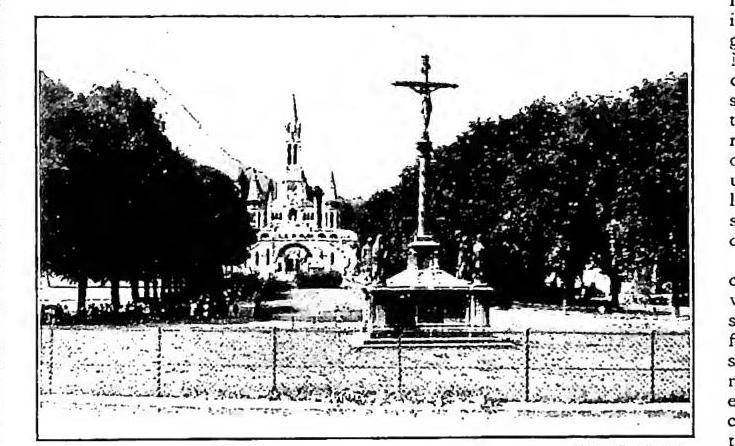
In 1861 the place called Massabielle, together with its surroundings, became the property of the episcopal see. In Aug. of the following year, through the personal intervention of the Empress Eugenia, permission was finally obtained from the Minister of Religious Affairs to build a place of public worship at Massabielle. The architect Ippolito Duran and the energetic parish priest Peyramale immediately began construction, not of a chapel, as Our Lady had requested, but of a fairly large Gothic church on the summit of the sanctified rock. The extremely difficult work lasted seve-
ral years. On 1 May 1866 the first Mass was celebrated in the crypt, and on 15 Aug. 1871 the first Mass in the upper church. On 2 and 3 July 1876 the new Sanctuary was consecrated in the presence of 35 archbishops and bishops, 3,000 priests, and approximately 100,000 faithful.
The well-known marble statue, so often reproduced, the work of Giuseppe Fabisch, which the Seer liked very little, was placed in the niche of the apparitions on 4 Apr. 1864. Fortunately, the entire grotto, with its delightful panoramic background, has remained in its original state. God alone knows the number of prayers offered there, the Masses celebrated there, the candles burned there, and the interior and exterior miracles performed there over the years. The enormous quantity of crutches and other votive offerings gives a faint idea of them.
Since the upper Basilica was proving increasingly inadequate, toward the end of the last century a second church was built in the lower part of the grounds, with a central plan and 15 altars, adorned with mosaics of the 15 mysteries of the Rosary, and solemnly consecrated—also with the title of basilica—on 6 Oct. 1901.
The evening or nighttime processions with torches, so dear to pilgrims, date from 28 Aug. 1872, while the afternoon Eucharistic processions, with their moving individual blessing of the sick and their trusting invocations, repeated by the crowd in various languages, go back to 22 Aug. 1887. In recent times, perhaps more miracles have occurred during this blessing of the sick than during bathing in the pools or prayer before the Grotto.
The « BUREAU DES CONSTATATIONS MÉDICALES ». — To investigate such miracles more thoroughly, Dr. de Saint-Maclou established, in 1884, a very modest Bureau des constatations médicales (B.C.M.). His successors were Boissarie (1892–1917), Marchand, Cox, Abadie-Bayro, Vallet, and Leuret. Vallet (1922–47) was the founder of the « Association médicale internationale de L. » (A.M.I.L.). Under the present president, F. Leuret, the entire office and the whole procedure have been reorganized at the request of the current bishop, mons. P.-M. Théas.
The « Bureau médical de L. » (B.M.L.) now has a « Bureau d'études scientifiques » (B.E.S.) attached to II. In addition, a « Commission médicale nationale » (C.M.N.) has been established for all France; in 1950 it consisted of 15 qualified physicians.
If a case of prodigious healing is presented at L. to the B.M.L., a corresponding declaration never follows immediately; but if the case merits it, the “miraculously healed” person is invited to appear after a year for a further examination. Thus, in 1948, the B.M.L., among so many cases, had set aside 85 for a second examination. Of these, only 15 appeared in 1949, and 9 of them were forwarded to the C. M. N. If this national Commission is also favorable, the case goes to the competent diocesan authority; the Ordinary appoints a commission ad casum and then, if he sees fit, pronounces judgment, in accordance with the Council of Trent (sess. XXV).
For example: in January 1951, a decree of Cardinal Clemente Roques, archbishop of Rennes, recognized as miraculous the healing of Jeanne Fretel, which took place at L. on 8 October 1948. Professor Leuret had already reported in 1950
The same author devotes 18 pages to the healing of a blind and paralyzed four-year-old boy. Concerning it, Monsignor Carlo de Provenchères, archbishop of Aix-en-Provence, declared on 31 May 1949: “Nous jugeons et déclarons que la guérison de Francis Pascal, survenue à Lourdes le 31 août 1938, est miraculeuse, et doit être attribuée à une manifestation spéciale de la Bienheureuse Vierge Marie Immaculée, Mère de Dieu. Ce décret sera lu dans toutes les églises et chapelles du diocèse... On chantera un Magnificat pour remercier Notre Mère du Ciel d'un miracle qui manifeste à la fois Sa puissance et Sa tendresse maternelle” (ibid., p. 160 ff.).
During the Holy Year of 1933, Maria Morbidelli, one of the Daughters of Mary of the parish of S. Camillo in Rome, who for years had been bedridden with pulmonary, bone, and abdominal tuberculosis, suddenly felt herself perfectly healed before the Grotto of L. The enthusiasm produced by this miracle among her companions led to the founding of the Pio movimento internazionale pro regolitate Mariae, which is still flourishing.
Regarding two of the latest years, Professor Leuret gives these impressive figures:
| Year | Pilgrims | Sick | Physicians |
|---|---|---|---|
| 1948 | 2,200,000 | 15,800 | 999 |
| 1949 | 3,000,000 | 20,000 | 1200 |
If one may conclude with certainty that a revelation is credible when it is also guaranteed by a single miracle, at L. there are many such miracles; and, quite recently, the current president of the Medical Office of L. spoke of the permanent miracle of the pools of L., “que aucun des malades qu'on y plonge ainsi, quelle que soit la gravité de leur état, n'en éprouve de mal, ni n'en ressente aggravation” (F. Leuret-H. Bon, p. 105). And the very existence of this worldwide Sanctuary, based on the visions of a fourteen-year-old girl and still full of vitality after almost a century, is in itself already a true miracle, such as no other religion can claim. For the diocese of L.,
V. TARBES
Vedi tav. CX.There is also an extensive bibliography on the healings: G. Bertin, Histoire critique des événements de L., Paris 1905; the publications of the presidents of the Medical Office of L.; Boisserie, Marchand, Vallet, etc.; Azevedo do Souto, L. e a medicina, Coimbra 1923; H. Monnier, Etudes médicales de quelques guérisons survenues à L., Paris 1930; N. Mittler, Des guérisons dites « miraculeuses » aux guérisseurs et à leur clients, ibid. 1940; F. Leuret-H. Bon, Les guérisons miraculeuses modernes, ibid. 1950; R. Le Bec-F. Leuret, Raisons médicales de croire aux miracles, ibid. 1950. To the contrary: E. Aigner, Die Wahrheit über eine Wunderheilung von L., Frankfurt a. M. 1909; id., L. im Lichte deutscher medizinischer Wissenschaft, Munich 1910; id., Ein Lourdeswunder vor Gericht, Frankfurt a. M. 1913. Clemente M. Henze