
ORPHIC MYSTERIES. — Orphism is the greatest religious phenomenon, of a mystical character, to emerge in the history of sixth-century B.C. Greece. It may be regarded as the theological Dioniso (v.), a god of Thracian origin whom the Greeks made their own thanks to their wisely receptive and agilely creative psyche. He is a god of wild nature, ruler of a region rich in wooded mountains and deep valleys, where the hissing of the wind howling through the mountain gorges appears as the living presence of the god, who delights in the unrestrained race and loves to be worshipped in the same exalted form in which he makes himself present.
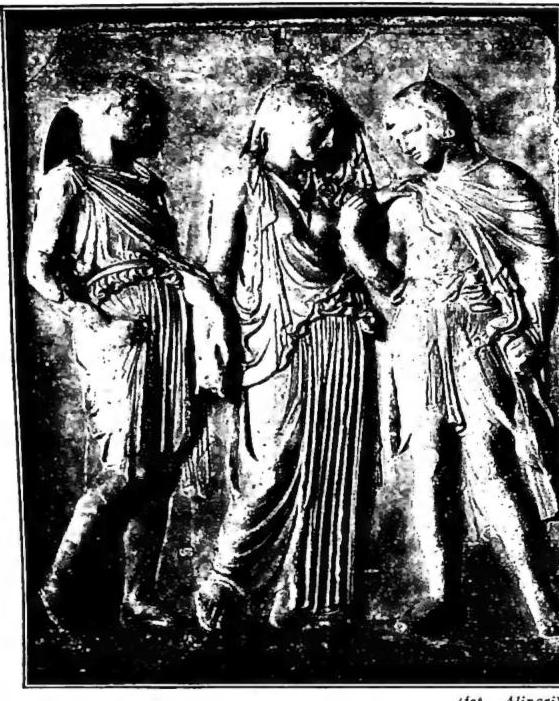
(Alinari photograph)
ORFICI, MISTERI - Orpheus and Eurydice. Relief of post-Phidian Greek art - Naples, National Museum.
Though savage in appearance, this rite was capable of religious elevation, parallel to the development of the social environment, because the mystical union with the god through the sacrifice of the animal sacred to him was contained in germ within the god’s omophagic incorporation; and in the god’s originally vegetal character, with its twofold aspect of death and resurrection, corresponding to the perennial course of nature, there was contained the prospect of a similar resurrection for the believer, provided that he assimilated himself to the god through the initiatory rite. This religious sublimation of the cult of Dionysus was accomplished in the sixth century by Orphism.
The sixth century was for Greece an age of profound social transformation. It marked the end of the so-called Greek Middle Ages, which lay between the collapse of the ancient monarchies reflected in the poems of Homer and the rise of the democratic states, of which Athens was the most illustrious example. In this turbulent age, Orphism represented the longing for liberation from a regime of oppression and violence, the refuge of the finest spirits, where the initiates were promised comfort in the present and freedom in the future. Hence among the Orphics there was a living horror of blood, and a powerful desire for justice (Δίκη) and law (Νόμος). For this reason Dionysus was adopted as the central god of Orphism: the god distinguished by his sufferings and unjust death, the foreign and popular god who had come from Thrace, in place of the Olympian gods who had brought glory to the old warrior aristocracies sung by Homer.
I. ORFEO
He is the legendary Thracian singer capable of drawing not only animals but all of nature to the sound of his lyre (Euripides, Bacch., 560).His mythical figure contains so many elements, reflecting the religious system ascribed to him, that it is no longer possible to delineate his original character. He is, in fact, of Thracian origin like Dionysus, and dies a Dionysian death, being torn apart by the Bacchae (Aeschylus, Bassarai, in Trag. Graec. Fragm., Fr. 113 Nauck); his head and lyre are carried by the sea to Lesbos, the island of singers; he is associated with Hades, to which he goes to recover his dead wife Eurydice, granted to him by Persephone in compensation for his song, but from whom he must separate because he has transgressed the command of the goddess, who had ordered him not to look back before he had emerged from the Underworld (Virgil, Georz., IV, 454; Ovid, Met., x, 10); he takes part in the expedition of the Argonauts; he is the inventor of the alphabet; he is regarded as the author of hymns, oracles, and cathartic formulas, the stock-in-trade of later Orphism and Neoplatonism. The etymology of his name is likewise uncertain: it may derive from ὄρρανός in the sense of solitary (Kern); from the root ὄρρ in the sense of dark, as an inhabitant of Hades (G. Curtius); or from the fish ὄρρος in the sense of fisherman (Eisler). Whatever one may think of his historical figure, it is certain that at the origins of the Orphic movement there must have been an Orpheus—that is, a man of profound theological intelligence and deep religious inspiration who sublimated the pre-existing Dionysian mystery by framing it within a philosophical cosmogony (the myth of Zagreus) and developing its moral prescriptions with a view to the higher destiny reserved for the initiated.
II. THE MYTH OF ZAGREUS
Dionysus, son of Zeus and Persephone, the last figure in the generations of the gods, receives in Orphism the particular name of Zagreus (Ζα + ἀγρεύς), in the sense of great hunter (of souls), by which he is linked in a very special way to the infernal world.He has received from his father the sceptre of the world. But the Titans, sons of Earth, incited by jealous Hera, plot against his life; and while Zagreus, an innocent child, plays in the fields, they deceive him with various objects (which correspond to the secondary instruments of the Orphic ritual), among which the most important is a mirror (Clement of Alexandria, Protr., 2, 17, 2; Arnobius, 5, 19; Nonnus, Dionys., 6, 197-210). He tries to escape their grasp by changing shape, but the Titans manage to capture him just when he has assumed that of a bull; they tear him to pieces and devour him raw. But Athena saves the heart of Dionysus and brings it to Zeus, who swallows it and then begets from Semele a new Dionysus, the glorious resurrection of the ancient one (Nonnus, Dionys., 6, 165 and following; Macrobius, In somn. Scip., I, 12, 12). For their impiety the Titans are struck by Zeus’s thunderbolt, and from their ashes the human race is formed; in it, therefore, the two elements are united, evil and good, the Titanic and the Dionysian, fused together from the moment when the Titans devoured the divine body of Zagreus. The entire Orphic discipline consists precisely in liberating the luminous, celestial, Dionysian element, which is the soul, from the dark, material, Titanic element, which is the body. In this reconstruction of the myth of Zagreus, laboriously but definitively carried out by the most erudite Lobeck, all the fundamental elements of the ancient Dionysian sacrifice are found: Dionysus under the name of Zagreus, the sacrificial bull, the tearing apart (σταραγμός) of the victim, and the eating of the raw flesh (omophagy). These elements still ritually produce all their religious efficacy, because the rite always draws the effectiveness of its action from its own innermost substance, independently of the orientations of the myth. But whereas in the Dionysian conception the sacrifice had the value of an ecstatic communion with the god, renewed on each occasion, in Orphic theology the sacrifice is the memorial of a primeval immolation that is a crime, a deicide, from which derives man’s mournful condition on earth, his dark imprisonment, from which liberation is long and difficult.
III. ESCHATOLOGY
Upon the destiny of the soul and the means of attaining it rest Orphic morality and eschatology: morality and eschatology of the highest significance, which offered later speculation the richest sources of inspiration and pious souls the sweetest delights and most consoling certainties. For the Orphics, then, the soul is of divine origin, while the body is a tomb (οὔμα, σῆμα) into which it has fallen as a result of a primordial fault. And the distance separating the dark prison of the body from the blessed abode to which the soul longs to ascend can be shortened and eliminated only at the price of a purifying expiation, of a catharsis (καθαρσίς).This expiation can be accomplished by following two
paths. The first is that of rebirths, since a single life is not sufficient to complete the expiation and the soul is condemned to transmigrate from body to body, in a succession of lives that returns upon itself like a circle: the circle of generation (ὁ χύκλος τῆς γενέσεως), which turns inexorably like a wheel, the wheel of destiny (ὁ τῆς μοίρας τροχός). The second path is that of purification in Hades, a place of terrors and delights, where the soul descends after death, but where in any event it does not find its joy, even in the most joyous of situations, because its sole joy is to be reunited with its principle, which is Zagreus.
To attain its ultimate goal, which is reunion with the divinity, the Orphic imposes upon himself a life of purity, asceticism, and ceremonial purifications, whose merits were also applicable to the dead, and whose prescriptions were contained in special rituals performed by Orphic priests for the benefit of individuals and cities. External signs also distinguish one who leads such a life: a white garment; horror of everything implying mortuary contact, such as: a) proximity to tombs; b) eating legumes, which are the principal offering made to the dead; c) wearing wool, even in the tomb, because wool was the covering of an animal; d) tasting eggs and meat, because these too come into contact with the souls wandering through the various cycles of metempsychosis; avoiding the generation of mortals (γένεσις βροτῶν), in the widespread sense of avoiding the pollution associated with childbirth (cf. Euripide, Cret., fragm. 145 Nauck).
For one who has led a pure existence, beyond the tomb there opens a prospect that has made generation after generation of Orphics throb with hope and inspired Pindar to compose an exalted description (Ol., 2, 62). In Orphic Hades reign Eubuleus (the “well-advised one”), an epithet of infernal Dionysus; Hades, also called Eukles (the “well-renowned one”); and above all Persephone, who predominates in the popular Orphic conception. From the entrance, two principal paths branch off to the right and left, in the shape of a Y, leading to the flower-filled meadows of the good and to the punishing Tartarus of the wicked. There flows the Lethe, or river of oblivion, proper to Hades, where there is no remembrance of life—a concept dear to the Orphics, who have abandoned the dark life of the world in order to draw from Zagreus the source of divine life. As soon as he enters Hades, the Orphic must take not the left-hand path, the ill-omened road of evil spirits, marked by a white poplar, but the right-hand one, which leads him to the spring of Mnemosyne, from which appointed guardians keep away anyone who has not had the privilege of initiation. He gives the password declaring him the son of Uranus and Gaia, of Heaven and Earth—that is, a participant in the Dionysian and Titanic compound in accordance with the sect’s cosmogonic myth—and asks Persephone, queen of the Underworld, to judge him (this is a new, specifically Orphic concept) and consign him to the sweet springtime of her fields, in expectation of his final return to the one Zagreus.
IV. THE TABLETS
This entire eschatology is set forth by one or another of the golden tablets found in Orphic tombs in Magna Graecia, Rome, and Crete. These tablets, only a few centimetres long and folded several times like scraps of paper, were found hanging around the neck or within reach of the deceased, serving simultaneously as guide, reminder, and amulet for his journey into the beyond. They contain brief formulas (and, in two cases, incomprehensible ones) from Orphic apocalyptic hymns in which the devotional life of the initiates found expression, and in which their faith was affirmed and their hope exalted. They are now held in the Museum of Naples (five), the British Museum (two), and the Museum of Crete (three). Of these tablets, the one found near present-day Strongoli in Calabria (ancient Petelia) is the most important for our knowledge of the topography of the Orphic Hades.Of the four found at Terranova di Sibari (ancient Thurii), the first affirms liberation from the iron law of the transmigration of souls through Orphic discipline; the other three are noteworthy: 1° for their affirmation of the purity that distinguishes the Orphic, who calls himself the pure one living among a host of the pure: « I, pure among the pure, come to you, etc. »; 2° for the affirmation, in b and c, of that injustice, that original guilt (which is the deicide of Zagreus), of which all souls
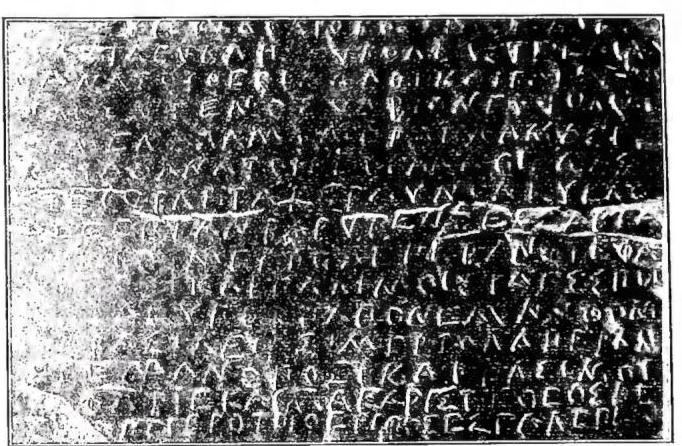
The last tablet (2nd century A.D.), found in Rome on the Via Ostiense, belonged to the matron Cecilia Secondina (this is the only case in which the deceased person is mentioned), who declares her prerogative as «pure among the pure», that is, as an Orphic, boasts of her divine lineage, and affirms that she attained blessedness by having always lived according to the Law.
V. LA LETTERATURA ORFICA
The gold tablets contain the most direct and genuine formulation of Orphic eschatology. Nevertheless, an entire mystical literature developed during the Alexandrian period and devoted to subjects of theogony, cosmogony, eschatology, etc., is attributed to an Orpheus who appears therein as poet and magician. The Ὄρσος (μνοι, numbering 88, in hexameters and of liturgical content, arranged according to the affinity of the mythological subject, the work of various authors and originating in all probability from Asia Minor, as may be inferred from the names of certain divinities mentioned—Antaia, Cybele, Hipta, Sabazius—gained prominence during the Renaissance.This Orphic literature is generally devoid of a unified conception, because there was no school to supervise and preserve intact the heritage of Orphic beliefs, which were maintained above all on account of their eschatological vision, the one to which the spirit
ORFICI MISTERI - ORGANIZZAZIONE DELLE NAZIONI UNITE
And indeed, if one considers that often unbalanced ferment of ideas which at the dawn of Christianity spread throughout the East under the complex name of Gnosticism, one will find there too—having arrived through the great Neoplatonic current, though reinforced by Iranian dualist elements and Babylonian astral speculations, which would later culminate in the strange Manichaean religion—that which is the central thought of Orphism: man is a mixture of good and evil; the soul is a ray of divine light immersed in the darkness of matter; the whole duty of man consists in acquiring gnosis, the doctrine that at once teaches him the reality of this condition of his and points out to him the path of liberation.
VI. ORFISMO E CRISTIANESIMO
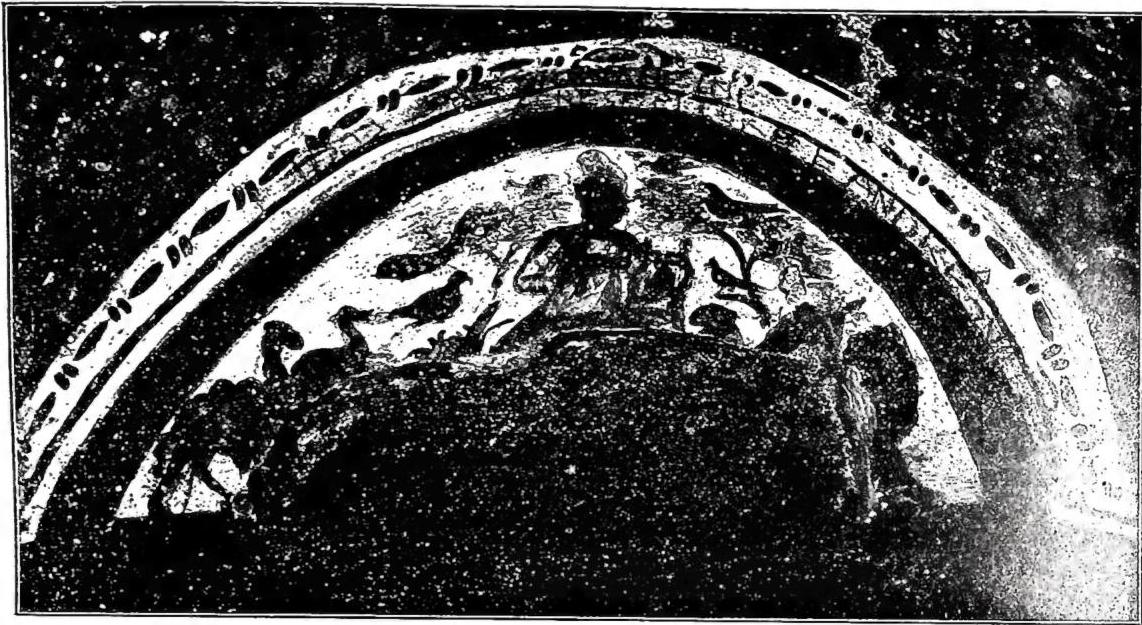
Tra le varie raffigurazioni che Orfeo ha avuto nell'arte pagana: cantore accompagnantesi con la lira; assalito ed ucciso dalle menadi; vicino ad Euridice; seduto in mezzo alle belve che ammansisce con il suono della lira, quest'ultima è stata la sola che il cristianesimo ha accettato e riprodotto nelle pitture cimiteriali (cf. Wilpert, Pitture, p. 223 sgg.): nel cimitero di Domitilla la più fedele nel riprodurre gli elementi del disegno pagano (id., ibid., tav. 229); nel cimitero di Callisto dove Orfeo è in figura del Buon Pastore con pecore e colombe (id., ibid., tav. 37); nel cimitero dei SS. Marcellino e Pietro con Orfeo e sei montoni (id., ibid., tav. 98): nel cimitero di Priscilla con Orfeo in mezzo al gregge (cf. G. B. De Rossi, Bull. arch. crist., 4ª serie, 5 [1887], tav. 6; V. anche la voce GESÙ CRISTO, VII. Iconografia).Questa preferenza è dovuta non già a una dipendenza specifica del cristianesimo dai m. o. ma al simbolismo suggerito dall'efficacia divina e irresistibile dell'insegnamento di Gesù capace di trascinare tutti gli uomini alla sua sequela. Quel tanto di orfismo che si è voluto riscontrare nel cristianesimo appartiene in realtà alle idee religiose correnti nell'epoca ellenistica e cioè: dualismo fondamentale tra l'anima e il corpo, sanzione ultramondana delle azioni compiute in vita, anelito alla purezza morale, rispetto per la figura di un fondatore e
ossequio per la sua dottrina. Mentre è dottrina specifica del cristianesimo: la fede nella morte volontaria ed espiatrice (non per violenza altrui, come in Zagreo) di Cristo, e nella sua risurrezione, fede che non è dovuta ad elaborazione teologica di s. Paolo, ma è stata da lui trovata viva e operante all'alba della nuova religione; il rito battesimale inteso come rinnovamento dell'uomo interiore, mentre nell'orfismo seriore, o neo-orfismo, che è quello in voga nell'epoca ellenistica, la salvezza si realizza mediante riti e formole che hanno sapore di magia.
BIBLI.: oltre alle opere generali citate sotto la voce MISTERI, v.: E. Maas, Orpheus, Monaco 1895; J. Harrison, Prolegomena to the study of Greek Religion, 1ª ed., Oxford 1903; 2ª ed., ivi 1921, sulla liturgia orfica; D. Comparetti, Laminette orfiche, Firenze 1910; V. Macchioro, Zagreus, 1ª ed., Bari 1920, 2ª ed. aumentata, Firenze 1930; O. Kern, Orpheus, Berlino 1920; id., Orphicorum fragmenta, ivi 1922; A. Boulanger, Orphée, Parigi 1925; M.-J. Lagrange, Les mystères: l'Orphisme (Introd. à l'étude du N. Test., IV. Critique historique, I, Parigi 1937); G. Faggin, Inni orfici, Firenze 1949, sulla letteratura orfica seriore. Nicola Turchi