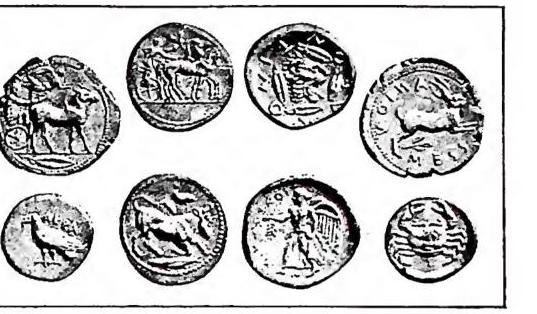
DRAMA (Ἄρχιμῆ). - Hellenic coin. According to the Greek translation of the Septuagint and the Vulgate, it already appears in the 5th century B.C. as a monetary unit (Esth. 2:69); but the Vatican codex (B) omits drachmās. It is generally held that this is the Lydian d., in use since the time of Croesus. Many moderns, however, rightly see in the Hebrew word darhēmōn (Neh. 7:70) not the transcription of ἄρχιμή, but of ἄρχιμός (=daric), a monetary unit of the Persians.
In the Hellenistic period the d. was also used in Palestine, and it probably corresponded to the Attic d., later assimilated to the Roman denarius (v.) (cf. 2 Macc. 4:19; 10:20; 12:43). In the New Testament the parable is well known of the woman who anxiously searches for a lost d. (Lk. 15:8-9). v. DIDRACHMA.
Penna, Angelo. “Dramma (ἌΡΧΙΜΉ).” In Enciclopedia Cattolica, vol. IV, col. 1926. Città del Vaticano: Ente per l’Enciclopedia Cattolica e per il Libro Cattolico, 1950. https://azioneromana.com/article/dramma-arkhime.
MLA
Penna, Angelo. “Dramma (ἌΡΧΙΜΉ).” Enciclopedia Cattolica, vol. IV, Ente per l’Enciclopedia Cattolica e per il Libro Cattolico, 1950, col. 1926. Azione Romana, https://azioneromana.com/article/dramma-arkhime.
BibTeX
@incollection{ec4_dramma_arkhime,
  author    = {Penna, Angelo},
  title     = {Dramma (ἌΡΧΙΜΉ)},
  booktitle = {Enciclopedia Cattolica},
  volume    = {IV},
  pages     = {1926},
  note      = {Cited by column},
  publisher = {Ente per l’Enciclopedia Cattolica e per il Libro Cattolico},
  address   = {Città del Vaticano},
  year      = {1950},
  url       = {https://azioneromana.com/article/dramma-arkhime}
}
One of some 20,000 entries brought back from the twelve printed volumes (1948–54). Spotted something? Help us improve it.
Click or scroll to zoom · drag to pan · Esc to close