
SOCRATES. - A philosopher among the greatest of ancient Greece and one of the greatest personalities of all time. Born in Athens in 469 B.C. to the sculptor Sophroniscus and the midwife Phaenarete, he first practiced his father’s craft; but the “daimonion” (δάμων τις), which spoke within him as a divine voice (Plato, Apology, 29–30), suggested to him the “mission” of teaching, confirmed by the oracle of Delphi.
To this mission, which he considered divine and unrelenting until his death, Socrates devoted his entire life, neglecting everything else, even his wife Xanthippe and his children. He did not maintain a formal school but taught through conversation in the squares, the gymnasium, the streets of Athens—wherever he encountered people willing to listen, ready for “dialogue.” He never left Athens except to fulfill his duties as a soldier (he took part in his youth in the battles of Potidaea, Delium, and Amphipolis); he abstained from politics, yet his powerful words deeply influenced the life of his time. His harsh criticisms of contemporaries and the democratic regime earned him the hatred of his adversaries. At the age of seventy, three citizens (Meletus, Anytus, and Lycon) accused him of corrupting the youth and teaching beliefs contrary to the state religion. Brought to trial, he disdained to defend himself against the charges, instead making an apology for his mission and refusing to renounce II. Found guilty by a narrow majority, he could have chosen exile; instead, in the debate to determine his sentence, he declared that he considered himself worthy of being maintained at public expense in the Prytaneum, that is, as a public benefactor. Condemned to death, despite the entreaties of friends and disciples, he refused to flee from prison so as not to offend the laws of his country and wished to bear witness, even in death, to the justice he had taught all his life to respect. He drank the hemlock with the serenity of the just man (399 B.C.). Until his last moment, he urged his most faithful followers who were present to “take care of themselves,” to be good, and not to think of him, for Asclepius, this time a good physician, was taking him from bodily life, amid the attentive wonder of disciples and friends, into the empyrean of the just spirits (Phaedo, 115–18).
Besides the Phaedo, the Apology and the Crito are the dialogues that immortalized Socrates’ life and death. His personality was exceptional: his manner of living, questioning, and answering baffled and amazed interlocutors and listeners. Socrates disturbed minds and generated doubts in them, that is, he forced them to search, to examine themselves (he made his own the Delphic maxim “know thyself”); for him, philosophy was “dialogue,” self-examination in relation to others,
an examination that is lofty teaching. Meno, in Plato’s dialogue of the same name (80a), says to Socrates, who is questioning him: “You fascinate me, you bewitch me, you enchant me, so that I am all perplexity”; and compares him to the torpedo fish, “which numbs whoever approaches and touches it.” Socrates unsettled: he inspired his listeners to change their lives; his words, Alcibiades says (Symposium 218a), are like “the bite of a viper” in “the most painful part,” the soul; and this bite is his “philosophical discourses.” Alcibiades himself likens him to the effigy of a Silenus that contains divine images within; and to the satyr Marsyas, who, like him “insolent” and “flutist,” without instruments, merely by means of naked words, produces the same effect: “to be violently drawn out of oneself and possessed” (ibid., 215a–216d). His personality dominated men of the stature of Alcibiades and Plato, who made him the protagonist of all his Dialogues, almost effacing himself behind the figure of the master. “A man, we may say,” it is written in the Phaedo (118a; cf. Letter VII, 324e), “of those whom we then knew, the best, the wisest, the most just.” Subsequently, the Greek Fathers of the Church drew a parallel with Christ and saw in Socrates the “witness” to the truth, who not only preached it but embodied it, practiced it, and bore witness to it even in death. The Latin Fathers did not share this view, but St. Augustine, in a chapter of the City of God (VIII, ch. 3), includes him in Christian philosophy as a wise man of lofty wisdom, contemplated in the light of eternal truth and realized in the practice of life. The Enlightenment (q.v.), rationalist and anti-Christian, exalted Socrates as “the saint of paganism,” tending to compare him to Christ in a tendentious manner. Rousseau (q.v.) is an exception, who in a page of the famous “Profession of Faith of the Savoyard Vicar” excessively diminishes Socrates’ figure, but concludes justly: “Yes, if the life and death of Socrates are those of a wise man, the life and death of Jesus are those of a God.”
Socrates wrote nothing, and this is partly explained by his understanding of philosophy as living research and dialogue, and above all by his profound conviction of fulfilling a divine mission. Consequently, his personality and his doctrine must be reconstructed through indirect testimonies, namely the Dialogues of Plato (q.v.), the Memorabilia of Xenophon, and what Aristotle (q.v.) says about him in the Metaphysics. This has given rise to the problem of the “sources” or the “Socratic question,” still not definitively resolved today. It is now almost universally agreed not to accept as a historical source the caricature of the philosopher presented by Aristophanes in the Clouds, with evident polemical intent; to consider Xenophon’s testimony insufficient, as he was incapable of understanding the doctrine and the lofty personality of his master, without however rejecting it; and to accept Plato’s testimony with critical prudence so as not to attribute to Socrates what belongs instead to his great disciple. For this purpose, Aristotle’s testimony is useful, as he presents Socrates as the philosopher of the “concept,” leaving to Plato the entire philosophy of the “ideas.”
“I am eager to learn, and the fields and the trees want to teach me nothing, unlike men in the city.” Thus Socrates to Phaedrus in the dialogue of the same name (231d). Socrates, in fact, unlike the pre-Socratics, had no interest in naturalistic research: the object of his speculation was man and human society; hence, “humanism.” This aligned him with the Sophists (q.v.); but the Socratic form of humanism was the radical critique of that Sophistic stance. Socrates, therefore, defined himself not “as” a Sophist, but “in comparison” with the Sophists, as Plato precisely does. For the Sophists, man is a subject of sensations; for Socrates, he is a subject, as reason, of an objective, cognitive, and moral order. Knowledge, which for the Sophists is opinion, for Socrates is concept; the practical activity that for the Sophists is skill, for Socrates is virtue (62e–63); the society that for the Sophists is individualism (the egoism of individuals and the right of the stronger), for Socrates is “dialogue,” “communication,” an organic structure of laws that demand obedience and respect. In short, for Socrates, there is a rational principle by which man communicates with an absolute order of truth. To awaken research according to this principle, to help find the truth, to convince man that intelligence has purposes beyond the practical, to orient him to live according to the laws of the good, and to accustom him to discussion to the end—these were the aims of his educational mission. Man is not merely sense, but also reason, and therefore capable of immutable and universal concepts. To know is “to know by concepts”: to have a concept of a thing is to define its essence, by virtue of which all things of that kind truly and really are what they are. Socrates is the discoverer of the concept, whose essential characteristics he fixed and defined.
SOCRATE
His method comprises two stages: irony and maieutics. Through the first, the philosopher, assuming almost the attitude of a disciple and declaring himself ignorant (for Socrates, the wise man is he who is conscious of his own ignorance), compels his interlocutors (sophists and young men educated by them) to confess their ignorance. Irony is the force of reasoning that pierces and deflates words filled only with their own emptiness, humiliates rhetoric and confounds it, kills ignorance by making it conscious of itself, in order to clear the ground for the other subtle and fruitful procedure of maieutics. This is the art of his mother: mastery in childbirth, inability to procreate (Theaetetus, 150 c–d), the obstetric power of interrogation that, from the depths, evokes into the life of consciousness the dormant yet fruitful truth. Moreover, maieutics signifies that truth is not learned from without but is won from within: a laborious generation whose products must be sifted by reason.
From particulars, abstracting what is contingent in them, through the method of induction (q.v.), one grasps the essence (q.v.), that by which a thing is what it is. Thus Socrates, in opposition to the sophists, vindicates the objectivity of knowledge, which also serves as the norm of conduct. To know means to define; and therefore to know the good means to possess the concept. Undoubtedly, according to Socrates, no one feels morally obliged unless he has an “interest” in doing so, but this does not at all mean, as the sophists taught, that the good resides in utility or in the private interest of each individual. For Socrates, the good consists in the utility of all. When a man acts for the common interest, he also gains his own happiness, which lies in the consciousness of acting justly, with full self-mastery through reason. The wise man is therefore just, brave, and temperate. For Socrates, the virtuous man is the wise man: he practices the good who knows it; virtue is knowledge. On the other hand, he who knows the good cannot but do it, since only the virtuous man is happy, and all men aspire to happiness. No one, therefore, is wicked voluntarily; whoever does evil does so through ignorance. To render men virtuous, it suffices to teach them what the good is; hence the improvement of society is a matter of education. Socrates’ ethics is eudaimonistic, in that it places the end or good of man in happiness, which, however, is the attainment of virtue, which is knowledge of the good. For him, the concept is the “law of the mind,” virtue the “law of life” of the individual and of society; and the “being” of the concept coincides with the “ought” of moral action.
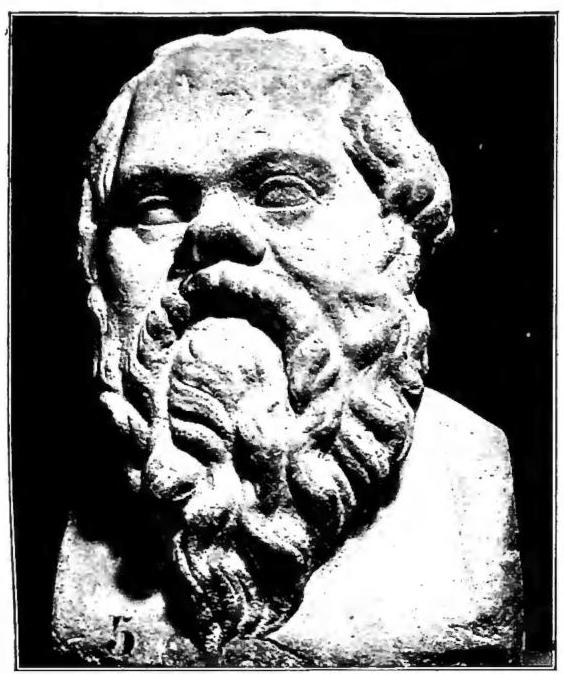
(photo Alinari)
SOCRATE — Bust of Socrates. Roman copy derived from an archetype of the early 4th century B.C. — Rome, Capitoline Museum.
pp. 98-111 (with bibliography). Extensive bibliography in Überweg, I, 56-59; recent bibliography in W. Ziegenfuss, Philosophen-Lexikon, II, Berlin 1950, pp. 557-58 and in G. A. De Brix, Bibl. philosophica 1934-45, I, Utrecht-Brussels 1950, pp. 42-44. Michele Federico Sciacca
SOCRATE. - Storico ecclesiastico, nato e vissuto a Costantinopoli dove esercitò la professione di procuratore legale (scholasticus). Nella sua gioventù era stato discepolo dei grammatici Elladio e Ammonio (Hist. eccl., V, 16, 9), che verso il 390 erano venuti a Costantinopoli.
La sua Storia ecclesiastica che tratta gli aa. 305-439 è stata pubblicata in due edizioni. Accortosi che non poteva fidarsi come fonte del solo Rufino, rielaborò i due primi libri (v. H. Edmonds, Zweite Auflage im Altertum, Lipsia 1941, p. 372 sg): ma anche per il I. VI si ha una doppia recensione. Le sue fonti erano: Rufino, Eusebio, Atanasio, la raccolta di atti sinodali di Sabino, Eutropio e notizie che venivano dai novaziani, per i quali dimostra un tale interesse che fu da alcuni preso per un novazianista; senonché in V, 20 egli elenca i novaziani tra altri eretici (sulla fonte novaziana per la storia di Paolo di Costantinopoli V. ultimamente W. Telfer in Harvard Theol. Rev., 43, [1950], p. 42 sg.). Il lato politico delle lotte teologiche non rimase nascosto a S. Origene viene da lui difeso (VI, 13); nella questione della destituzione di s. Giovanni Crisostomo tiene in sospeso il suo giudizio (VI, 19, 8).