
DEFUNTI, VENERATION of the. - The complex of all practices directed toward the deceased among various peoples and in different religions.
CONTENTS:
I. In non-Christian religions
II. Among the Jews
III. In the theological thought of the Catholic Church
IV. In the liturgy of the Church
V. In canon and civil law
VI. In medicine.### I. IN NON-CHRISTIAN RELIGIONS.
In non-Christian religions, veneration of the deceased almost always assumed the character of cult. O. Schrader (op. cit., p. 16) holds that such cult may be realized in three distinct ways, namely: the treatment of the corpse (burial, cremation, etc.) and the attentions paid to it during and after the funeral rite (for this latter form V. ANTENATI, CULTO degli; FUNERARI, RITI). The three forms may coexist to varying degrees, but all imply, even where the deceased are neglected or regarded with fear or repulsion, precise beliefs concerning death, the soul, and the abode of the dead (v. INFERNO).
For prehistory, cautious inferences regarding the cult of the dead may be drawn from the not very numerous sepulchral remains that reveal indications in this sense. Thus, while for protohumans of the Lower Pleistocene (Acheulean, Clactonian, and Levalloisian cultures) nothing can be said that is less than hypothetical (the interpretation of the Zhoukoudian site, where skulls were found, has led some to posit a skull cult connectible with the cult of the dead, but this remains doubtful), the situation is relatively clearer for the Middle Pleistocene: in the Mousterian culture, it was customary to bury the dead "in a resting position with the head placed on the forearm" or in a position that would seem to attest to the practice (found among present-day primitives) of binding the corpse, placing lithic tools beside them (funerary furnishings?), which, together with supposed traces of cannibalism (a form of cult of the dead among peoples of nature), would testify to true cult practices in honor of the dead. In the cultures of the Upper Paleolithic, individual and collective burials are found, both in the open and in caves, in artificial pits or on bare ground: the corpse (sometimes in a resting position, sometimes curled up—an indication of binding?) is often sprinkled with red ochre or placed on a "bed" covered with this material (was this meant to restore to the deceased the blood, seat of vital energy, for the afterlife?), protected, particularly at the head and feet, by stone slabs, and accompanied by true funerary furnishings, including weapons, ornaments, and objects of common use. Similar characteristics are found in the finds of the Epipaleolithic (in which particular honor was paid to skulls, arranged in collective pits, always on a layer of red ochre) and the Mesolithic (v. RELIGIONE nella; and, for the Neolithic and the Metal Ages, the history of individual cultures in these epochs).
Among primitives, the complex of beliefs concerning the dead varies, and thus so do the forms of cult.
Among the Australians, in addition to endocannibalism (the practice of consuming the flesh of the deceased to appropriate their qualities: cf. E. Volhard, Il cannibalismo, trad. it., Torino 1949, pp. 488-506), also found in Africa, various forms of burial are noted: inhumation (corpse stretched out or curled up), deposition on trees or on special platforms (to achieve mummification of the deceased, who is then preserved by relatives), and cremation. Singular is the practice of double burial, in which, after exposing the corpse to decompose, the bones are collected and then buried or placed in caves, or, in part, preserved by kin. It is a common belief that the person continues to live after death: for this reason, the corpse is sometimes placed on a boat so that it may make its journey; for this reason, among the Arunta, an armed dance is performed at the place where the spirit of the deceased is believed to linger, to induce it to depart definitively from the world of the living.
Among the primitives of Asia, the Andamanese behave similarly to some Australian tribes: they allow corpses to decompose, after which relatives preserve the skull, having painted it with red ochre. Meanwhile, the Sakai and Jakun of the Malay Peninsula abandon the deceased at the place where they were at the moment of death (sometimes covering them with a layer of earth) and then leave the place itself. A return to double burial is found among the Dayak and Toraja of Indonesia.
Like the Bushmen, the Pygmies of Africa believe in the survival of the spirits of the dead, who receive reward or punishment in the afterlife according to their earthly conduct. Similar beliefs are held by the Zulu. On the other hand, among many African families, there is the custom of abandoning the deceased at the place of death and performing practices upon them to facilitate decomposition: the reason for this lies in a "fear of contamination" believed to emanate from the corpse.
The elevation of the corpse, cremation, and burial are also found among the Eskimos, along with the abandonment of individuals near death in a secluded place. Among the Algonquins—as among other American tribes—mummification was common; but among the primitives of America, there was also the belief that the deceased could not enter their realm before their mortal remains were destroyed: hence practices designed to hasten the decomposition of the corpse or the use of cremation (v. dei).
A precise description of the rites in honor of the dead is available for the peoples of pre-Columbian America. In Mexico, the treatment differed for those who died in war and those who died of natural causes. The former were first honored with four days of funeral chants performed by widows and children in a procession accompanied by a special dance. Subsequently, "effigies representing the deceased were constructed; they were covered with maguey or agave paper, dressed in tunics and bands; vulture wings were attached to these effigies so that they could fly before the sun." After offerings of food were made to the effigies, and another four days had passed, "the widows made the final offering of Neuthli, an indigenous beverage, scattered roses on the ground, and burned incense. Finally, all the effigies were thrown into the fire, and as they burned, the widows wept" (C. Crivelli, La religione dei popoli che abitarono il Messico e l'America centrale, in P. Tacchi Venturi, Storia delle religioni, I, 2ª ed., Torino 1939, p. 127). The latter, however, were cremated during a ceremony that involved human sacrifices, and the ashes were collected in a box upon which the statuette of the deceased was placed. Human sacrifices followed at regular intervals for a total of eighty days. The spirit of those who died in battle enjoyed immortality, while that of those who died of natural causes (except those who succumbed to diseases sacred to Tlaloc), after a long journey in the afterlife, died definitively (v. also MESSICO: Religione; PERU: Religione).
In no other country, probably, did the cult of the dead (d.) attain such importance and splendor as in ancient Egypt. From the oldest tombs, dating perhaps to the fifth millennium B.C., in which the corpse was buried in a nearly superficial pit with various furnishings beside it, one moves to those of the Old Kingdom, consisting of much deeper pits, above which a small building with sloping walls was constructed. Over time, the tombs were enlarged with the addition of several rooms. Kings were buried in pyramids, and beside them a temple dedicated to the king himself was built, where a regular cult was maintained. The corpses were mummified with great care and with the concern to preserve the dead (d.) as they had been in life. The burial rite involved the recitation by the priest of incantations intended to restore the use of the senses to the dead (d.); food offerings were then made, which were repeated at regular intervals. The complex of rites persisted into the Middle Kingdom, during which, due to the increased economic level of the population, tombs multiplied considerably in number. The inhumation system did not change, nor did the offerings, which, however, especially in the New Kingdom, were made preferably in temples. The persistence of the belief in a life after death is evident: a belief that, however, changed in substance, shifting from the idea of a simple survival, perhaps in the tomb itself, with needs entirely similar to those of earthly life, to that of the soul of the dead (d.) journeying to the "kingdom of the West" (Amenti [v.]; V. also EGITTO: Religione; LIBRO DEI MORTI).
Far less conspicuous was the cult of the dead (d.) among the peoples who inhabited Mesopotamia. Among the various forms of burial, only inhumation is known: in the earliest times, the corpse was placed naked in the ground, probably beneath its own dwelling, or sometimes in large terracotta coffins. Later, the dead (d.) appears in a crouched position, very often oriented. Beside it were foods, weapons, and various furnishings. The funeral ceremony involved lamentations in the temple, directed by a priest, animal sacrifices, and libations made by relatives at the tomb. In Sumerian times, there were also—perhaps—human sacrifices. The poem recounting Ishtar's descent into the underworld also speaks of washing and anointing the corpse, of dressing it in red garments, and of music that would accompany the funeral: however, the meaning of all this is not entirely clear (v. also BABILLONESI: 10, Religione).
Inhumation in caves or stone tombs, in which food, drink, and object offerings were placed, was common among the Canaanites, who believed they could learn the future through the spirit of the dead (d.). Among the Phoenicians, it was the belief in the continuation of life after death, in which the soul is inseparable from the body, which therefore had to be carefully buried in the tomb ("house of eternity"), preserved in wooden chests or sarcophagi.
In the Aegean world, traces of the cult of the dead (d.) are detectable in Crete (Mesara) as early as the Early Minoan period. Here were the great tholoi, perhaps family burials capable of holding hundreds of corpses, in which the dead (d.) were placed on bare ground (though in some tholoi there were sarcophagi), and beside which mostly aniconic idols and small vases (at Mochlos) intended to contain food and drink were found. In the Middle Minoan period, cemeteries or individual burials appear: above the dead (d.), in a crouched position, are large vases sometimes overturned (pithoi). And, very often, caves on the seashore were transformed into ossuaries: perhaps, as evidenced by the sarcophagus of Hagia Triada, it was believed that a sea voyage was necessary to reach the afterlife. There were also artificial ossuaries (e.g., at Malia), built in masonry and divided into several rooms, in some of which, an unmistakable document of the cult of the dead (d.), tables that certainly functioned as altars have been found. But it is in the Late Minoan period that "architecturally independent funerary constructions with rich internal apparatus" appear (such as the "tomb of the double axe" at Knossos). And it is in this period that the number of larnakes increases considerably, where the dead (d.) is placed supine with bent knees. Among these sarcophagi, the already mentioned one from Hagia Triada is famous, on which a true ceremony in honor of the dead (d.) is painted: "three individuals clad in animal skins bring to the deceased, standing before the tomb, two calves and a boat." On the other sides of the sarcophagus, the sacrifice of a bull, an offering by a priestess, and various other elements are depicted, suggesting a funerary sacrifice (v. also EGRA RELIGIONE).
The sacred texts of Vedic India provide clear indications of a cult of the dead (d.) that was fully realized both in funeral ceremonies and in rites following burial in specific pits. It was believed that the dwelling of the dead (d.) was heaven, the kingdom of Yama, but from heaven the dead (d.) could return in the form of a spirit to its home in search of food (especially at the time of the new moon). A meal was therefore prepared and placed beside small pits filled with water intended for the ablutions of the dead (d.). This was followed by offerings of oil, perfumes, etc. Such offerings were repeated monthly and on occasions such as births, marriages, and the like. The texts also provide a precise description of the funeral ceremony, during which the corpse was burned with a ritual that varied depending on whether it was a Brahmin, a kṣatriya, or a vaiśya (v. BRAHMANESIMO). These practices persist, though with significant changes, in Hinduism: the corpse is burned, and the ashes, collected in an urn, are thrown into the Ganges or another sacred river. The change in direction is justified by new Hindu beliefs: man is reincarnated after death according to the law of Karman; everything must therefore be aimed at achieving purity to interrupt the cycle of rebirths (v. INDUISMO).
In Zoroastrian religion, the complex of practices in honor of the dead (d.) is governed by the concept of impurity believed to emanate from the corpse: the dead (d.) is neither buried nor burned to avoid contaminating the earth and fire. Instead, it is abandoned on the dakhma (a pit surrounded by stone beds arranged in concentric circles) to be devoured by vultures. The skeleton is then thrown into the pit. In the house of the dead (d.), purificatory ceremonies follow, intended to dispel impurity. This horror of the corpse is also found among the present-day Parsis (v. IRAN, religione dell'; PARSISMO).
Traces of the cult of the dead (d.) in Greece are already found in the Mycenaean period: from this era are the tholoi and shaft graves; here, a funerary sacrifice was probably performed, and gifts and offerings were placed, the latter perhaps repeated on certain occasions. In this period, cremation was also introduced alongside inhumation. References to a cult of the dead (d.) found in epic poetry all date back to the Mycenaean period: even funeral games were thus held in honor of the dead (d.). In the classical period, acts of cult were already paid to the dead (d.) who was laid out in his home after death. A vase full of water was placed by the door so that visitors could purify themselves upon leaving. In the tomb, where the corpse was placed enclosed in a clay or wooden coffin, offerings were placed; a coin was placed in the mouth of the dead (d.) to pay Charon. After burial, "a libation of wine, oil, and honey was poured over the tomb; and bloody sacrifices, human in earlier times, were not uncommon."
After the ceremony, the funeral banquet took place, and offerings (ἐνγύγματα, γρά) were renewed at the tomb on the third, ninth, and thirtieth days. In addition, there were the ἀξένα Ἐνάτης (v. ECATE), offerings left at crossroads in honor of the spirits that returned to earth seeking vengeance, and annual festivals: GENESI (v.), NEMESI (ΝΈΜΕΣΙΣ) (v.), Antesterie (v.).
Among the Romans as well, burial was accompanied by sacrifices, and annual festivals were dedicated to the dead: Parentalia (v.) Lemuria (v.). During the Lemuria, "the pater familias, rising at midnight and washing his hands three times with pure spring water, would wander barefoot through the house, snapping his fingers and placing black beans in his mouth, which he then cast behind him while repeating a certain formula of exorcism. It was believed that during this ceremony, the spirits would gather the beans." During the Parentalia, on the other hand, sacrifices were offered by children or heirs to the spirits of the departed.
Prehistoric findings also reveal the existence of a cult of the dead among the ancient Celts and Germans. However, nothing precise is known about these practices, nor does it seem that a general cult of the dead existed among the peoples of the Far East (China and Japan), where instead the cult of ancestors is observable.
II. AMONG THE HEBREWS.
The burial system was inhumation, usually not in the ground but in a cave or loculi, often familial, and this desire for cohabitation after death finds its realization in subsequent Jewish cemeteries, carved into rocky walls but also artificial (cf. for Abraham and Sarah: Gen. 23, 4-20; for Deborah: ibid. 35, 8; for Jacob, ibid. 49, 29-30; for Moses: Deut. 34, 6; for Joshua: Ios. 24, 30-33; for David: I Reg. 2, 10; for Solomon: ibid. 11, 43; etc.). Exceptional and due to foreign influences were embalming (cf. for Joseph: Gen. 50, 25) and cremation due to contingent circumstances (cf. for Saul and his sons: I Sam. 31, 11-13; for a severe pestilence: Am. 6, 10).
The funeral preparation of the corpse consisted simply of washing (Act. 9, 37) and closing the eyes and mouth (Gen. 46, 4); at least in ancient times, it does not seem that a particular dressing followed: but the dead were buried with their usual clothing and ornaments. The corpse was also wrapped in a sheet or shroud, bound with bands (cf. for Lazarus: Iob. 11, 44), and perfumed with the addition of spices (cf. the burial of Jesus "sicut mos est Iudaeis sepelire" (Io. 19, 40)) or by burning them above and around (Jer. 34, 5). The funeral procession was carried out by the friends of the deceased and was preceded, accompanied, and followed by the recitation of biblical passages and lamentations. External manifestations of mourning were minimal, consisting of a funeral banquet ("the bread of mourning": Os. 9, 4), abstention from work for seven days (the duration of mourning: Gen. 50, 10), cutting of hair, and sprinkling of ashes on the head (Esth. 4, 1); these customs were neither concomitant nor to be considered normative. For important persons, monuments were erected on the tomb (cf. for the Maccabees: I Mach. 13, 27-30); while the lack of burial and lying unburied was considered a misfortune or punishment (I Sam. 17, 44; I Reg. 13, 22; Jer. 9, 22; 22, 19; etc.).
### III. IN THE THEOLOGICAL THOUGHT OF THE CATHOLIC CHURCH.
The maternal attentions of the nascent Church for the bodies of the faithful departed are guided by two articles of faith: the resurrection of the flesh (v. RESURREZIONE) and sacramental sanctification (v. SACRAMENTI).
1. The faith in the resurrection, which Christianity defended against the shock of general incredulity (cf. Mt. 22, 23; Lc. 22, 27; Act. 17, 32; St. Augustine: "In nulla re sic contradicitur fidei christianae, quam in resurrectione carnis" Enarr. in Ps. 88, 2: PL 37, 1134). Around the bodies of Christians, from the beginning, there breathed an atmosphere of peace, hope, and joy: the faithful have not died but have withdrawn from the land of exile: recessit (Christian epitaphs) and have preceded others into the homeland: praecessit (Christian epitaphs); praecessit cum signo fidei (Roman Mass canon), because they have been called by the Lord: accessitione dominica (Cyprian, De mortalitate 20: PL 4, 596) and by the angels: accessitus ab Angelis (in two Roman epitaphs). They are therefore not lost but rather sent ahead as if to prepare a place for the other brothers: non amissimus sed praemissimus (Cyprian, loc. cit.), thus the day of their obitus should be celebrated as a new dies natalis. Their bodies are not stiffened by death but composed in sleep, awaiting the trumpet call of the resurrection: "In christianis mors non est mors, sed dormitio et somnus" (St. Jerome, Ep. 75 ad Theod.: PL 22, 685), hence the name cemetery (καμιάω = I sleep) given to the sacred place where the bodies were laid. Due to this sublime conception of death, the early Christians banished lamentations and wailing from their funerals: "Non ululatum, non planctus, ut inter saeculi homines fieri solet sed psalmorum linguis diversis examina concrepabant" (St. Jerome, Epitaphium Paulae: PL 22, 878), and St. Paulinus of Nola gives the reason: "gaudentemque Deo flere, nocens amor est" (Poem. 32, 44). In an epitaph from the 4th century, this delicate concept is expressed: let the groan of hearts be understood because you, innocent child, were welcomed by the Mother of the Church (Mater Ecclesiae) while joyfully returning from this world.
2. The sacramental sanctification, of which the body was the pivotal point—"caro salutis cardo" (Tertullian, De resurrectione carnis 8: PL 2, 806)—permeates the entire human being, so that when the spirit returns to God, it leaves the remains imbued with celestial fragrances. The bodies of the faithful, therefore, are not impure, as the Jews believed, nor sacred in the sense of the Twelve Tables, but are human remains consecrated by divine charisms—"caro abluitur... caro signatur... caro ungitur... caro corpore et sanguine Christi vescitur" (Tertullian, loc. cit.)—and destined for the most coveted of fates: perfect reintegration at the end of time. Piety and humanity, sustained by this faith, multiplied the most delicate cares around the remains of the faithful:
a) After death, the eyes and mouth of the deceased were closed: "Oculos illos et ora claudentes" (Eusebius, Hist. eccl., VII, 22: PG 20, 690). Washed with warm water, the body was modestly arranged on the bed: "Exinde... manus componunt, oculos claudunt, caput directe statuunt, pedes reducunt, lavant" (St. John Chrysostom, Hom. in Iob.; cf. Tertullian, Apologeticum, 42: PL 1, 492).
b) Then, in imitation of the treatment given to the body of the Redeemer, it was anointed with precious aromas: "Thura plane non emimus; si Arabiae quæuruntur, sciant Sabaci pluris et carioris suas merces christianis expeliendis profligari quam diis fumigandis" (Tertullian, Apologeticum, 42: PL 1, 490). By the 4th century, a sprinkling of balsam and myrrh sufficed: "Aspersque mirra, sabaeo corpus medicamine serva" (Prudentius, Cathemerimon, hymn., 10, 51: PL 59, 880). Sometimes, perfume was introduced through small holes made in the tombstone, and often a vial of fragrant essences was placed near the body so that its scent might linger even after burial.
c) The body was then wrapped in one or two sheets, generally white: "Candore nitentia claro, praetendere lintea mos est" (Prudentius, Cathemerimon hymn., 10: PL 59, 870) and covered with a layer of lime. If the deceased were members of the clergy, they were dressed in the vestments of their rank; martyrs were wrapped in rich garments. High-ranking persons often displayed excessive pomp in the clothing of their dead, for which they were sometimes reproved: "Cur et mortuos vestros auratis obvolvitis vestibus? Cur ambitio inter luctus lacrymasque non cessat? An cadavera divitum nisi in serico putrescere nesciunt?" (St. Jerome, Vita 1. Pauli Eremitae: PL 23, 28).
d) The body thus arranged was displayed in the home or in the church; it was kept vigil over with the recitation of prayers, especially psalms, which, when possible, were sung (cf. St. Gregory of Nyssa, Vita Macrinae, 41: PG 46, 992-93; St. Augustine, Confessiones, 9, 12: PL 32, 776). The psalmody was interspersed with the joyful singing of the Alleluia, as is still customary in the Eastern Church.
e) The transport of the body assumed greater or lesser solemnity depending on the circumstances. In times of peace, the body, carried on shoulders or in special carts (carrucae), was accompanied by the clergy (cf. epitaph of Paschasius, at Viviers) and by the faithful bearing torches: "atque cereis calicibus funus duxerunt" (inscription from Chiusi). Sometimes it took on the aspect of a triumphus, especially when transporting the bodies of martyrs and confessors (cf. Victor of Vita, Historia persecutionis vandalicae, 1, 14: PL 58, 198).
f) At the place of depositio, which was the cemetery (catacombs) or the adjoining basilica, the funeral rites were performed: psalmody, prayers, Mass: "Item antitypon regalis corporis Christi et acceptam seu gratam Eucharistiam offerte in ecclesiis vestris et in coemeteris atque in funeribus mortuorum" (Apostolic Constitutions, VI, 30). St. Augustine thus describes the funeral rites of St. Monica: "Cum offerretur pro ea sacrificium pretii nostri, iam iuxta sepulcrum posto cadavere, antequam deponeretur, sicut fieri solet" (Confessiones, 9, 12: PL 32, 776).
3. St. Paulinus of Nola asked St. Augustine whether the care given to the bodies of the dead benefits their souls, and the holy Doctor responded masterfully in the celebrated treatise De cura gerenda pro mortuis (PL 40, 591-610). Directly, "curatio funeris, conditio sepulturae, pompa esequiarum, magis sunt solatia vivorum quam subsidia mortuorum", yet these delicate attentions—"humanitatis officia"—are to be approved, for they indicate respect for those bodies which, sanctified by the Sacraments, became instruments of the Holy Spirit "ad omnia bona opera" (cf. De Civitate Dei, I, 1, cap. 13). Indirectly, these cares benefit the souls of the departed insofar as they revive the memory and prayer—"recordantis et precantis affectus"—which, "cum defunctis a fidelibus carissimis exhibetur, eum prodesse non dubium est iis, qui cum in corpore viverent, talia sibi post hanc vitam prodesse meruerunt." St. Thomas (Sum. Theol., suppl. q. 71, a. 11) echoes the thought of St. Augustine, which has become the common doctrine of the Church (cf. cann. 1203-12; Pius XII, encyc. Mediator Dei, 30 Nov. 1947, in AAS, 39 [1947], p. 530).
IV. IN THE LITURGY OF THE CHURCH.
Prayer for the dead is attested throughout Christian antiquity, and by the 2nd century it also assumed a public and official character; for the dead began to be commemorated in the canon of the Mass (v. CIMITERI CRISTIANI ANTICHI), and the Apostolic Constitutions of the 4th century speak of the widely diffused custom of gatherings at the tombs of the dead for the singing of psalms, with the reading of Scripture passages on the 3rd, 9th, 30th days, and on the anniversary of death. Parallel to this practice was that of commending oneself to the intercession of the dead, who were believed to have attained eternal peace.
I. HONORS TO THE BODY IN THE WESTERN RITE
The early Christians continued (Acts 8:2) the practice of washing the body, entrusting it in some Churches to clerics or attendants, anointing it, and arranging it according to local custom, wrapping it in bands, linen or silk sheets, or, as a sign of penance, in sackcloth. Sometimes these bands were gathered around the head and secured with a wax seal, sprinkled with holy water; priests were occasionally placed with a tin chalice in hand. Those who had held ecclesiastical or civil dignities were dressed in the garments and insignia of their office.Today, it is common practice to place a Crucifix or the Rosary in the hands of the deceased.
The use of a coffin became widespread at the end of the Middle Ages. The body was covered, except for the face, by a cloth that draped over the sides, sometimes precious; today, the pall is black with a cross in the middle and covers the entire bier; for young unmarried women, it may be white. For children, as a sign of purity, the entire rite is performed in white and with a proper formulary, based on the concept that they do not need suffrages. Custom also allows for the placement on or around the bier of the insignia of the deceased’s social rank, offices, and dignities; the presence of banners of associations that do not have a political character or tendencies recognized as adverse to the Church is also permitted. In the past, the Church had to intervene several times to limit excessive pomp in funerals, especially those of ecclesiastics; in the 17th century, it still considered the funeral carriage a sign of vanity and luxury. Gravediggers, who were initially tasked with carrying the bodies, were sometimes replaced as a sign of honor by clerics and even bishops; in the Middle Ages, this function was performed by guild companions or colleagues of equal rank in the case of ecclesiastics, women always being excluded, as the funeral was a liturgical service. Today, bishops must be carried by priests in surplices; ecclesiastics by other ecclesiastics of lower rank, and laypersons by laypersons.
The use of candles in the procession is very ancient and originated from the fact that funerals were held at night; it later remained as a sign of honor. With Christianity, it took on the meaning of light and eternal life and was never absent from the funeral liturgy, beginning with the candles lit beside the bed, then accompanying the deceased to the church and remaining lit around the body during the service. Mention of it is made as early as the funeral of St. Cyprian (d. 258), and St. Jerome commented on its use: "ad significandum lumine fidei illustratos sanctos decessisse et modo in superna patria lumine gloriae splendese" (Adv. Vigil., 13).
The use of flowers in funerals is in itself indifferent; it takes on special meaning from the spirit that accompanies II. The Roman Ritual (tit. V, cap. 7, 1) states regarding children: "si impone sulla testa una corona di fiori o di erbe aromatiche ed odorifere in segno della integrità della carne e della verginità." Because pagans used flowers in feasts and banquets, making them appear as a sign of vanity, some ecclesiastical writers such as Tertullian, Minucius Felix, and Clement of Alexandria opposed them. The Fathers of the 4th century seem less severe; St. Ambrose and St. Jerome advised that prayers and alms should be preferred. Prudentius sings of the Christian’s tomb: "Nos tecta fovebimus ossa — violis et fronde frequenti" (Cathemer., X). No special prescription regulates customs in this regard today, unless local abuses occur; but it is in keeping with the spirit of the Church that the deceased be accompanied to the grave with prayer and works of charity rather than with displays of lights, decorations, or flowers. Priests proceed in procession to the deceased’s home to remove the body and then accompany it to the church, usually by the shortest route, while singing psalms. In the church, the bier is placed in the center so that the feet face the altar, as the deceased would have done while alive when looking at the altar; if the deceased is a priest, the head is turned toward the altar, as this was his position relative to the faithful.
St. Augustine, in the Confessions (IX, 12), describing his mother’s funeral, makes it clear that the principal part consisted of the Mass celebrated at the tomb before the body was laid to rest. Paulinus writes that, upon the death of St. Ambrose, he was taken to the church, and after the Mass, he was buried. Even today, the essential part of the funeral liturgy is the Mass. What precedes and follows is a composition of the late Middle Ages (the Libera me Domine dates to the 9th century); it is called the "funeral absolution," a rite that has nothing to do with sacramental absolution, although the prayers are inspired by the same concept of the power to bind and loose conferred upon the Church. Evidence of this is found in the classic formula "Absolve quaesumus, Domine, animam famuli tui," still used today; the aspect of judgment was clear in the Roman Pontifical of the Curia (13th century), where the celebrant, before proceeding with the absolution of a cleric, asked permission from the clergy surrounding him. In any case, the ancients saw in the rite the remission to the deceased of the punishment due to his faults and absolution from ecclesiastical censures. Once, there was only one formula of absolution, as it still appears in the Roman Ritual. But the Pontifical assigns a more solemn one for the pope, cardinals, bishops, and distinguished state figures, introduced in Rome around the 13th century. On such occasions, the absolution is given by the celebrant and four bishops, who, positioned at the four corners of the bier, repeat the incensation each time, while the schola sings a responsory with verses and recites an oration. The rite concludes with the fifth absolution by the celebrant, preceded by a sermon on the life of the deceased. In the absence of bishops, it may be performed by cathedral dignitaries. The sermon may also be given by a simple priest.
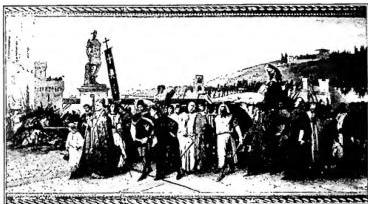
DEFUNTI, venerazione dei - The Funeral of Buondelmonte. Work by Saverio Altamura (ca. 1870) - Rome, Galleria Nazionale d'arte moderna.
(Ist. Alinari)
The Dies irae (v.) is a medieval sequence rich in doctrinal content, religious sentiment, and lyrical-dramatic impetus; for this reason, it was admitted into the liturgy. The offertory Domine Iesu Christe lends itself to discussion due to certain phrases deemed even pagan in flavor, though they actually correspond to biblical expressions; for the emphasis on signifer sanctus Michael, of distinctly Eastern, perhaps Coptic, taste; and for the hemistich Quam olim, repeated according to ancient usage and preserved here because the offering by the faithful was retained longer in the Mass for the dead. It is believed to have been composed in Rome in the 8th century and modified in Gaul in the 9th century, probably by an Irishman. The text once had not one but three verses. In the communio, the Lux aeterna already appears in manuscripts from the 10th century. In the Mass for the dead, certain parts and ceremonies are omitted (Ps. 41 at the beginning, blessing of water at the Offertory, kiss of peace, Ite missa est, blessing) because they are not consonant with the particular austerity of this Mass, or because the entire rite was intended to converge on suffrage for the dead.
The accompaniment to burial "should not be made with moans and weeping, as is customary among worldly men (a reference to the praeficae, hired women who wept at funerals), but with the chanting of psalms" (St. Jerome: PL 22, 898). And indeed, this was the constant and universal purpose, so that splendid antiphons, responsories, and psalms accompany the dead, by the hand of angels, to eternal peace—not to burial but to Paradise. Roman law prohibited burial within the walls, but later this precept fell into disuse for various reasons, and the dead were buried in cemeteries around the church and in the church itself; the brevity of the journey well explains the complex of formulas still in use.
It should be noted that the practice, already attested by St. Ambrose, of kissing the dead before burial and bidding them farewell three times according to an Eastern custom, is observed; later came the custom of sprinkling a little earth on the grave while saying: "Take, O earth, what is yours; you are dust, and to dust you shall return," which remains a popular practice in many places. Widespread, though disapproved, was also the custom of placing the Eucharist in the mouth of the deceased; this practice was corrected in many places by placing it there a few moments before death, or in the tomb, to protect the body from diabolical or sacrilegious influences. Likewise, in some places until well beyond the 6th century, the rite of refrigerium was practiced—a custom already common among pagans—which consisted of a libation of wine or a banquet held by relatives at the tomb of the dead. It was prohibited due to the abuses that arose, as attested by the well-known episode of St. Monica (St. Augustine, Confess., VI, 2).
The dead are remembered in every Mass (v. DITTICI), but care was always taken to pray for them particularly on specific days: in the East and in the Gallican regions of the West on the 3rd, 9th, and 40th day after death; in Rome, Africa, and Palestine on the 3rd, 7th, and 30th. This practice is inspired by biblical events: on the 3rd day, Jesus rose from the tomb; Joseph of Arimathea observed a seven-day mourning for his father (Gen. 50:10); the Jewish people mourned Moses for 30 days (Deut. 34:8) and Aaron (Num. 20:30).
On these days and on the anniversary, funeral rites are celebrated with texts and ceremonies that recall those of the burial, though evidently reduced.
The Ambrosian liturgy has an ordo for the funeral with a structure similar to the Roman one but richer in elements and with a markedly ancient character; it has preserved the chanting of the Passio of Our Lord, already in use in Rome, and with additional antiphons and responsories completes the funeral of bishops, priests, and deacons. The chanting of the litanies of the saints is also highly significant. In the reform carried out by St. Charles, various Roman influences were introduced: until St. Charles, the commemoration of all the dead, introduced in Milan between 1120 and 1125 by Oirico, was celebrated on the Monday following the dedication of the Major Church (3rd Sunday of October). This practice has been preserved to some extent in the parishes of the diocese on the day after the dedication of their own church, or, if the date is unknown, on the day of the Office for the dedication of the lesser church.
Enrico Cattaneo
II. HONORS TO THE BODY IN EASTERN RITES
In the Byzantine rite, funerals involve three stages: in the deceased’s home, in church, and at the cemetery. In the deceased’s home, the priest celebrates a brief office accompanied by incensation, known—when performed separately—as the Ἀκολουθία τοῦ νεκρωσίμου τρισάγλου, or more commonly the "little pannychis." It includes the chanting of three troparia, a brief litany, a prayer, and the apolysis, all applied to the deceased. During the procession, the Trisagion is sung. In church,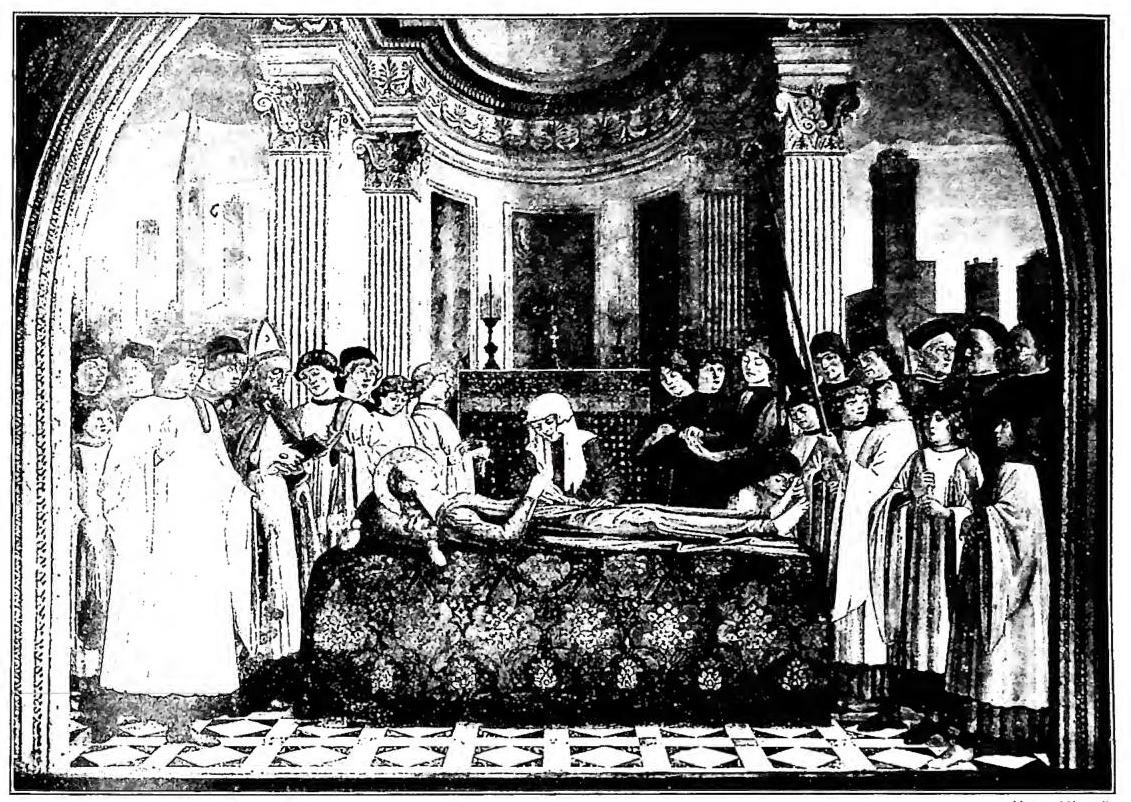
In other Eastern rites, the funeral office also includes a large number of chants, hymns, and rhythmic compositions of various kinds, which are abundant in the Eastern liturgy and applied to a wide variety of categories of persons. Priests are reserved particular rites (anointing with holy chrism in the Armenian rite, processions within the sanctuary or striking the coffin against the doors and walls of the church in the Syriac rites), which emphasize the close bonds that united them to the altar. The farewell is always moving and often expressed in dialogues full of tenderness between the deceased and those who remain. The Syrians have an office of consolation for the second and third days after burial; among the Copts, prayers continue for seven consecutive days.
The commemoration of the deceased takes place, in the Armenian rite, on the 2nd, 7th, 15th, and on the anniversary; in the Syriac rite on the 3rd, 9th, 30th, and on the anniversary; in the Coptic rite on the 3rd, 7th, 14th (or 15th), 40th, after one month, six months, and one year; in the Ethiopian rite on the 3rd, 7th, 12th, 30th, 40th, 60th, 80th, after six months, and one year.
The commemoration of all the deceased is observed, in the By-
zantine rite, twice a year, on the so-called Meatfare Saturday and on the Saturday preceding Pentecost; in the Armenian rite, five times, on the day following the great feasts: Epiphany, Easter, Transfiguration, Assumption, and the Exaltation of the Cross, with the recitation of a special office during the nocturnal hour; in the Syriac rite three times, namely the last three Fridays before Lent (the first for priests, the second for the faithful, and the third for strangers); in the Chaldean rite every year, on the last Friday before Lent.
Special remembrances of the deceased occur several times during the Mass, particularly in the preparation and offering of the Eucharistic Bread, more extensively in the diptychs and in the prayer of intercession (before or after the Consecration), in many other prayers and litanies, or in certain hours of the Divine Office.
It should be noted that the color black for the liturgy of the deceased is not known among the Easterners, except for some Catholics who have recently been influenced by the Latin tradition; likewise, funerals do not inherently involve the celebration of the Eucharistic Sacrifice. Several customs (e.g., blessed olive branches or bread among the Byzantines, funeral banquets, the farewell kiss) are ancient and have precedents in pagan practices, sanctified by Christianity.
Like the Office of the Sacred Triduum, that of the Dead has preserved its archaic character. Amalarius already notes this similarity, which he explains by the nature of sorrow or mourning that would have inspired the composition of this Office in the manner of that of the Sacred Triduum. In reality, this similarity indicates its antiquity. The Office of the Dead indeed seems to date back to the time before St. Gregory the Great. Hence its Roman origin. From the texts, such as the Ordo of St. Angilbert, the prescriptions of the Council of Aachen (817; cann. 12, 50, 66, 73), and Amalarius (De secl. Off., I, IV, ch. 42; De ord. Antiphon., ch. 65), it appears that the Office of the Dead was already in use in Gaul before the reform of St. Benedict of Aniane, to the extent that Amalarius notes no differences between Gallican books and those recently arrived from Rome. From the Ordo Romanus of John the Archchanter (ed. Silva-Tarouca, Mem. della Pont. Acc. Rom. di Archeologia, I, Rome 1923, p. 213 ff.), it is concluded that this Office was already in use in Rome before 680.
The Office of the Dead originally consisted only of Vespers, with the three Nocturns and Lauds. Later, additions and variations were introduced: for example, as early as the 9th century at St. Gall, the invitatory with Psalm 94, which became generally used in the 13th century (presente cadavere); St. Pius V made it obligatory. From the 10th century onward, a greater funeral Office with three Nocturns and nine lessons is distinguished, and a lesser one with a single Nocturn, chosen from the three preceding ones according to the day. The lessons were also changed: instead of those from Job, those taken from Eccl. 7 "Melius est ire" or from St. Augustine’s De cura gerenda pro mortuis (as today on November 2) were used. The text of Notker (d. 912) "Media in vita" was often sung at the "Benedictus" instead of the original antiphon "Ego sum".
The Office of the Dead was recited on the 3rd, 7th, 30th days and on the anniversary of a death (for the Office presente cadavere, ancient ordines prescribe the recitation of psalms in the order of the Psalter). Gradually, this Office remained the only official prayer of the Church for the suffrage of the dead. It was also recited during funerals (independent of the canonical Office of the day), on the first free day of the month, on every Monday of the week, or even daily, except during Paschal and Christmas time, for all the deceased. In the reform of the Breviary under Pius X, Compline and the minor hours were added for the day of the Commemoration of All the Faithful Departed (November 2), and the lessons were changed, while in common usage the Office remains unaltered.
IV. COMMEMORATION OF ALL THE FAITHFUL DEPARTED
Evidence of a collective commemoration of the faithful departed is found in St. Augustine, who, in De cura gerenda pro mortuis, c. IV, speaks of prayers that the Church offers in a general commemoration of all the faithful departed: « supplicationes pro spiritibus mortuorum, quas faciendas pro omnibus in christiana et catholica societate defunctis etiam tacitis nominibus sub generali commemoratione suscepit ecclesia ». Prayers for the dead in general are already found in a fragment of an ancient anaphora from the liturgy of Mark during the time of St. Athanasius (295-375): « Iis qui obdormierunt, requiem animarum praesta » (Rev. des scienc. relig., 8 [1928], pp. 489-515), and in the Euchologion of Serapion of Thmuis (after 359), orat. IV: « Sanctifica omnes in Domino defunctas ». The Roman Church had, in the prayer of the faithful (Oratio fidelium), before the Offertory, a special supplication for all the faithful departed. When the prayer of the faithful disappeared from the Roman rite during the time of Gelasius I (it remained in the Ambrosian rite), the prayer for the dead was replaced by the Memento after the Consecration, where one prays first for the departed specially commemorated, then for all; however, until the 12th-13th centuries, this was done only in Masses for the dead and in ferial Masses, not in those of Sunday. The so-called Missale Bobbiense (PL 72, 434) in its Missa Romensis cottidiana (8th century) is the first witness of this Memento. But perhaps the Memento dates back already to the time of Gelasius I (492-96), who replaced the commemoration of the departed in the prayer of the faithful with the Memento.A special day for the commemoration of the departed appears for the first time in the « Regula monachorum » attributed to St. Isidore of Seville (d. 636), set on the Monday after Pentecost (PL 83, 894), cap. 24 n. 2: « Pro spiritibus defunctorum altera die post Pentecostem sacrificium Domino offeratur ». This custom of a special commemorative day is generally found in prayer fraternities among monasteries; for example, between the monasteries of Reichenau and St. Gall in 800 (Monumenta Germ., Libri confraternitatum, ed. P. Piper, Berlin 1884). The day was set on 14 November: « commemoratio omnium semel fiat... defunctorum memoria. Ipsoque die presbyteri ternas Missae et ceteri fratres psalterium decantent ». Later, other monasteries joined this fraternity, which thus extended into Switzerland, Italy, France, Germany, and Austria. Another center was Fulda, where the day of prayers was set on 17 December, on which the anniversary of the first founding abbot, Sturmio, was celebrated, along with the memory of all deceased brothers (PL 105, 400, n. 25). In other places, different days were set, as noted for 26 January by Mabillon (Acta SS. Ord. S. Bened., VIII, p. 584, n. 111) and for the first day after the octave of Epiphany, 14 January, by Martène (De antiquis ecclesiae ritibus, Antwerp 1738, I, IV, c. 15 n. 16). At the same time, documents multiply with legacies imposing the obligation of prayers for all the faithful. From this custom of founded Masses or prayers, Cluny derived the « fidelis inventio » of choosing 2 November, the day after the feast of All Saints, for the special commemoration of all the faithful departed. Already Amalarius in De ordine Antiphonarii had linked the two Offices, of the Saints and of the dead, but without establishing a special day for the commemoration of all the departed. It is due to St. Odilo, the great abbot of Cluny (994-1048), that 2 November was chosen in the Cluniac Benedictine calendar as a day of special prayers for the departed of the whole world and of all times: « festivo more commemoratio omnium fidelium defunctorum, qui ab initio mundi fuerunt usque in finem » (PL 142, 1037, 38). By virtue of St. Odilo’s statute, large alms of bread and wine were distributed, as on the day of the Lord’s Supper, to thirteen poor people and to others, and Vespers of the dead were sung on the preceding evening, after Vespers of the Saints. On the day itself, all the bells were rung, as on feast days, the Office of the dead was recited, and the Mass was celebrated with great solemnity. All priests said Masses for the departed. In addition to this custom of 2 November for all the departed of the world, St. Odilo established certain prayers for the anniversary of deceased brothers. Among these confreres, Emperor Henry (d. 1024) is also named. The date of St. Odilo’s statute is uncertain, but in his chronicle, Sigebert of Gembloux (d. 1112) fixed it at 998, recounting under this date the legendary events that would have given rise to it (PL 160, 197-98). However, to determine its time, it is better to rely on the « Consuetudines Farfenses », written by Guido of Farfa (cod. Vat. 6808), which note this innovation twice: the first, shorter recension without Odilo’s name and without the fraternity statute (with the name of Emperor Henry); the second, longer one attributes the statute to St. Odilo and also contains the prescriptions for the fraternity itself. Mortet and Wilmart date the « Consuetudines Farfenses » to the years 1039-1043; Hourlier to 1024-1033, based on the fact that the imperial insignia donated by Henry to St. Odilo after his coronation were carried in processions. In 1033, they were almost all sold to aid the needy during a great famine. Only one manuscript in the Bibliothèque Nationale de Paris (lat. 17716), somewhat later, fixes St. Odilo’s decree at 1030-1031, a date that corresponds to that indicated by the « Consuetudines Farfenses ».
With the name and authority of St. Odilo, this « fidelis inventio » of 2 November was definitively introduced into the Cluniac calendar and spread to all dependencies of Cluny while St. Odilo was still alive, reaching as far as Farfa. From John of Avranches (d. 1079), we know that it was accepted in Normandy. Lanfranc, archbishop of Canterbury (1070-1089), prescribed in his decrees that monks should observe it both in monasteries and in cathedrals: « ipas die sacerdotes omnes celebrant missas pro omnibus fidelibus defunctis » (PL 150, 477). In addition to the Benedictines, the Carthusians also adopted the new custom (Consuetudines Guigonis, c. XI: PL 153, 655). The secular clergy gradually followed the example of the monks, both on their own initiative and by episcopal imposition. In Milan, it was introduced in 1120 by Archbishop Udalricus, on 16 October, the day after the anniversary of the dedication of the Cathedral; St. Charles Borromeo moved it to 2 November. Sicardus, bishop of Cremona (d. 1215), in the Mitrale, I, IX, cap. 50 (PL 213, 426), speaks of it as already in use in the territory of Cremona. In Rome, it was certainly known and in use at least by the time of the Ordo Romanus, XIV (1311), where in nn. 98 and 101 it is indicated as « Anniversarium omnium animarum »; no sermon is preached, and no consistory is held. In the Ordo Romanus XV, however, according to Cardinal Schuster (Liber Sacramentorum, IV, Turin 1932, p. 85), traces of a much older liturgical custom are found, since on 8 July an « Officium defunctorum pro fratribus (the cardinals) et Romanis Pontificibus » (PL 78, 1343) is indicated, precisely as in the Ordo of Farfa from the 10th century.
A new phase in the commemoration of the faithful departed began toward the end of the pontificate of Pius X. By decree of 25 June 1914 (AAS, 6 [1914], p. 378), a plenary indulgence « Toties quoties » was granted for 2 November, previously granted only to the Benedictine Church. With the bull Incruentum of 10 August 1915, Benedict XV granted every priest the privilege of saying three Masses on 2 November: the first according to the particular intention of the celebrant, the second for all the faithful departed, and the third according to the Pope’s intention, that is, to satisfy the many Mass legacies that over the centuries had become insoluble, lost, or remained unfulfilled. All altars are privileged.
This privilege was already in use in Spain, shortly before 1500. In 1540, Paul III granted the churches and chapels of the diocese of Orihuela in Spain the privilege of celebrating two Masses both on the feast of All Saints and on the following day, November 2,
to satisfy the great number of Masses requested by the people for the suffrage of the deceased. Likewise, Julius III confirmed vivae vocis oraculo in 1553 the ancient privilege in force in the province of Aragon (including Catalonia, Valencia, Navarre, and the islands of the Balearics, Sardinia, and Ibiza), and in the Dominican Order, to celebrate three Masses on November 2 for the same purpose. And on June 25, 1571, Pius V confirmed the same privilege for the Dominican province of Spain (with Navarre detached from the province of Aragon). Meanwhile, Ladislaus IV, King of Poland (1632-48), obtained on the day of his coronation the same privilege for his kingdom, but it was later forgotten. At the request of the kings of Spain and Portugal, Benedict XIV extended the privilege of three Masses to the regular and secular clergy of their kingdoms and colonies (Benedicti XIV Bullarium, II, Venice 1748, n. 225), and Leo XIII granted it to all of Latin America in 1897.
As a consequence of the privilege of the three Masses, Benedict XV elevated (February 28, 1917) November 2 to a feast of double rite for the universal Church.
V. LAW.
Canon and civil law here consider not only the human body, whole or mutilated, deprived of a soul with at least an apparent organization, but also the parts separated from the human body, bones, and ashes (S. Congregazione del Concilio, December 10, 1927, in AAS, 20 [1928], p. 261; S. Uffizio, August 3, 1897, in P. Gasparri, Fontes iuris canonici, IV, Rome 1926, n. 1100).
I. CANON LAW
In accordance with Roman law (Law X of the Twelve Tables: Hominem mortuum in urbe ne sepelito, neve urito), Christians in the early centuries buried the dead outside city walls along public roads, both on the surface and underground (catacombs). Only by exception, beginning in the 4th century, did they start to bury the dead within cities, around churches; later (6th–13th centuries), as an increasingly extended privilege, until it became common practice, corpses were also interred in the atrium and then inside churches, though always at a certain distance from the altar and never beneath it (c. 15, C. XIII, q. 2; can. 1202 § 2).Corpses must be buried in cemeteries (v. CEMETERY) or tombs blessed with a particular rite (cann. 1205-1206); only the remains of persons holding special ecclesiastical dignity or of royal families may be interred in a church (can. 1205 § 2). Burial must not take place until sufficient time has passed to remove any doubt concerning death (can. 1213), and an interred corpse may not be exhumed without the Ordinary’s permission (can. 1214). The corpse is transported to the church for the funeral rite by the priest and then to the burial site (cann. 1224 ff.). Regardless of the deceased’s dignity, clerics are forbidden to carry the corpse of a layperson on their shoulders or by hand (can. 1233 § 4). While piety must be practiced toward all the dead, only the corpses of those whom the Church has raised to the honors of the altar may lawfully and dutifully receive liturgical cult and veneration (v. RELICS).
The Church professes respect for all corpses but excludes from the honors of ecclesiastical burial the remains of those who do not belong to it or, though belonging to it, have rendered themselves unworthy (v. ECCLESIASTICAL BURIAL).
To ensure the respect due to the corpse and the place where it is laid, the CIC considers it a crime and severely punishes their violation, whether committed for theft or any other evil purpose (can. 2328).
II. ITALIAN CIVIL LAW
Italian legislation, like that of almost all countries, cremation (v.), the latter, however, only if the deceased (d.) has expressed in a will the desire to be cremated, and provided there is no suspicion of death due to a crime (art. 59 of Royal Decree 21 Dec. 1942, no. 1880). Burial, as a rule, cemetery (v.), or in private or family chapels not open to the public, located at least 200 meters from inhabited centers; however, the Ministry of the Interior may authorize the interment of corpses in other locations when special honors are to be rendered. Cremation is carried out in crematoria authorized by the prefect; and cinerary urns containing the remains of complete cremation may be placed in cemeteries, or in chapels or temples belonging to moral entities, or in private columbaria that have a stable destination and are safeguarded against any profanation (arts. 337-43 of the Consolidated Text 27 July 1934, no. 1265).No corpse may be enclosed in a coffin, nor subjected to autopsy, embalming, preservative treatments, freezing, or refrigeration, nor inhumed, entombed, or cremated, before 24 hours have elapsed from the moment of death, except in cases of decapitation, mutilation, or other absolutely certain thanatological signs, ascertained by the forensic physician; in cases of sudden death or if apparent death is suspected, observation must be extended to 48 hours, unless the forensic physician certifies earlier signs of incipient putrefaction of the corpse; in cases of death due to infectious-diffusive disease, or if the corpse shows signs of incipient putrefaction, or when other special reasons require it, the mayor, upon proposal of the health office, may reduce the observation period to less than 24 hours (arts. 7-8 of Royal Decree 21 Dec. 1942, no. 1880).
Burial may not be granted except with the authorization of the civil status officer, who may not grant it until the prescribed observation period has elapsed and after ascertaining death by the forensic physician no earlier than 15 hours from the time of death (art. 141 of Royal Decree 9 July 1939, no. 1238, and arts. 4-6 of Royal Decree 21 Dec. 1942, no. 1880). The corpses of persons who died in hospitals, or of those who, having died elsewhere without medical assistance, are transported to a hospital or an observation depot or a morgue, are, except in certain cases, subjected to diagnostic examination, which has predominantly scientific purposes (art. 32 of the Consolidated Text 31 Aug. 1933, no. 1592; art. 85 of Royal Decree 30 Sept. 1938, no. 1631; arts. 34-36 of Royal Decree 21 Dec. 1942, no. 1880). Corpses whose transport is not covered by relatives within the family group up to the sixth degree, or by confraternities or associations that may have assumed the obligation for funeral transport of their members, and corpses resulting from medico-legal examinations (excluding suicides), which are not claimed by relatives within the said family group, are reserved for teaching and scientific investigations; therefore, after the prescribed observation period has elapsed, they are delivered to university anatomical theaters, where, after investigations and studies have been carried out, they are recomposed as far as possible and transported to the cemetery for burial (arts. 37-39 of Royal Decree 21 Dec. 1942, no. 1880).
Other regulations govern: a) the requirements for coffins and funeral carriages (arts. 15-16, 27-29, 32-33, 53-54, and 56 of Royal Decree 21 Dec. 1942, no. 1880); b) autopsies (art. 16 of Royal Decree 28 May 1931, no. 602, and arts. 40 and 96 of Royal Decree 21 Dec. 1942, no. 1880); c) embalming and treatments for the temporary preservation of the corpse (art. 41 of Royal Decree 21 Dec. 1942, no. 1880); d) exhumation and disentombment (art. 16 of Royal Decree 28 May 1931, no. 602, and arts. 61-67 of Royal Decree 21 Dec. 1942, no. 1880).
The Penal Code (arts. 410-12) protects the public interest in ensuring respect for the sentiment of piety toward the deceased (d.), imposing severe penalties on those who: a) commit acts of vilification upon a corpse or its ashes (imprisonment from 1 to 3 years; and from 3 to 6 years in cases of disfigurement, mutilation, acts of brutality, or obscenity); b) destroy, suppress, or remove a corpse or a part thereof, or remove or disperse its ashes (imprisonment from 2 to 7 years); c) conceal (i.e., temporarily hide) a corpse or a part thereof or its ashes (imprisonment from 15 days to 3 years); d) dissect or otherwise use a corpse or a part thereof for scientific or didactic purposes in cases not permitted by law (imprisonment from 15 days to 6 months or a fine from 400 to 40,000 lire).
#### VI. IN MEDICINE.
From a hygienic perspective, the removal of the corpse from the social community is carried out in all human groups, in various forms such as inhumation, incineration, or exposure of the corpse.
From an affective standpoint, the most obvious arrangement that can be made for the corpse is undoubtedly that of preservation, the simplest form of which was to entrust it to the bosom of the earth, almost forgetting that the earth, obeying the laws of nature, inexorably reclaims that matter which it once lent to life.
However, there are not infrequent particular cases in which the earth derogates from this law, preserving the body intact for a more or less extended period.
The corpse in such conditions undergoes a process of saponification (adipocere) or spontaneous mummification caused by natural processes due to particular environmental and climatic conditions. Thus, for example, in the Strait of Magellan, between Patagonia and Tierra del Fuego, as in the African deserts, the degree of dryness is such that corpses, even when left on the surface of the ground, rapidly mummify, remaining undecomposed for years. In Ferentillo (Spoleto), in the parish of Precetto, in a cemetery approximately 200 years old located in a building from the 11th and 12th centuries, the deceased (d.) deposited there, after about a year, appear mummified to such an extent that their features remain clearly recognizable, with the body weight reduced by about six-sevenths and thus very light; this occurs due to a natural process of rapid subtraction of fluids from the corpse (dehydration), owing to the particular hygroscopic qualities of the soil, rich in calcium and clay, and the strong ventilation. However, apart from such and other cases of spontaneous preservation, since ancient times humans have attempted methods that better ensure the preservation of the corpse, particularly for cases in which the deceased (d.) was a person of high rank.
Examining the various preservation methods, mummification presents itself as the most ancient process, widely diffused among the Egyptians, who were its originators. It is based primarily on the desiccation of tissues, desiccation which constitutes one of the most effective means of preserving organic tissues. The mummification process of the Egyptians, though varying according to the expense that could be borne by the relatives of the deceased (d.), essentially consisted in the emptying of the visceral cavities (cranium, thorax, abdomen), by mechanical or chemical means (caustic solutions), in the careful washing of these with antiseptics, in their filling with balsamic and resinous substances (myrrh, cassia, bitumen, asphalt), in the thorough desiccation obtained by keeping the body immersed for many days (Herodotus speaks of seventy days) in a dehydrating powder composed of sodium carbonate, sodium sulfate, and sodium chloride. The bodies of the wealthy and persons of high rank, after further washing, were tightly wrapped with strips of linen glued and varnished with gum and other resins.
The art of embalming flourished in Italy, particularly in Rome, from the 16th century onward, reaching its highest perfection. Subsequently, the attempted methods increasingly oriented toward the concept of complete imbibition of the corpse with balsamic and antiseptic substances incorporated into more or less inert media, forcibly introduced into the circulatory system in place of circulating fluids.
While methods based on vascular injections aim to preserve the body with a flexibility similar to that of the living, another series seeks to achieve the preservation of the corpse by desiccating, hardening, and almost petrifying II.
The most famous among petrification methods is the one associated with the name of Girolamo Segato (1792-1836) of Vedana (Belluno).
It seems that Segato, who took the secret of his discovery to his grave, had achieved the goal of perpetual preservation of organic bodies. However, today at the Museum of the History of Science in Florence, one can see his works, including the famous mosaic table, worm-eaten and with a leathery appearance.
Not a few others attempted the petrification of corpses, seeking to replace organic matter with inorganic; thus, the Florentine Andrea Cozzi in 1837, the Pisan D. Mori and the Roman D. Comi in 1839; Dr. Paolo Gorini of Lodi in 1849, whose preparations can still be observed in the Museum of the Hospital of his city. Efisio Marini of Cagliari, who died in Naples in 1900, seemed to have conquered the secret of petrifying bodies, but the secret was not revealed and is still guarded by his living daughter. Among the more recent figures of our century, the names of Antonio Lotteri, C. Gregory, G. Chiarella, A. Maggia, N. Pianotti, O. Nuzzi, and finally that of Prof. Francesco Spirito, current director of the obstetric-gynecological clinic and Rector of the University of Siena, should be remembered. His method of body preservation guarantees, in addition to complete petrification, also a perfect persistence of form and satisfactory color. A secret method of embalming corpses is that employed by the Russians Zbarsky and Vorobiev to preserve Lenin's body, a method that, however, requires periodic inspections, continuous care, and repairs of the corpse (G. P. Arcieri, op. cit.).
Taking a different path, Variot succeeded in metallizing corpses through electroplating, infiltrating them with gold and copper; however, the process does not penetrate deeply and thus fails to prevent decomposition for long.
Giuseppe de Ninno