Machine translation of the 1948–1954 Italian original. The original text is authoritative.
KARMAN (KARMA). — In the Rgveda (v. RGVEDA), the word k., “the work” par excellence, designates the sacrificial rite and the fruit derived from it in this life and the next. When, in the age of the Upanisad (v.), faith in the omnipotence of the rite declined, human action and its effect gained importance, and they too came to be called k. Every action, good or evil, in addition to its natural effect, has a supersensible one in the k., the merit or demerit inherent in human actions, which adheres to the soul in ways variously imagined by the authors of the different philosophical systems, but always with the same effect: joy or sorrow as the reward or punishment of good or evil conduct. What is called man’s destiny does not depend on blind fortune, but on k.: some are born rich and others poor, some healthy and others ill, some well-formed and others deformed as a result of the k. of a previous existence.
The recompense of merit and demerit does not, in fact, end within the brief span of a single life; there is always a residue of k. when death arrives, and this determines rebirth in that form of existence which is allotted to each person in accordance with his
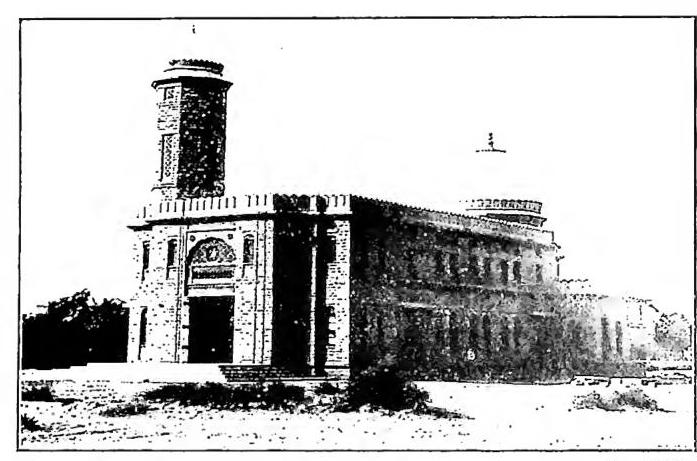
KARAKI, ARCIDIOCESI di. — Catholic church in Indian style.merits: in heaven, on earth, or in hell. The transmigration of souls, or samsāra, dependent on k., has existed ab aeterno, but man can escape the tormenting succession of births and deaths through liberation (mohya, nirvāṇa), which is the end toward which the religions of India strive by different paths. The first clear testimony to a belief in k. is found in the passage of the Byhadāra-nyaka-upanīṣad (III, 2, 13) that, referring to the conversation between Artabhaga and Yājñavalkya, says: “And if they spoke of anything, they spoke of action (k.); and if they praised anything, they praised action, because one becomes good through good actions, evil through evil ones.” And further on (IV, 4, 5): “Man is entirely desire, and as is his decision, so is his action; as is his action, so is his fate.” The term samsāra is not yet used; it appears for the first time in the later Katha-upanīṣad (I, 3, 7). In Buddhism, which denies a substantial and permanent soul, k. cannot be an affection of the soul, and one should therefore not speak of transmigration, but of “rebirth.” K. is conceived as a transcendent force that provides for the perpetuation, beyond death, of the psycho-physical existence of the deceased, so that every remainder of merit or demerit may receive its reward. “But k. is inanimate,” object the followers of Nyaya, “and therefore it needs to be regulated by the Supreme Soul, that is, God.”
BIBL.: R. Garbe, Die Sümbhya-Philosophie, Leipzig 1917, pp. 232–42; H. Jacobi, Die Entwicklung der Gottesidee bei den Indern, Bonn-Leipzig 1923, pp. 9–18 ff. Ferdinando Belloni Filippi
Cite this article
“KARMAN (KARMA).” Enciclopedia Cattolica, vol. VII (1951), p. 416. Azione Romana digital edition, https://azioneromana.com/article/karman-karma.