
ECCLESIASTICAL BURIAL. — Ecclesiastical burial consists of the following three elements: removal of the body in order to bring it to the funeral church, ritual obsequies in the church, and accompaniment from the church to the place of burial (can. 1204).
There is a grave obligation to provide ecclesiastical burial, according to the order and procedures of the liturgical books (can. 1215), unless there is a grave reason precluding all or one of the elements of ecclesiastical burial, as, for example, in the case of an epidemic, in large hospitals, etc.
The funeral church is that to which the deceased must be transferred by right (cann. 1204, 1215). In determining it, the following order of preference is to be observed: first, the chosen church (can. 1216 § 1); then, the family church (can. 1229); finally, by ordinary right, the parish church (can. 1216 § 1). The other provisions are subordinate to this general criterion.
All the faithful are granted the faculty to choose the church for their obsequies and the place of burial, with the sole exceptions of minors and professed religious who are not cardinals, bishops, abbots or prelates nullius, apostolic vicars or prefects. Unless there is an express contrary will, a legitimate custom, or a particular provision, the presumption ubi tumulus, ibi funus or ubi funus, ibi tumulus applies, provided, however, that the matter concerns a strictly ecclesiastical cemetery or a juridical person. The choice of the funeral church or cemetery must be free: religious and secular clergy are therefore forbidden, under pain of nullity of the act, to induce anyone by vote, oath, or promise to choose their own funeral church or cemetery (can. 1227). The choice may be made personally or through a legitimate agent, who may proceed with it after the death of the principal (can. 1216 § 2). The person vested with paternal authority may choose the burial place of minors subject to him, even after their death (can. 1224 § 1). In every case the choice is always revocable. The choice must fall upon one of the following four categories: a) a parish church; b) a church of regulars; that of the nuns is reserved exclusively to women who, for reasons of service, education, illness, or hospitality, habitually reside within the boundaries of the enclosure, even if they should happen to die outside the monastery; c) churches of patronage, insofar as concerns the patron; d) a church which, by particular provision, enjoys the right of burial. The choice that has been made may be proved by all the procedural means customarily employed.
The family tomb or sepulcrum maiorum is a place, within or outside the cemetery, lawfully chosen and designated for the benefit of a particular family, a particular class of persons, or a juridical entity. It may be of four kinds: family, if it is intended solely for the ascendants and descendants of a family; hereditary, if it serves only the heirs; mixed, if it is established for the family and the heirs; or that of a juridical person, if it is assigned to the latter. Any physical or juridical person sui iuris may construct a family tomb (cann. 1208 § 31, 1209 § 1), with the written permission of the superior on whom the cemetery within which it is intended to be constructed depends (can. 1209 § 1). The place of burial is the family tomb if the body can be conveniently transported there or if the interested parties provide for this at their own expense (can. 1229 § 1), and the funeral church will likewise be that of the family tomb, subject to local customs and diocesan statutes.
By common ordinary right, the funeral church is the deceased’s own parish, that is, the parish in which he had his domicile or quasi-domicile, whether actual or legal (can. 94). If there was more than one proper parish, the funeral church is the church of the parish within whose territory the death occurred (can. 1216). If the death occurred outside the proper parish, the body is to be transported to the nearest parish church, provided that, in the judgment of the Ordinary, it can be reached commode pedestri itinere; otherwise, it is to be taken to the parish church of the place of death, unless the family, the heirs, or those having title provide at their own expense for the transport of the body to the deceased’s parish (can. 1218 §§ 1-3). In case of doubt, the right of the proper parish always prevails (can. 1217).
By special ordinary right, for the Roman Pontiff the funeral church is the Vatican Basilica; for cardinals, if they die in Rome, the church designated by the Pontiff, and, if they die outside Rome, the most distinguished church of the place of death (can. 1219 § 1). For residential bishops, even if raised to the cardinalitial dignity, as also for abbots or prelates nullius, apostolic prefects or vicars, permanently constituted apostolic administrators, and coadjutor bishops, it is the cathedral, abbey, or prelatic church, if transportation is possible without hardship; otherwise, it is the most distinguished church of the place of death (can. 1219 § 2). If a bishop has two or more dioceses united aeque principaliter, it is the cathedral of the place of death; if they are united minus principaliter, it is the principal cathedral church (can. 1218). For residential beneficiaries, it is the church of their benefice (cann. 1220, 1218); for professed religious, novices, and domestics permanently residing in a religious house and dying there, it is the church of their own house or at least of their religious institute (can. 1221). For those who die in a hospital, and for the boarders and guests of religious, the common ordinary law applicable to all the faithful is observed, unless particular provisions establish otherwise (can. 1222). For those who die in a seminary, it is the church of the seminary (cann. 1222, 1368).
The minister of funerals is generally the person responsible for the funeral church. In particular, it is the right and duty of the parish priest to provide, personally or through another, burial for his own deceased parishioners. If the deceased has several parish priests, the minister is the parish priest of the funeral church (can. 1230 § 1). If death occurs in another parish, but the body can be conveniently transported there commode pedestri itinere, it is the proper parish priest’s responsibility to provide ecclesiastical burial, after notifying the parish priest of the place of death (can. 1230 § 2; 1218 § 3); otherwise, the funeral minister is the parish priest of the place of death.
The ministers of the Pontiff’s funeral are the cardinals (constitution Sede vacante, no. 20; motu proprio of Pius XI, 1 March 1922, AAS, 14 [1922], 145). For cardinals, even if not bishops, who die in Rome, the minister is the dean of the Sacred College, unless the pontiff has designated someone else; the proper parish priest, however, removes the body. If they die outside Rome and in an episcopal see, the ministers are, in order of precedence, the dignitaries of the cathedral church; if outside an episcopal see, the minister is the rector of the most distinguished funeral church. For residential bishops, as also for abbots and prelates nullius, the ministers are the dignitaries of the cathedral church; if outside the episcopal see, as also in the case of abbots and prelates nullius, the ministers are the dignitaries and canons of the cathedral, abbey, or prelatic church; if they die outside the see, the minister is the rector of the most distinguished church. Titular bishops follow the common law applicable to the faithful, as do residential bishops who die in Rome. For beneficiaries, the minister is the rector of the church of the benefice; the deceased’s proper parish priest, however, removes the body and leads it to the doors of the funeral church (cann. 1216, 1218, 1230 § 4). For religious, novices, postulants, and domestics to be buried in the religious’ church, the minister is exclusively the religious superior; for lay religious institutes, on the other hand, the minister is the chaplain of the house. For religious women and novices who die in the religious house and are exempt from parochial jurisdiction, the minister is the chaplain; if they are not exempt, the minister is the parish priest. If they die outside their own house, the prescriptions of common law are observed (can. 1230 § 5). For those who die in a hospital or seminary, the minister is the rector of the funeral church.
In the case of elective or gentile burial, if the church is exempt from the jurisdiction of the parish priest, the minister is the rector of that church; but it is the parish priest who, with the processional cross of the funerary church, takes up the body and conducts it to the doors of the church (cann. 1230 § 3, 1215). If the church is not exempt, the minister is the parish priest in whose territory the church is situated, provided that the deceased was subject to that parish priest (can. 1230 § 4). If the body is transported to a place where the deceased had neither his own parish nor had made an election, it is the cathedral church’s responsibility to celebrate the funeral rites; in its absence, this responsibility passes to the parish church in whose territory the cemetery for the burial is situated, always subject to local customs and diocesan statutes (can. 1230 § 7, 1218, 1229).
Once the funeral rites have been celebrated in the church, the body, except in the case of elective or gentile burial, must be buried in the cemetery of the funerary church (cann. 1231 § 1, 1228, 1229). The minister is the one who celebrated the funeral rites, unless the body is to be buried in a cemetery to which it cannot conveniently be transported. Apart from this case, the minister, wearing a stole and carrying the processional cross, may pass through the territory of other parishes or dioceses, even without the permission of the respective parish priest or Ordinary (can. 1232).
From the funeral procession there may not be excluded, except for a grave reason to be judged by the Ordinary, other secular or religious clerics and associations of the faithful whom the family or heirs of the deceased have invited; nevertheless, the clerics attached to the church have precedence over all others (can. 1233 § 1). Societies or emblems manifestly hostile to the Catholic religion are excluded from the funeral procession (can. 1223 § 2). Flags or banners of Catholic societies may also be admitted into the church, as may blessed flags. Those of political parties are excluded, since they cannot be blessed (Holy Office, 20 March 1947: AAS, 39 [1947], p. 130). The route and arrangement of the procession are determined by the parish priest, without prejudice in any case to legitimate rights of precedence (can. 1233 § 3). Clerics are forbidden to carry the coffin of a layman, whatever his dignity may be (can. 1233 § 4).
Those who have not been baptized are excluded from ecclesiastical burial (can. 1239 § 1); catechumens, on the other hand, who through no fault of their own did not receive Baptism before dying, are treated as the faithful for burial (§ 2). Finally, as a general rule, ecclesiastical burial is granted to all the baptized, unless expressly provided otherwise (§ 3).
Can. 1240 enumerates six categories of persons who are denied ecclesiastical burial if they have not shown signs of repentance before death (for example, by calling a priest, kissing the Crucifix, or reciting the act of contrition): 1) those notoriously apostate from the Christian faith or notoriously enrolled in a heretical or schismatic, Masonic, or similar sect; 2) excommunicated persons or those personally under interdict after a condemnatory or declaratory sentence; 3) those who have deliberately committed suicide; 4) those who died in or from wounds sustained in that act; 5) anyone who arranged to be cremated; 6) all other public and manifest sinners.
Deprivation of ecclesiastical burial also entails the refusal of any funeral Mass, including the anniversary Mass, and of other public funeral services (can. 1241), as well as, where possible, the exhumation of an excommunicated person to be avoided, already unlawfully buried in a sacred place (cann. 1242, 1214 §, 1212). In case of doubt, the matter must, if possible, be referred to the Ordinary; while the doubt remains, ecclesiastical burial may not be denied; any resulting scandal must, however, always be removed (can. 1240 § 2).
Once the burial has taken place, the minister must record in the appropriate book the name and age of the deceased, together with the names of the parents and spouse, the time of death, the reception of the Sacraments and the name of the minister who administered them, and the place and time of burial (can. 1238). For fees V. PORZIONE PARROCCHIALE; STOLA, DIRITTI di.
(Ist. Enc. Catt.)
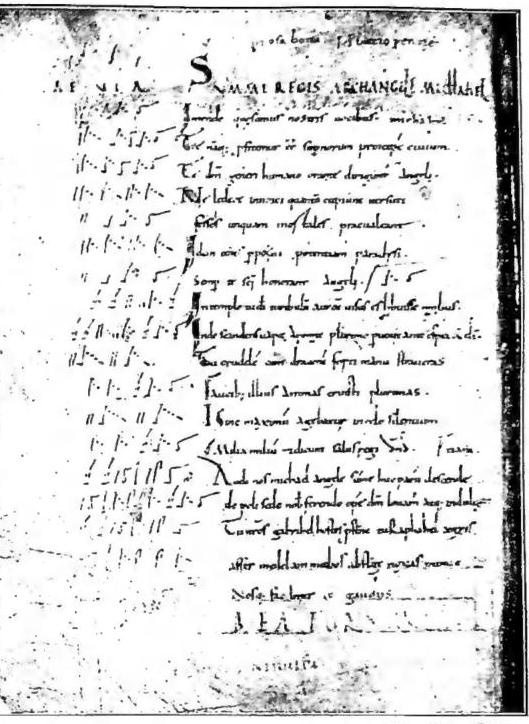
SEQUENCES – S. in honor of s. Michael. From a collection of Lives of the Saints, originating from Fleury. As in the ancient prosaries, the neumes are transcribed in the margin – Vatican Library, cod. Reg. lat. 318, f. 122v (9th–10th century).
with Filippo l'Ardito and with s. Luigi IX, who died in 1270 beneath the walls of Tunis.
The custom soon aroused such horror that in 1300 Pope Bonifacio VIII was led to issue a bull of excommunication against those who boiled and stripped human bodies of their flesh for burial far from the places of death, and he prohibited the burial in consecrated ground of human remains that had undergone such treatment. In the past, this bull was erroneously interpreted as a prohibition by the ecclesiastical authorities against anatomical studies. On the contrary, during this period the Church had begun to protect scholars from the fury of the populace, which abhorred human dissections, granting, whenever necessary, special dispensations for carrying out «notomie» and supervising anatomical studies.