
PREHISTORY (RELIGIOUS MANIFESTATIONS). — By prehistory are meant the extremely ancient phases of human civilizations about which written testimonies are lacking and which can be reconstructed only partially, chiefly on the basis of archaeological remains and, secondarily, of arguments derived by analogy from ethnological and sociological comparison with present-day primitive peoples. The division of prehistory into cultural aspects is based on the nature of the tools left by prehistoric humans: those of crude stone (Palaeolithic), polished stone (Neolithic), and metal (copper, bronze, iron). The discovery and use of metals gave a more vigorous impulse to the development of the various peoples and hastened their entry into history.
Prehistoric knowledge derives almost exclusively from excavations. These have also brought to light abundant evidence of religious manifestations among the most ancient Mediterranean and European peoples. The immense span of millennia embraced by prehistory, which cannot be calculated with sufficient approximation, reaches back to the earliest remains now known to have been left by humans, that is, to the first phases of the oldest period of the Quaternary geological era, the Pleistocene.
It is characterized by the enormous expansions of the ice sheet of northern Europe and of the Alpine, Pyrenean, and other glaciers. This was a grand and complex phenomenon: the phases of expansion were in fact interspersed with interglacial phases, that is, periods of retreat of the glaciers themselves. Gradually, the general Pleistocene environment gave way to that of the present Holocene, the second period of our Quaternary era.
The term Palaeolithic designates the industries and human civilizations that developed during the Pleistocene: weapons and tools were almost exclusively made of stone. Earthenware itself was not yet known. From those remotest times, prehistory descends to the first development of civilizations and protohistoric cultural aspects, to the dawn of classical times. It is not easy to establish a precise boundary between prehistoric and protohistoric cultural aspects, also because peoples distant from the great centers of early cultural development—the countries of the eastern Mediterranean—lagged behind, often preserving archaic usages and customs for a long time.
The life of Pleistocene humans depended on the harsh environment; they would have succumbed in the hard struggle for existence had they not possessed, in addition to exceptional physical abilities, particular spiritual dispositions, which led them, from that time onward, also to a gradual refinement of the lithic industry, an initial social development, and religious and artistic manifestations. There is, for example, probable evidence of a skull cult dating from the lower Palaeolithic phases. In large natural recesses at Chou-kou-tien near Beijing, beside hearths and remains of a very crude lithic industry, lay the skulls of an extremely primitive human being. Skulls of the cave bear, an extinct species, and selected long bones of the same animal, carefully placed in special stone boxes within the anthropic deposits of two caves situated at great height in the heart of the Alpine valleys of St. Gallen in Switzerland—the Wildermann'sloch (1,628 m above sea level) and the Drachenloch (2,445 m above sea level)—are regarded as offerings of first fruits to a deity. During the recent interglacial phase, these caves had temporarily sheltered precisely daring hunters of the cave bear.
(from a plaster cast, Rome, Museo Preistorico e Pignoni)
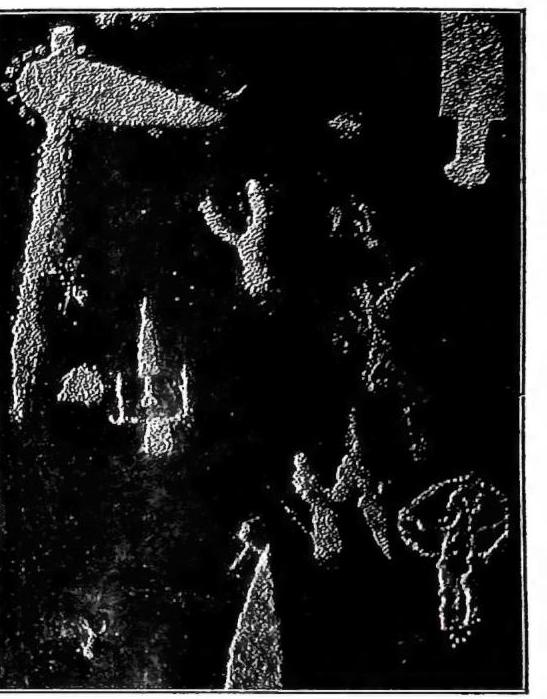
PREISTORIA - Rock engraving of Val Meraviglie. Note the schematized bovine, the dagger, the battle-axe, and the small human figure - Monte Bego (Maritime Alps).
…sion, in one of the caves of Monte Circeo, the Guattari Cave. At its bottom, within a sort of stone circle, there lay an isolated skull, lacking the lower jaw, whose posterior portion of the base had been destroyed ab antiquo. It is known that modern primitive peoples used precisely to extract the brain from the lower part of the skull for cannibalistic rites. It cannot, however, be excluded that this was a case of human sacrifice. The oldest burials known today, brought to light in French sites dating from the time of the last great glacial expansion, already attest to the general diffusion of the notion of a continuation of earthly life in an invisible and mysterious world in which the individual retains his own personality. This notion, which emerged with increasing clarity in the burials of subsequent prehistoric periods, was fully expressed in the written texts of historical Egypt (Book of the Dead, Book of Funerals, etc.). As one descends from the Lower Palaeolithic to the more recent prehistoric civilisations, one observes an increasingly broad diffusion of funerary customs and rites. The tombs of the Upper Palaeolithic came to light in far greater numbers than those mentioned from the Lower Palaeolithic. From the more recent Neolithic and Eneolithic periods, and from the civilisations of bronze and iron, in addition to a very large number of isolated tombs, there are also numerous cemeteries containing hundreds of graves. In general, ancient funerary customs continued, albeit with many variations. The practice of cremating the corpse, in place of the primitive inhumation, began to spread only during the Bronze Age; but it never suppressed inhumation, which remained very widely practised and dominant in many regions.
Food was offered to the deceased. The funerary equipment itself (utensils, weapons, vessels) attests to the intention of providing the deceased with the provisions indispensable for the afterlife. Not a few concepts already belonging to prehistory also survived into historical times. The numerous and varied manifestations of the spiritual and religious life of the Upper Palaeolithic peoples now attest to the existence of a higher degree of civilisation.
In European Upper Palaeolithic sites (French, Austrian, etc.), three-dimensional female statuettes of stone and ivory were collected: idols or symbols of fertility. The woman is represented naked, almost always steatopygous. The female idol subsequently became extremely widespread, especially in the Eneolithic period and then during the Bronze Age, from the Indus Valley and Mesopotamia to Egypt, Crete, the Cyclades, Asia Minor, Greece, the Balkan Peninsula, and throughout Western Europe. It is not unlikely that the primitive concept of fertility was joined by the more or less vague notion of Tellus Mater.
In the innermost parts of caves frequented by Upper Palaeolithic man in the regions of southwestern France (Font de Gaume, Lascaux, etc.) and, in the Iberian Peninsula, in the Cantabrian Mountains (Altamira, etc.), true artists engraved or painted, with perfect style and naturalness, the wild animals that were hunted or whose memory was preserved: the mammoth, only rarely; more frequently the reindeer, bison, horse, etc. These works of art were related to concepts and customs, whether animal-worshipping or, if one prefers, magical-religious. There are, in fact, various indications of practices presumably believed capable of facilitating the capture of the animals represented, which provided a considerable part of the food supply. It seems unlikely that these were totemistic practices. Small figures of the animals themselves, carved in the round or engraved on reindeer antler or on stone slabs, lay within Upper Palaeolithic deposits in caves of the same regions. Throughout the Mediterranean slope of the Iberian Peninsula, from Malaga and Almeria to Lerida and Tarragona (the so-called Spanish Levant), there are overhanging rock faces and rock shelters, clearly the sites of a cult, or of cults connected with the life of those peoples, with sometimes grandiose painted scenes of deer hunting, combats, and other scenes of everyday life. The figures, both human and animal, still retain naturalistic features. They are attributed to the Upper Palaeolithic. At the same time, on these same rocks, a tendency developed toward increasingly schematic representations of humans and animals. In the Mesolithic period, schematic representation replaced the earlier forms on the rocks and continued until the Eneolithic period. At the beginning of the Holocene, once the ice had retreated, the natural environment (climate, fauna, flora, relief of the land, etc.) gradually changed into that of the present day. With a similarly gradual continuity, human industries and the cultural forms of the Upper Palaeolithic first passed into those known as Mesolithic and then into those of the Neolithic. Neolithic man in Eurasia and Mediterranean Africa turned chiefly to pastoralism and agriculture. The fertile regions of the Near East appear to have played a predominant role, especially in the emergence and spread of agriculture. At the height of the Neolithic period, the first weapons and tools of copper, the first metal to be used, were introduced. Its metallurgy, practised in the Near East from as early as the fourth millennium, spread throughout the Mediterranean and European countries during the third millennium. Thus arose the civilisation known as Eneolithic or Chalcolithic, which in the island of Crete, the Cyclades, and Asia Minor assumed luxuriant forms. Funerary customs and rites developed and, as has been said, became established.
The influence exerted by the higher cultural forms of the Near East is also discernible in the extremely wide diffusion of the female idol mentioned above. The female idol also appears, painted together with other representations, on the aforementioned rocks of the Spanish Levant, which were sites of worship. At times it is accompanied by the divine symbol of the axe: for example, in the funerary hypogea of the Petit Morin valley (Seine-et-Marne). In the full Eneolithic period, worship was already being offered to a bull-shaped divinity which, for example, in Sardinia, appears schematically represented in the funerary hypogea of Anghelu Ruju (Alghero). In a broadly “Ligurian” and Eneolithic cultural environment, the so-called anthropomorphic stelae and statue-menhirs came to light in various French regions, in Lunigiana, and in the upper Adige. The anthropomorphic stelae are large slabs whose front bears a carved, primitive, and schematic human figure. The statue-menhirs are true three-dimensional statues. The French stelae generally have a funerary character. It is unknown whether the Lunigiana stelae were markers of tombs or were connected with the worship of deities represented anthropomorphically. It was also suggested that they might be hyperological representations.
The Bronze Age, which arose from the Copper Age, developed in the second millennium B.C. The manifestations of religious and cultic concepts attributable to this civilization, particularly numerous, offer evidence of broad, at times intense, cultural contacts among the peoples of the Mediterranean and Europe. They responded to concepts that deeply permeated spiritual life, from the place of worship to the tomb: concepts more or less different in the various regions, which came to play a significant part in the formation of prehistoric and historical religious practices. These concepts in fact possessed the continuity naturally inherent in whatever pertains to religion. The Bronze Age civilization in Crete and the Aegean lands, likewise a continuation and development of the Copper Age civilization, appears as a luxuriant prehistory. In Crete, during the properly Minoan period and the immediately succeeding periods, places of worship were mountain peaks, caves, and chapels within the great palaces (Knossos, Phaistos). One of the most frequent symbols of the divinity was the double axe, often represented superimposed upon the so-called “horns of consecration,” that is, the schematic rendering of a bull’s head. At other times, the head of the bull—the pre-eminently sacred animal in Crete—was instead reproduced in its entirety. Another symbol of the divinity was the defensive weapon, the typical double-lobed shield. A betylic cult was also practiced, that is, worship rendered to a sacred stone or betyl. The symbols mentioned above were represented in sacred or religious-funerary scenes, in which the sacred tree also appears. The pillar and the column were probably religious symbols as well; in representations they often appear associated with evidently sacred animals: the lion, the dove, and so forth. Some scenes present the female divinity dominating the forces of nature and generation. Most of her attributes passed into Greek mythology to Rhea, Cybele, and others. Fantastic monsters—the griffin, the sphinx, and so forth—were repeatedly depicted. In the Mycenaean world of the second half of the second millennium, representations of the bull’s head with the double axe, the nude goddess with doves, and other symbols also reappear. Aegean cultural influence radiated widely over the coasts of the Ionian Sea, Sicily, and Sardinia.
The numerous religious manifestations of this civilization, now known in considerable number in our country and in western, central, and northern Europe, give an idea of the variety of conceptions of the divinity, which not infrequently appear related or analogous to those of Crete and Mycenae. Various divinities had their abode, or were embodied, in mountains, rivers, and springs. Man, as shepherd and farmer, no longer directed a form of worship toward the animals he hunted, but toward the animal most useful to him, the bovine. A sacred mountain may be cited: Monte Bego (2,873 m.) in the Maritime Alps. Among the varied carvings on the smooth rocks situated above 2,000 m. above sea level, the figure of the bovine predominates. The animal is generally represented in an extremely schematic manner; at times it is even shown yoked to the plow. In Sardinia, the worship of a bull-shaped divinity, already documented in the aforementioned funerary hypogea at Anghelu-Ruju from the fully developed Copper Age, continued during the Nuragic period as well; a bull’s protome adorned the megalithic structure covering the spring of healing water at the temple of S. Anastasia at Sàrdara. The bull-shaped divinity, protector of the tomb, thus also appears connected with the worship of healing waters. The worship of the weapon is likewise repeated; examples are provided by the same engraved rocks of Monte Bego, where, beside the bovine, the dagger, sword, and battle-axe were represented with great frequency. In the Nuragic temple of S. Vittoria at Serri (Cagliari), the true Cretan double axe was raised upon a slender pillar. The farmer regarded the Sun as the star that gives light, the star that causes the seed to germinate. Solar worship was widely diffused among the peoples of the Mediterranean and Europe. Thus, on the engraved rocks of southern Scandinavia, the cruciform wheel, representing the solar chariot, appears raised by a human figure or carried on a boat. Exceptionally, the cruciform wheel can also be seen on the engraved rocks of Monte Bego, where it is closely associated with the bovine. In Egypt, solar worship was the foundation of that religion, as demonstrated by the colossal temples, the great monumental inscriptions, and the numerous papyri. Another solar symbol in central and northern Europe was the swan. The worship of the healing waters already mentioned was widely diffused; one should recall here, for example, the caves of Pertosa and Latronico in the mountains of the Salerno region. From the Paleolithic Age to the dawn of historical times, rock representations were great monuments of worship. Numerous examples are found in various parts of the world, including among modern primitive populations. The varied representations on the rocks of the Spanish Levant, which endured until the Copper Age, have already been discussed. The representations at Monte Bego began, with a distinctive character, in the period preceding the Bronze Age; they continued, in the forms mentioned above, at least until the beginning of the Iron Age. It is plausible that the rocks on which people carved, or less frequently painted, were generally regarded as the abode of divinities. On rocks in Scandinavia, near watercourses or waterfalls, Neolithic peoples still devoted to hunting engraved figures of elk and other animals that formed part of their diet. During the Bronze Age, the agricultural peoples of Scandinavia engraved the solar wheel, the plow, and other associated figures. In North Africa, perhaps from the final periods of the Paleolithic Age until, one may say, historical times, various animals were represented on rocks near springs, some of which later migrated and disappeared. From the earliest periods, many other representations accompanied or followed them. It may be held that the various religious concepts, embryonic in the Neolithic period and developed and progressively defined during the Copper and Bronze Ages, did not disappear but gradually underwent transformation during the Iron Age, with greater or lesser delay in regions more or less distant from the great Mediterranean centers of civilization. The carvings at Monte Bego, for example, continued for several more centuries during the Iron Age. A strong Mediterranean substratum is also recognizable in the classical Greek and Latin religions. - Vedi tav. CXXXI.