
EPIGRAFIA CRISTIANA LATINA e GRECA. - L'epigrafia si può dire giustamente l'occhio del-
And then it is not always easy to judge whether an inscription is Christian or pagan, that is, the work of Christians or not. In practice, Christian epigraphy properly speaking takes into consideration only those inscriptions that bear a sign of Christianity, since its task is principally that of gathering from the tombstones the testimonies of ancient Christian life as such. Nor must one fear that this method, for the age in which Christianity was the religion of the great majority, such as the 5th and 6th centuries, logically leaves a large number of inscriptions that are actually the work of Christians to be considered as pagan; since for the ancients, and in particular for the men of those centuries, the class of purely civil and secular inscriptions scarcely existed; their profound religious sentiment found a way to express itself
Ancient Christian epigraphy begins to appear at the end of the 2nd century, almost simultaneously in Rome and Phrygia; but its evidence remains scarce throughout the first half of the 3rd; thereafter it becomes frequent, even before the Constantinian peace, at least in the Roman catacombs and in some localities of Asia Minor. But the vast majority of texts (which are mostly epitaphs, or funerary inscriptions) belong to the 4th and 5th centuries; for the first half of the 4th century one is still almost restricted to Rome, Chiusi, and western Asia Minor; then rapidly in all regions of the Empire there is a flourishing of texts that within the space of a little more than a century yield the great mass of paleochristian inscriptions known so far.
In the sad centuries that followed, it appears that the ignorance and misery of the times greatly restricted the use of epigraphy or at least practiced it mostly on materials so fragile that the texts have not lasted down to us. In fact, for the 6th and 7th centuries we have a good number of monumental inscriptions, but dense groups of epitaphs only in certain countries such as Gaul, Spain, Egypt, and Cilicia.
Epigraphy has a considerable part to play in the study of Christian antiquity in general. As for how it contributes to a better knowledge of dogmas and religious conceptions V. DOGMATICHE ISCRIZIONI. But to an even vaster extent it helps to form a more precise idea of the life in general of ancient Christians; of their religious and civil uses and customs, and of ecclesiastical institutions. The exploration of ancient cemeteries makes known their funeral rites and many curious details of daily life, e.g., the secrets of individual onomastics and its transformations; from ancient churches one learns more concretely how official worship was carried out, under what material conditions, with what instruments; civil and private epigraphy, particularly of the multifaceted instrumentum domesticum, show to what extent the Christian religious spirit had penetrated souls and expressed itself in even the most unexpected manifestations and sometimes in true deviations into superstition. The rich iconographic heritage of figured monuments, which has revealed a whole world, often curious and unexpected, of artistic ideas and symbolic elaborations, receives from the inscriptions that sometimes accompany them fixed points for a positive interpretation of otherwise insoluble problems and for a certain chronological arrangement and historical vision of the whole of the facts. Philology, which once deemed worthy of its study only the pages of great authors composed in the official language and disdained the humble testimonies of unpretentious texts, often incorrect and barbarizing and full of vulgarisms, has now learned the interest of dealing with crude yet spontaneous and genuine documents of the living language, and successfully studies therein the evolution of Latin and Greek, which both in pronunciation and in morphological and lexical aspects move ever more decisively toward giving birth to modern languages.
However, even history, as it is more properly understood—that is, the grand history of events and men who are called important—often finds in epigraphy a precious aid, mostly regarding single facts that are known from inscriptions alone or receive an unexpected and decisive illustration, and sometimes even in questions of a more general nature. By now, to give a few examples, it is admitted that a history of the primitive diffusion of Christianity (and thus the geography of the orbis christianae antiquus) can no longer be written without the valid contribution of epigraphy, of which Harnack has given a good example; how much light hagiography, especially Roman and African, can draw from inscriptions has been shown repeatedly by Delehaye and Monceaux; Aricanda (v.) casts an instructive light upon the persecution of Maximinus, and the famous question of the census of Quirinius is keenly affected by an unfortunately mutilated tablet from Tivoli, just as in another recently discovered at Nazareth there is perhaps the echo of rumors artfully spread by the Jews about the disappearance of Jesus' corpse (Mt. 28, 13). What would we know of popes like Eusebius and Marcellus
Semitic epigraphy and that of ancient Egypt have made countless contributions to a better understanding of the historical environment and of certain facts and personages of the Old Testament, as Vigouroux has shown at length; but the New Testament as well, and in particular the Acts of the Apostles, received new light on many points from epigraphic discoveries. However, the usefulness that the Bible scholar can derive from ancient inscriptions concerns more generally the text and the language. An innumerable series of Greek and Latin biblical citations scattered across the epigraphs could, if systematically collected and studied as a whole, teach many things about the local varieties of the texts, the diffusion of particular recensions, the use of different translations, and the familiarity
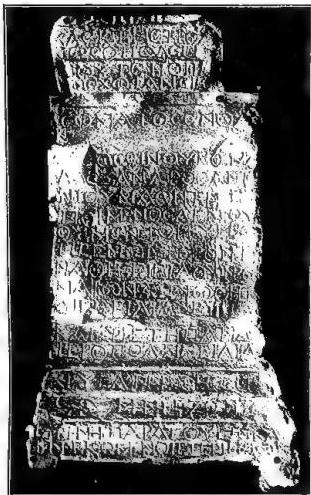
VALERIAE NICE FLAVIAE FILIAE
VALERIVS' FVNDAMVMPAT' E R[Int. Rec. Cert.]
EPIGRAFIA CRISTIANA - Sepulchral inscription of Valeria Nice Flavia (2nd cent.). Cast in the Lateran Christian Museum. The original is in the cemetery of Praetextatus - Rome.
that the Christian people had with the various sacred books, and on the credit attributed to several apocrypha.
No less fruit has been derived from epigraphy for the exact understanding of certain idioms of the New Testament and, more generally, for the proper evaluation of the language in which it is written. Without completely denying that more or less Semitizing background left by the culture proper to its authors and the nature of its sources, it is now agreed that the great majority of its lexical, morphological, and syntactic particulars are those common to the current Greek language spoken by the people at that time, in which precisely those books were written. This demonstration has been made principally on the basis of inscriptions, ostraka, and papyri.
Paleochristian inscriptions have survived for the most part on slabs of marble or other less noble stone; relatively few are those engraved on metal or clay of everyday objects, and few are those painted with a brush; quite numerous, instead, are those scratched with a hard point on plaster. The ancients had the same faults as moderns; thanks to them, certain walls upon which every passerby and every idle loiterer left his record have become precious palimpsests for us, upon which are layered sentiments and news of the highest interest. Suffice it to recall the graffito from the Palatine with the scene of the mockery of the image of Jesus, or the wall found still covered with graffiti of devotees at the tomb of St. Peter, or the much better-known ones in the catacombs of St. Sebastian.
The script capital (v.), in the current, rather irregular and asymmetrical forms—often truly very ugly—of the 4th and 5th centuries. The tormented cursive (v.) forms are almost exclusively reserved for graffiti. The often-considerable difficulty of reading these inscriptions stems from the fact that many abound in errors, lack punctuation between words or have it misplaced, present mixtures of sibylline abbreviations, strangely deformed letters, or a phonetics and grammar very far from the regular one. The person carving the inscription often does not know how to read and mechanically copies a text he does not understand; other times, the very person dictating the inscription is illiterate and expresses himself as the common people of the lowest districts speak.
The pronunciation of Latin and Greek in the 4th and 5th centuries was by then profoundly altered, and if a man from the age of Pericles or Caesar had walked through the streets of his city again, he would have struggled to recognize it as his own and to make himself understood. The poor authors of Christian epigraphs, who write as they speak, continually confuse B with V (Vitalis and Bitalis), DI + vowel with Z (diaconus and zucunus, baptizatus and baptidiatus), C, K, and Q among themselves (quiesces and ceopres, Quirius and Cyrius), X with C, S, and S (cinit, vicis, cinit, Xystus and Sustus), IE with GE and ZE (femarius and Genarus and Zenaria, Aloiosus and Alagiosus, Genesis and Ieneia, Manis and Magias), TJ with Z and S (Genitane and Geuans), Y with E (Hypatius and Epatia), V with O, and E with I especially in Gaul (christiani and crestiani, titidans and tetidans), not to speak of diphthongs, double consonants, and aspirates where too often they fail to find their way, and final consonants often omitted in writing as in pronunciation (bocata so = vocata sum). Worse still is when, due to misunderstood erudition, words are etymologized in reverse (Heliodorus for Heliodorus, believing it derived from Aelius).
Those who write in Greek add to most of these a great number of errors peculiar to their pronunciation, confusing AI with E (αἰτῶν for ἀτῶν, ξήσος for ξήσιος), OI with Y (ὄνθος for ἀνόξαι, κόμησις for κόμησις), α with O and OY (διόξω for δρόνου, Ζώσιμος for Ζώσιμος, Ὀνόριος for Ὀνόριος), H and EI with I (κίτε for καῖται, ἐστρανίς for ἐστρανίς, κόμιος for κόμησις), thinning the endings IΩΣ and ION into IΣ and IN (λοῦσις for λοῦσιος, πεδὶν for παθόν), prefixing a euphonic I before initial impure Σ, as the Latins also did (Ἰωρῆς and Ἰερᾶς for Spas); the subjunctive tends to eliminate the optative, weak forms take the place of strong ones especially in verbs, and the phenomena of heteroclisis and metaplasm multiply.
Lexical and grammatical degeneration does not usually cause much trouble in brief inscriptions of a stereotyped formula, such as prose inscriptions usually are. But it often creates great difficulties for the correct understanding of metrical inscriptions. These are ordinarily composed of pure hexameters or distichs, and only rarely are in iambic verse. Very few are metrically correct; some permit themselves so many liberties that they can be considered rhythmic verses rather, regulated that is by the tonic accent rather than by the quantity of the syllables. But it is not for this reason that those poems are difficult to understand, but rather because of the indeterminacy of the expressions and the strain of the constructs, in which the ineptitude is evident of whoever had to put those words into verse and got by as best he could, doing violence now to grammar, now to meter, now to the thought itself, disguising it in clichés that mean nothing. Even the poems Damasus (v.) are for this reason often incredibly obscure.
Often the improvised poet tries to get by by resorting to models of poems that he plunders as much as he can, even entire lines. The thoughts to be expressed, particularly in an epitaph, are generally the same. And Damasian compositions, which must have been very much liked, fell especially victim to this fate. Indeed, some think that stonecutters used actual manuals of metrical epigraphic phraseology, from which they drew each time, as from models, what served their purpose. Thus it is explained that two eulogies of Bishop Alexander of Tipasa reappear almost entire for Bishop Cresconio and Cuicui (E. Diehl, Inscriptiones Latinae Christianae veteres, Berlin 1924-31, nos. 1103, 1825 and p. 511); the dedication of S. Pietro in Vincoli in Rome reappears in part at Tebessa and then in the 6th century in a baptistery at Ravenna (Diehl, ibid., nos. 977 and 1840 to CIL, VIII, 10707-10708). This method was so esteemed that the earliest metrical epitaphs themselves appear already composed in this way. Thus the oldest dated Greek epitaph, the carmen of Alexander of Hierapolis from 216, was composed by literally plundering the metrical eulogy of St. Abercius (v.), which in turn had already made use of older poems, as revealed by the first and last verses, which are defective precisely for that reason. Truly
Phonetic and morphological defects are usually much more severe and frequent in proper names, wherein they subsequently generate much greater difficulty for correct reading and understanding. For even the onomastics of early Christian inscriptions are by this time very different from those known from classical authors. The use of the tria nomina, still frequent in the 3rd century, subsequently becomes extremely rare, and the presence of gentilicia also becomes increasingly sparse over the course of the 4th century. Great confusion is also introduced into the title-names of important figures, for whom gentilicia often become cognomens (and even act as praenomens), while conversely true cognomens assume endings functioning as gentilicia. The only constant element, even for people of good standing, is the presence of the cognomen, and those who wish to put on airs take more than one. Proper personal names in modern languages descend in a straight line from the cognomens as they were already in use in the 4th and 5th centuries.
The question of typically Christian names—that is, coined by Christians—has been raised by many, and this path has been pursued quite far. It is a difficult and thorny path to travel and full of pitfalls. All things considered, it is not even the case that, at least for the 4th and 5th centuries, the names brought into use by Christians were numerous. We are dealing with certain biblical names such as Petrus, Ioannes, Susanna; names derived from Christian concepts such as Anastasius, Paschasius, Agape, Athanasius, Adeodatus; or certain compositions especially dear to Africans (Deogratias, Quodovildeus, Habeides, Deusdedit, etc.); sometimes names already used by pagans became extremely common and almost proper to Christians due to their fame or meaning—such are Paulus, Maria, Stephanus, Redemptus, Cyriacus, Bonifatius, Dominicus, Elpis. Often counted among these are so-called names of humiliation, such as Proiectus, Stercorius, Kampusovis, Calumniosus, Contumeliosus, Importunus, Alogius; but these are rather to be attributed to a fashion specific to the time than to a sentiment of Christian virtue. Moreover, one encounters the
same names that are also found in pagan inscriptions of the same period, even those of a purely idolatrous stamp, such as Mercurius, Venerius, Isidorus, Diodorus, Apollodorus, Diogenes, Saturninus, Palladius, Aphrodisius, etc. No one paid any attention to II.
However, these names very frequently are no longer used in the forms proper to the good classical period, but are adapted to current taste with new suffixes such as -ius, -antius, -entius, -omius, -osus, -ensis, -io, -as. Thus, rather than Eutychus and Εὐαεβίς, one says Eutychius and Εὐαεβίς, Tyrannio and Dominio instead of Tyrannus and Dominus, Bousius and Leonius instead of Bousus and Leo, and likewise Asterius, Adelphius, Agapius, Venantius, Vincentius, Mortensis, Calendio, Trophimius, Ἐπαρχάς, etc. Their declension is also profoundly altered by a series of phenomena that can be reduced to two main heads: the invasion of Greek endings over Latin ones, and the prevalence of weak forms over strong ones. Juliane-es, like Agape-es, Menas-a become normal forms, and alongside Hague-es one has Hague-es or Hague-es-ets, and similarly Seman-ets or ens, Spes-ens, Eutychus-ets, Hedys-ets, and the like, down to Vitalis-ets, Menas-ets, Epictesis-ets, Attilus-ets.
It does not matter that all this onomastics is also etymologically more Greek than Latin. Many estimate that they can deduce the nationality of persons from the quality of the names, but the study of inscriptions shows that, at least for the 3rd-5th centuries, this is an illusion. Latin names are very common among Orientals at that time, just as Greek names are among Westerners. No attention was paid to this, or if some factor influenced it, it was solely fashion and a certain taste for exoticism.
Instead, it is instructive to examine the decline in the use of Greek in the West through epigraphy. Up to the time of Constantine, a third to a fourth of the inscriptions are Greek. Thereafter they decrease rapidly, so that from the mid-4th century onwards, with the exception of some artificial poetic composition, only the inscriptions of Orientals—who almost always declare themselves as such—are Greek.
The age of these inscriptions is recognized by various clues, but above all by paleography, the formulary, and the date sometimes inscribed upon them, and more rarely by allusions to known persons or events. The paleographic argument, and in part also that drawn from the formulary, is easy to handle in a fairly numerous and homogeneous complex of inscriptions, but very difficult and delicate when dealing with single inscriptions. In that case, one can never be too prudent.
The date on inscriptions (i.e., the year in which they were written) is usually recorded according to the consular era, which was official for the Roman State, or according to other local or regional eras. Until Constantine, this was done very rarely; from about the middle of the 4th century until the middle of the 6th, dated inscriptions become extremely numerous. Their usefulness is evident, and therefore special collections of them have also been made. They are like milestones marking the path of epigraphic development and help establish chronological canons even for the mass of undated inscriptions. Throughout the entire West, the consular era is in normal use, that is, indicated by the consuls who were in office that year; only in western Spain and Mauritania are particular eras of those regions used. This usage, however, becomes universal in the East, where the multitude of particular eras, often not well known—especially in Asia Minor, Syria, and Palestine—tends to create considerable difficulties. And let indiction (v.) often indicated in later inscriptions, which for practical chronological value is almost negligible.
A problem no less difficult than the chronological one is often, at least for the most ancient inscriptions, whether one is dealing with pagan or Christian texts. Even granting the principle that an inscription is to be considered pagan until its Christian character is demonstrated, there nevertheless still remains a wide zone for hypotheses and conjectures of various kinds. This is all the more true because one often still finds in situ on Christian tombs—for example in the catacombs—inscriptions that bear signs of paganism rather than Christianity, such as the invocation of atrocious vengeance against violators of the tomb, dedication to the Dii Manes, mention of Hades, Tartarus, and other pagan divinities, and certain expressions of disconsolate pessimism. Conversely, manifestations of noble religious, monotheistic, or eschatological thought should not at times be illusory, as they can also be found on the lips of adherents to special philosophical currents or mystery cults, as is the case with the cippus of C. Clodius Fabatus at Rignano Flaminio (Diehl, loc. cit., no. 3443). And today the question is sometimes further complicated by the hypothesis of belonging to heretical sects or Jewish communities. Thus, an inscription as important as that of Regina (Diehl, loc. cit., no. 4933) is disputed between Christians and Jews, and the no less remarkable one of Probina (Diehl, loc. cit., no. 3330) among Jews, pagans, and Christians.
For the most ancient periods, search has been made for crypto-Christian formulas, but the path is exceedingly difficult and perilous, nor has it yielded appreciable results. Thus, although Wilhelm succeeded in demonstrating the Christian character of a formula that is neutral in itself, such as ἕστα σὺν πρὸς τὸν Θεόν (a threat against violators of the tomb), disputes have not yet ceased regarding the "angels" of the stelae of Thera, nor can anything certain be said about a group of inscriptions from Arles bearing pax tecum (CIL, XII, 84).
Often the Christian character of an inscription also results from the accompanying representations, almost always of a symbolic nature. Since these are very rare on pagan gravestones and, depending on the various regions, of a well-determined character; as a rule of a type much more secular than religious. However, even here a certain prudence is necessary, since palms and crowns also not infrequently occur to adorn pagan epitaphs, and sometimes even fish, mostly dolphins. And for Phrygia, where a rich series of representations of a particular character appears (architec-
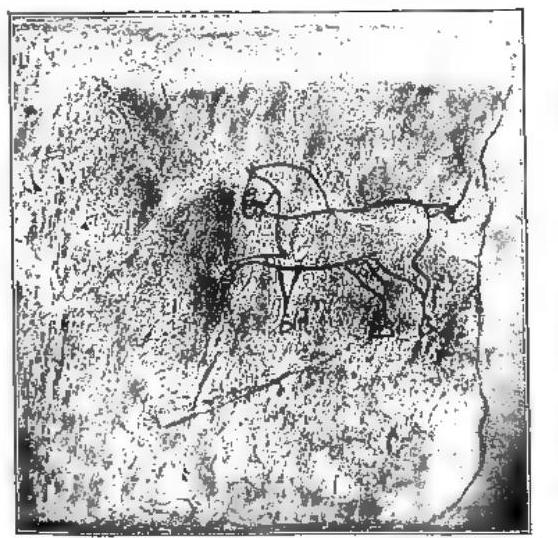
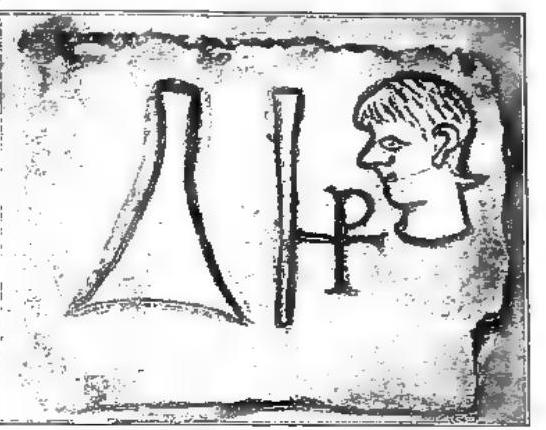
The most common figurations are the Good Shepherd and the sheep, the orant, Noah's dove, birds of various species (particularly doves and peacocks) or, alone and facing a vase, the phoenix, the dolphin or other fish, the anchor, crowns and palm branches, decussated monograms or monogrammatic crosses, alone or accompanied by the apocalyptic letters A and Ω and also by doves, grapevine branches, bushels of wheat, tools of trades (especially those of the stonemason), scenes of private civil life and sometimes even of religious initiation, as well as some biblical scenes, racing horses, a small ship that opposes… often figurative representations from the name of the deceased by way of coats of arms (the figure of a sheep on the tombstone of a Prebatus, because the sheep in Greek is called probaton; the peacock, bird of the sun called in Greek helios, on the tombstone of a certain Aelia, and so on).
The vast majority of early Christian inscriptions are funerary in character, either in prose or in poetry. They are characterized by a general concern to record the date of death and burial of the deceased, something that, as ominous, was studiously avoided by pagans. Furthermore, titles of civil status as a rule give way to those signifying the deceased's position in the Christian community. The frequency with which Christians express their religious sentiments finds very few comparisons on pagan epitaphs of the same period. More or less the same applies to the care taken for the safety of the tomb. All this stems from that faith which, as it gave new form to life, also confers a new aspect upon death, radically changing the vision of their respective values.
Among the other classes of inscriptions, the monumental ones—that is, those affixed to buildings—deserve mention, not only for their number and historical importance, but above all for their novel character. Pagan inscriptions tend to highlight the author of the building and his work; Christian ones, on the other hand, focus on the purpose of the work, that is, the interest of the community and divine worship. He, for example, to whom a temple is dedicated, previously remained in the background as if in shadow; now he comes to the foreground, at the center of the subject matter. And in general it must be observed that all early Christian epigraphy presents, in comparison with the pagan one, a more spiritual air, that is, a more intimately religious one. Faith and religious sentiment in the latter as a rule give way to a stereotyped formalism; here, instead, they assert themselves fully, free from any ritualism. This is perhaps the most profound and universal value of early Christian epigraphy, superior even to its strictly historical and documentary value. - See plates XXXIII-XXXIV.
The inscriptions of Rome were not included in vol. VI of the CIL, as they were to be published separately. De Rossi produced 2 vols. for them: I. Epitaphia certis temporis notis illustrata, Rome 1857-61; II, part 1, Series codicum in quibus veteres inscriptiones Christianae descriptae sunt a saec. XVI, ibid. 1888; later A. Silvagni added two more, no longer in thematic order, but topographical: Nova series, I: Inscriptiones incertae originis, ibid. 1922; II: Cimiteri in suis Cornelia, Aurelia, Portuensis et Ostiensis, ibid. 1932. Useful collections of a special nature were provided by Fr. Bücheler, Carmina epigraphica, 2 vols., Leipzig 1893-97, which also includes all Christian texts, with supplements by E. Eneströ[m], ibid. 1912 and E. Lommatzsch, ibid. 1926; P. Monceaux, Enquête sur l'épigraphie chrétienne d'Afrique, 60 articles in the Revue archéol, 4th series, 1-8 (1903-1906); continued in Mémoires de l'Acad. des Inser. et belles lettres, 12 (1907), 1, pp. 161-239; A. Ferrua, Epigrammata Damasiana, Rome 1942. A very comprehensive corpus of all Christian Latin inscriptions with copious and most useful indices was produced by E. Diehl, Inscriptiones Latinae Christianae veteres, 3 vols., Berlin 1924-31.
Greek inscriptions were first collected in CIG-IV, nos. 8608-9026 by A. Kirchhoff (Berlin 1859) with indices by H. Röhl (ibid. 1877). In the new ed. of the Corpus, Inscriptiones Graecae, ibid. 1870 ff., Christian inscriptions are included only in part and in various ways in the individual volumes: worthy of special mention is XIV, Inscriptiones Graecae Siciliae et Italiae, additis graecis Galliae, Hispaniae, Britanniae, Germaniae inscriptionibus, ed. G. Kaibel, Berlin 1890. Other general collections do not exist, but only partial ones such as A. Bayet, De titulis Atticae christianis antiquissimis, Paris 1898 (completed by J. S. Creaghan and A. E. Raubitschek, Early christian epitaphs from Athens, Istoria, 40, Woodstock 1947); Fr. Cumont, Les inscriptions chrétiennes de l'Asie mineure, in Mélanges d'archéologie et d'histoire, 15 (1895), pp. 245-90 (facsimiles, indices, tables); V. Strazzella, Inscriptionum Christianarum quae in Syracusanis catacombis repertae sunt corpusculum, Palermo 1897; V. V. Latyšev, Iscrizioni greche cristiane della Russia meridionale, St. Petersburg 1897 (in Russian); G. Millet, J. Pargoire, L. Petit, Recueil des inscriptions grecques chrétiennes du Mont-Athos, Paris 1904; G. Lefebvre, Recueil des inscriptions grecques chrétiennes d'Égypte, Cairo 1907; W. M. Ramsay, The cities and bishoprics of Phrygia, 2 vols., Oxford 1895-97; id., Studies in the history and art of the Eastern provinces of the Roman Empire, Aberdeen 1906; Fr. Cumont, J. G. C. Anderson, H. Grégoire, Studia Pontica, III, Recueil des inscriptions grecques et latines du Pont et de l'Arménie, Brussels 1910; H. Grégoire, Recueil des inscriptions grecques chrétiennes d'Asie mineure, Paris 1922 (only the islands and the western coast); C. Wessely, Inscriptiones Graecae Christianae veteres occidentis, Halle 1936 (first fascicle, the continuation of which was interrupted by the war); J. Getznetz and G. Soteriou, Corpus der griechisch-christlichen Inschriften von Hellas, I: Isthmos-Korinthos, ed. by R. Beese, Berlin 1941. The Jewish inscriptions (mostly Greek) of present-day Europe were collected by J. B. Frey, Corpus inscriptionum Iudaicorum, I: Europe, Rome 1936.
Regional collections worthy of mention for the large number of Christian inscriptions they contain are, for Africa: St. Gsell, Inscriptions latines de l'Algérie, I: Inscriptions de la Proconsulaire, Paris 1922; L. Châtelain, Inscriptions latines du Maroc, ibid. 1942; A. Merlin, Inscriptions latines de la Tunisie, ibid. 1944. Even more useful for Greek inscriptions, given the lack of a recent Corpus, are Ph. Le Bas, W.-H. Waddington, Voyage archéologique en Grèce et en Asie mineure pendant 1843 et 1844, part 2: Inscriptiones grecques et latines, III: Asie mineure, Syrie proprement dite, ibid. 1870 (indices by J. B. Chabot, in Revue archéologique, 28 [1896], p. 213 ff.); G. Perrot, E. Guillaume, J. Delbet, Exploration archéologique de la Galatie, de la Bithynie, de la Phrygie, de la Mysie, Paris 1862-72; B. Latyšev, Inscriptiones antiquae orae septentrionalis Ponti Euxini Graecae et Latinae, 3 vols. plus a book of supplements, St. Petersburg 1883-1901; W. K. Prentice, American archaeological expedition to Syria in 1899-1900, part 3: Greek and latin inscriptions, New York 1908; Syria (Publications of the Princeton University archaeological expedition
to Syria in 1904-1905), Division III: Greek and latin inscriptions, A. Southern Syria, ed. by D. Magie and R. Stuart, Leiden 1907-21; B. Northern Syria, ed. by W. K. Prentice and E. Lattmann, ibid. 1908-22; L. Jalabert, R. Mouterde, Inscriptions grecques et latines de la Syrie, Paris 1920 and 1929 (two fascicles); Monumenta Asiae Minoris antiqua, 6 vols., London 1928-Manchester 1930, dedicated entirely to Phrygia, except vols. II and III to Cilicia. For instructional study, the most useful are F. Grossi Gondi, Trattato di epigrafia cristiana latina e greca del mondo romano occidentale, Rome 1920, which is analytical, and C. M. Kaufmann, Handbuch der altchristlichen Epigraphik, Freiburg i. Br. 1917, which is more of a listing (though with various inaccuracies). Older and of much lesser utility are E. Le Blant, Manuel d'épigraphie chrétienne d'après les marbres de la Gaule, Paris 1896; id., L'épigraphie chrétienne en Gaule et dans l'Afrique romaine, ibid. 1869; [P.](...) Styger (Sisto Scapinelli), Notiones archaeologicae christianae disciplinis theologicis conformatae, II, part 1: Epigraphia, Rome 1909; O. Marucchi, Epigrafia cristiana, Milan 1910. Successful and well-made are the two long articles: L. Jalabert, Épigraphie, in DTC, I, coll. 1904-27, and L. Jalabert and R. Mouterde, Inscriptions grecques chrétiennes, in DACL, VII, coll. 623-94; Fernand Cabrol, Manuel d'épigraphie chrétienne, I: Inscriptions latines, Paris 1912; II, Inscriptions grecques, ibid. 1913 (commented examples); A. Silvagni, Monumenta epigraphica christiana saec. XIII antiquioria quae in Italiae finibus adhuc exstant, Rome 1943 (I, Rome; II: 1, Mediolanum; 2, Como; 3, Papia; III, 1, Luca; IV, 1, Neapolis; 2, Beneventum), large plates for palaeographic study. New texts are reported at length in the appropriate regional sections by J. J. E. Hondius, Supplementum epigraphicum Graecum, Leiden 1922 ff., and summarized in their content in the analytical bulletin of Epigraphia, Milan 1939 ff. For Christian epigraphic studies in general, consult section 8, Epigraphia, of the bibliographical bulletin in the Rivista di archeologia cristiana, Rome 1929 ff. - Antonio Ferrua