
SYNCRETISM. – A universal phenomenon, connected with the most serious religious problems, particularly in relation to Judaism and Christianity.
CONTENTS:
I. Preliminary notions
II. Syncretism in pagan religions
III. Syncretism in Islam
IV. The problem of syncretism in relation to the religion of Israel and Christianity
V. From Abraham to Moses
VI. Under Assyrian and Persian domination
VII. The Hellenistic period
VIII. Early Christianity
IX. From the first apologists to the barbarian invasions
X. The age of the barbarians
XI. The Middle Ages
XII. The Renaissance and the "Reformation." –XIII. From the 17th century to the present day
XIV. Conclusions.I. PRELIMINARY NOTIONS
1. History of the word — a) Originally, "syncretism" (s.) signified the temporary union of the Cretans with the aim of resisting a common enemy (Plutarch, Moralia, ed. Bernardakis, III, 271). b) In the early days of the "Reformation," the term was sometimes used to express the union of humanists and "Reformed": "You see with what hatred some conspire against the liberal arts," Erasmus wrote to Melanchthon, "it is right that we too should syncretize: aequum est nos quoque συγχρῆξαυ" (Melanchthon, in Corpus Reformatorum, I, 78). c) In the 17th century, the term, as if derived from κεράννυμι, indicates the union proclaimed by the Protestant theologian G. Calixt (1586-1656) and his followers, who argued that Lutherans, Calvinists, and Catholics should reach an agreement on certain fundamental articles. Hence, lengthy controversies ensued, which yielded no results. d) At present, a philosophy is often called "syncretistic" when it derives suggestions and theses from authors other than its founders: neo-Stoicism, neo-Platonism, etc. e) More commonly, the term "syncretism" (s.) denotes a religious system composed of elements drawn from different cults or different philosophies. Here, the term is used in this latter sense.2. Necessary distinctions
To clarify the issue, it is important to observe that the absorption of foreign elements, in many respects, is the very law not only of physical life, given the task of nourishment, but also of psychic life, given the tasks of education, study, and the exchange of ideas: the most heated discussions are not for this reason the least useful, at least for minds capable of reflecting without any passion other than the passion for truth. Some absorptions result only in amalgams (συγχράσεις), at least temporarily, often deleterious because the organism refuses to assimilate them; others result in syntheses (συνθήσεις); in this case, they not only repair the wear of the body or spirit but also provide the vital principle with the means to develop its latent energies and potentialities. Therefore, in judging "plagiarisms" and "derivations" among philosophies or religions, it is inadmissible to limit oneself to noting vague and superficial analogies on both sides; it is also inadmissible to stop at the observation that a religion, for example, did not initially possess this or that rite or dogma, of which an equivalent is found in another, because the latter may have simply actualized its own potentialities either autonomously (explication, not innovation), often resulting in resemblances that derive from parallel evolutions (mere fortuitous coincidences), or under the action of external stimuli (sometimes reciprocal maturation). In short, it is necessary to distinguish "borrowings" of pure terminology (indispensable for the exchange of ideas in a given era); "borrowings" pure and simple or those involving more or less profound adaptations; borrowings made out of deference to the taste of the era and concerning capital or accessory points, such as decorative arts; borrowings made out of competition, with or without modifications, to ensure one's own success, etc. (cf. H. Pinard de la Boullaye, L'étude comparée des religions, II, 3rd ed., Paris 1929, pp. 119-34).II. SYNCRETISM IN PAGAN RELIGIONS
Regarding pagan religions, scholars unanimously admit that, however far one traces them back through the centuries, they have exchanged beliefs and rites in varying degrees.This syncretism presents itself in two forms: one automatic, almost spontaneous and popular, since philosophical reflection plays no appreciable part in it; the other systematic, or reflective, for the opposite reason.
3. Spontaneous Syncretism
It is determined by circumstances; the contact between religions imposes comparisons and gives rise to contaminations: this occurs especially in centers of commercial exchange, in large markets, in ports. It often stems from "mixed marriages"; King Solomon offers us a typical example (III Reg. 11:1-18). Within the same religion, rivalry among independent sanctuaries drives them to appropriate from one another conceptions and practices that meet with the favor of their clients. Wars, and above all great invasions, provoke considerable repercussions. The vanquished are inclined to regard as superior, or at least as powers to be reckoned with, the gods of the victors, and the latter are induced by political prudence to practice tolerance and even to appropriate for the benefit of the ruling class the most splendid functions of the subjugated cults (cf. A. Barth, Les religions de l'Inde, in Oeuvr. compl., I, Paris 1914, p. 142; cf. p. 164; F. Cumont, Les relig. orient., 4th ed., ibid. 1929, pp. 189, 298). Therefore, an exact history of syncretism cannot be written without knowledge of the contacts, and often the successive crossings, that each ethnic group has undergone.An example: Islam penetrated India around 1000 A.D.; the Aryans between 1200-1000 B.C.; now, the excavations at Mohenjo-daro and Harappa have demonstrated that they found in the Indus Valley a civilization dating back at least to the third millennium, contemporary with that of the Assyro-Babylonians and no less evolved. In the vast peninsula lived, besides the Dravidians and the Munda (Austro-Asiatic), the archaic populations of the Chenchu, the Reddi, the Baiga, the Bhil, etc., among whom, mixed with a jumble of beliefs and rites that bring them close to polytheism, one still finds faith in a Supreme Being, creator and moral legislator. The Brahmins, whose religion was turning toward formalism and magic, maintained their supremacy by instituting the caste system; however, they did not prohibit participation in the cults of the lower castes, even going so far as to become their ministers. Hence the strange amalgam that is Hinduism.
4. Reflective Syncretism
The longer the list of gods grew, the more compromises between their cults multiplied, and the more the need was felt to bring some order to that chaos. To achieve this, it sufficed to group the gods into families: father, mother, children, etc. This, in large part, is the origin of the triads, ogdoads, enneads, which are attested in a great number of religions. However, once the various susceptibilities were at play, it was inevitable that many groups of devotees would organize these families according to their preferences (cf. the general indices of A. Bertholet [Chantepie de la Saussaye], Lehrbuch, II, Tübingen 1925, p. 722; Enc. of Rel. and Ethics, XIII [1926], p. 612 [index]; P. Tacchi Venturi, Storia delle rel., 3rd ed., II, Turin 1949, p. 837 [index under the entries triadi, ogdoadi, enneadi]).Another solution allowed traditional hierarchies to be respected and consisted in assimilating, from people to people, gods who had roughly equivalent dignity or attributes (theocrasia) and in explaining allegorically the myths concerning them (Egyptian, Greek, Roman interpretation; cf. P. Wissowa, Interpretatio romana, in Archiv für Religionswiss., 19 [1916-19], pp. 1-49; K. Prümmer, Religionsgeschichte, Handbuch, Freiburg im Br. 1943 [indices VI and VIII, Interpretatio, pp. 885, 901]).
Finally, it was possible to conceive the gods, at least the most notable ones, as different manifestations of a single divinity, worshipped under various aspects and names (divine polynomia); hence the name of "Pantheus" given to some of them, according to the preferences of the groups, and the creation of symbols expressing this belief (cf. Pantheion, Pantheus, Pantheus, in W. H. Roscher, Ausführlich. Lex., III [1884-86], coll. 1555-57; J. Toutain, Les cultes païens, II, Paris 1920, p. 8 ff., 241 ff.; F. Cumont, Panthea signa, in Daremberg and Saglio, Dict. des antiquités, IV, pp. 314-15). In turn, numerous thinkers of the Hellenistic age: Plutarch, Celsus, Apuleius of Madaura, Maximus of Tyre, Numenius of Apamea, Porphyry, Iamblichus,
SINCRETISMO - « Silvanus Pantheus » radiato, con il turcasso di Apollo, il caducero di Mercurio, la clava di Ercole e il serpe avvolto all'tronco, come nel culto di Sabazio - Musco Vaticano, Sala degli animali.
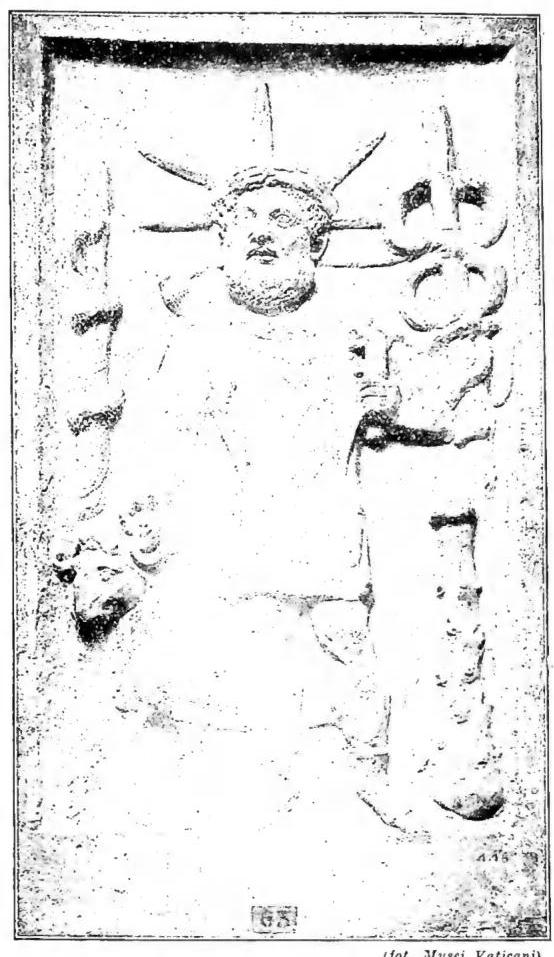
Al s. riflesso o sistematico sono da riportare certi culti fittizi, di breve durata, organizzati dai capi di Stato; specialmente i seguenti: il culto di Serapide, istituito, pare, da Tolomeo I Sotere (323-283 a. C.), cf. G. Lafave, Sérapis, in Daremberg e Saglio, Dict. des antiquités, IV, s. d., 1248-51; Roeder, in Pauly-Wissowa, 2ª serie, I (1914), 2394-2426; il culto del « Sol invictus », fondato da Aureliano (v.), cf. J. Wissowa, Religion und Kultus der Römer, 2ª ed., Monaco 1912, pp. 365-68; Groag, Demetrius Aurelianus, in Pauly-Wissowa, V (1905), coll. 1399-1400; Marbach, Sol, ibid., 2ª serie, III (1927), coll. 907-13; la sintesi tentata nell'India dal monarca musulmano Akbar (m. nel 1605), cf. I. Goldziher, Le dogme et la loi de l'Islam, vers. franc., Parigi 1920, pp. 242-243 (v. AKBAR).
Derivano pure manifestamente dal s.: lo gnosticismo (v. GNOSI) nelle sue molteplici forme, le une anteriori, le altre posteriori al cristianesimo: l'ermetismo (v.), MANIERISMO (v.) e i suoi succedanei, una moltitudine di sette antiche o moderne e le fantasie decorate con il teosofia (v.).
III. Il s. NELL'ISLAM. - Per il suo monoteismo, questa grande religione deve essere classificata a parte. Il suo carattere sincretista appare fin dalla sua origine.
I Beduini dell'Arabia conservano ancora la fede in un Essere supremo. Aliah Ta'ālā, il dio che è sempre stato; (cf. A. Palmieri, Coran, in DThC, III [1908], col. 1732; C. Snouck-Hurgronje, in A. Bertholet, Lehrbuch, I [1925], p. 652). Il grande merito di Maometto è di aver proscritto, di fronte al suo, ogni culto idolatrico. E che a questo l'abbia condotto la conoscenza delle altre due « religioni del libro », secondo la sua espressione, è provato ad evidenza dall'analisi del Corano.
« Maometto conosceva così bene il giudaismo e il cristianesimo quanto era possibile alla Mecca del suo tempo e si mostra così dipendente da queste due religioni, che infatti difficilmente s'incontra nel Corano un'idea religiosa che non sia derivata da esse » (Fr. Schwally, Gesch. des Qordns, 2ª ed., parte 2ª, Lipsia 1919, p. 121); cf. A. Palmieri, art. cit., in DThC, III, coll. 1786-91 (con bibl., col. 1833); D. I. Margoliouth, Muhamedans, in Enc. of Rel. and Eth., IX (1917), pp. 480-83; H. Lammens, Une adaptation arabe du monothéisme sémitique, in Rech. de sc. relig., 7 (1917), pp. 161-86; W. Rudolf, Die Abhängigkeit des Qordns von Jud. und Christent., Stoccarda 1922 (bibl. pp. vi-viii); T. Andrae, Der Ursprung des I. und des Christent., Uppsala 1926.
Dopo la scomparsa del profeta, le difficoltà provocate dalla interpretazione del Corano, le tradizioni divergenti invocate specialmente dai due grandi partiti dei sunniti e degli Shiti, le rivalità politiche, le religioni e le filosofie così differenti con cui, nel corso della sua espansione, entrò in contatto (cioè: il neoplatonismo, più tardi: l'aristotelismo [V. AVERROISMO], lo yoghismo dell'India, il monachesimo cristiano [V. SŪRISMO]), le superstizioni inveterate dell'induismo e quelle dell'Africa nera, non potevano mancare di provocare i più strani compromessi. Alcuni più recenti sono dovuti alla crisi generale del « modernismo ».
IV. THE PROBLEM OF SYNCRETISM IN RELATION TO THE RELIGION OF ISRAEL AND CHRISTIANITY
5. Progressive expansion of debates
From the earliest centuries of the Christian era, some pagans, such as Celsus and Emperor Julian, claimed that Christianity had largely drawn from earlier religions. In the 16th century, the accusation was renewed by the "Reformation."Indeed, to justify the abandonment of "papist" beliefs and practices, it sufficed to present them as so many pagan infiltrations, altering the "pure Gospel." Hence a multitude of publications, most of them without any value, all the more so since ancient religions were, at that time, poorly understood. Since
the weapon was easy to wield, it was constantly used to authorize ever more serious abandonments, even reaching the dogmas of the divinity of Jesus Christ and the Trinity. "All works that refer to the history of religions," wrote the rationalist E. Havet, "necessarily arrive at this point" (Le christianisme et ses origines, I, 3rd ed., Paris 1880, p. XXXII). In fact, just as every materialist monism must pronounce itself in favor of the eternity of the world and spontaneous generation, so every rationalism, excluding a priori miracles and supernatural revelations in the biblical sense of the word, must strive to explain through syncretism both what it rejects and what it approves in religions to which it recognizes some superiority, or even, under certain aspects, a definitive or absolute value.
2. Some principles of solution. — a) It is evidently necessary to distinguish between official religion and popular religion or practices. Suppose even the purest religion, Newman judiciously observed, but as long as men are men, it is unthinkable that the less elevated will not lower it in part to their level (Letter to Pusey, in Difficulties felt by Anglicans in catholic teaching, II, 2nd ed., London 1910, p. 81); but what right do they have to be considered its representatives when it condemns and seeks to correct them? (cf. St. Augustine, De moribus Ecclesiae, ch. 34, nn. 75-76; PL 32, 1342; Contra Faustum, bk. 20, ch. 23; ibid. 42, 388).
b) Whether apparent or real, derivations are far from having the same value: one must indeed speak the language of the people to whom one addresses oneself (as we shall see, identical terms can also express notably different realities); one must indeed adopt those forms of art that they appreciate, the gestures that according to them express adoration, even some of their rites, if they are expressive and in themselves irreproachable; it is the dogmas that determine their meaning.
c) From their first appearance on the scene, Christian apologists have also observed that the Most High, while modifying them somewhat and giving them a new meaning, could have sanctioned certain practices analogous to those of the pagans, even inherited from them, because the "chosen people" were not capable of tolerating more perfect ones. This thesis, called that of "condescension" (συγκατάβασις), has the merit of resting on a very just idea of infinite prudence and goodness and on some very clear facts (institution of kingship [I Sam. 8 and 10, 18-28]; provisional tolerance of polygamy and divorce, later suppressed [Mt. 19, 3-9] "nisi ob fornicationem," outside the case of invalid marriage [J. Bonsirven, Le divorce dans l'A. T., Paris 1948], etc.). However, the applications of divine condescension should not be multiplied without sound judgment.
V. FROM ABRAHAM TO MOSES
1. The Patriarchs. — The ancestors of Abraham certainly practiced, like all "primitives," the sacrifices of firstfruits, animal sacrifices, and likely offerings of flour and oil, as did their neighbors. God's intervention in favor of Isaac was meant to make them understand that He reproved the sacrifice of newborns (Gen. 22, 1-18). Circumcision did not exist among the Semites, and Abraham may have derived it from the Egyptians during his first stay in their country (Gen. 12); but it became the sign of their covenant with the one true God (Gen. 17, 9-14 [V. CIRCONCISIONE]). Neither for the former nor the latter is there reason to speak of totemism v.). Called by Joseph, the Hebrews, according to their traditions, remained in the lands of the Delta for 430 years. Nomads as they were, they found there a civilization of sedentary people. Yet the refined arts of the latter and their polytheism, not to mention their magic, could not fail to seduce them. Nor is the episode of the golden calf (Ex. 32) proof of this.2. From the Exodus to the Exile. — The covenant of Yahweh with Israel was renewed on Sinai, and Moses proclaimed its conditions. His code of laws, in many points, coincides with that of the Assyrian monarch Hammurabi, certainly earlier and witness to a civilization in some respects more advanced; it prohibits, for example, taking personal vengeance for the killing of a relative (Num. 35, 16-21). Such indications authorize the thought that the points of agreement are better explained by common traditions than by derivations (v. ARCA DELL'ALLEANZA; HAMMURABI (HAMMURAPI); NEOMENIA; SABRATO; TEMPIO). The Hebrew code regains all its superiority in the realm of religion and morality: rigorous monotheism, prohibition of images because they fostered idolatry, strict observance of the Decalogue. At the express request of His people, Yahweh instituted prophecy (Deut. 15, 22; V. A. Clamer, in h. l., in L. Pirot, La ste Bible, II [1946], pp. 633-35). Again out of condescension, to shield them from the temptation of turning to soothsayers and pythonesses (I Sam. 28, 5-20; II Reg. 1, 1-14, etc.), He authorized them to consult Him directly through the ephod (I Sam. 23, 6-13; 30, 6-8) and the úrim and tummim (Num. 27, 21, etc.; V. A. Clamer, loc. cit., p. 422).
Despite these provisions, the judges and prophets of Israel had to struggle ceaselessly against the invasion of foreign gods, the sometimes abominable practices of their cults, and the multiple forms of superstition. In popular religion, syncretism is thus evident.
VI. SOTTO IL DOMINIO DEGLI ASSIRI E DEI PERSIANI
1. Durante una cinquantina d'anni, gli Israeliti gemono sotto il dominio dei re di Babilonia; molti di essi vennero deportati; i loro profeti, specialmente Ezechiele, presso gli esiliati, e Geremia nella Giudea, rappresentano loro queste disgrazie come il giusto castigo delle loro infedeltà. I colpevoli si riprendono e si irrigidiscono contro la seduzione dei loro vincitori. Eruditi come, tra molti altri, Ed. Stucken, H. Winckler, H. Zimmern, A. Jeremias, hanno sostenuto il contrario. Quali «babilonisti» estendevano persino l'influsso del grande Impero al mondo intero; ma confutazioni autorevoli da parte di non cattolici e di cattolici hanno ormai fatto giustizia delle loro tesi.2. Padrone di Babilonia (538 a. C.), Ciro, re dei Persiani, autorizza gli esiliati a tornare in patria. Fra i due popoli le relazioni si conservano cordiali. A loro volta, alcuni specialisti di studi iranici fanno appello al s., fino a pretendere, come Ed. Meyer, che «il giudaismo è una creazione dell'Impero persiano», Esagerazione da dilettante, «dilettantische übertreibung», rispose a buon diritto R. Smend, in Theol. Literaturzeit., 37 (1912), col. 486.
In realtà, la redazione definitiva dei libri sacri, i due Avesta (v.), l'antico e il recente, ebbe luogo sotto Sapore I (241-71 d. C.). Soltanto le Gatha dell'antico possono risalire a Zoroastro; ma riguardo alla sua riforma monoteista l'Avesta recente segna una manifesta deviazione.
Ora, più si fa risalire questa riforma verso il sec. VI e sec. VII a. C., tanto meno resta verosimile che Israele abbia trovato in essa qualsiasi cosa che già non gli fosse stata garantita con tutt'altra autorità dai suoi profeti. Lo stesso si dica delle idee religiose e morali, riunite (non si sa secondo quale criterio) e consacrate dall'Avesta recente: antagonismo dei due principi del bene e del male, Ahura-Mazda e Ahriman (dualismo sfruttato più tardi dal manicheismo [v.], vittoria finale del bene, sopravvivenza e ricompensa dei giusti, angolologia. Tutt'al più l'analogia di alcune dottrine ha potuto favorire, da ambedue le parti, una certa maturazione di idee. Soltanto, pare, la concordanza tra gli Amesha Spenta, personificazioni molto indecise degli attributi divini, e i sette Arcangeli della Bibbia, rende molto verosimile una dipendenza; la quale, come si vede, si riduce a poca cosa. Insomma, conclude uno dei giudici più competenti, W. F. Albright: «Le concezioni dell'Iran non cominciano ad agire sul giudaismo prima degli ultimi due secoli precristiani. E anche così, non esercitarono il loro influsso se non nel caso che il terreno fosse pienamente preparato» (From the stone age to christianity, 2ª ed., Baltimora 1946, pp. 276-80).
V. M
J. Lagrange, op. cit., pp. 405-409; K. Prümmer, Religionsgesch. Handbuch, Friburgo in Br. 1943, pp. 606-10.VII. THE HELLENISTIC PERIOD
The conquests of Alexander the Great upended the ancient world. After the fall of Jerusalem (334 B.C.), Judea was soon subjugated. The prestige of Greek civilization, the persecutions carried out to establish its polytheism and customs, the intrigues of the High Priests, and their assiduous flattery toward civil power would certainly have led to the ruin of the ancient faith, had it not been for the Maccabean revolts, the tenacity of their troops, and the fierce intransigence of the Pharisees. Neopythagorean and Essenes (v.); but overall, the latter proved more opposed to Hellenism than the "separated" themselves, that is, the Pharisees.For the sake of brevity, we include among the more recent sapiential books, such as Wisdom (written in Greek), the older ones as well. That among their maxims of common sense (rather pedestrian in Ecclesiastes), their rules of conduct, and their moral speculations, numerous analogies with those of pagan authors are noted, is hardly surprising, given that they belong to the same literary genre. The similarities may be the result of mere coincidence rather than plagiarism. Where the resemblance seems almost certain—namely, between the Wisdom of Amen-em-ope and the Book of Proverbs attributed to Solomon—it concerns more the mode of presentation, the form, than the substance: one might say there was a filtration (cf. A. Mallon, in Biblica 8 [1927], pp. 3-30).
To exalt the author of the world (creator ex nihilo, god of pantheism, subordinate demiurge, or principle of good in a dualistic system), it was necessary to renounce anthropomorphic images (Gen. 2:7) and instead emphasize His wisdom and the power of His will or His word ("Dixit... et facta sunt"; Gen. 1). Hence, from one religion to another, there arise—on these various subjects—spirit (intelligence, source of inspiration, etc.), wisdom, and word (both imperative and efficacious in themselves, etc.), πνεῦμα, σοφία, λόγος, inevitable and thus multiple analogies; but nuances also emerge, ranging from the simple abstract concept to a personification that is sometimes purely literary or poetic, sometimes more distinct, with or without divinization. Now, the thought of the
authors of the Old Testament retains its distinctive characteristics, derived from the unique nature of Yahweh Himself. If one examines the progressive teachings of the Bible regarding the Spirit, the Wisdom, and the Word of God, one is justified in concluding: the parallel speculations of the pagan world may have, and likely did, stimulate their own reflections; but as for beliefs or dogmas, they had nothing to borrow from them, and much to oppose. Indeed, they firmly eliminated polytheism, its incoherent mythology, and corruption. Consequently, one of Philo (v.), Josephus Flavius (v.), felt compelled to justify the intransigence of his compatriots (Against Apion, II, 36 end; cf. 17-22). Their exclusivism drew upon their heads the same hatred they were accused of harboring: "apud ipsos fides obstinata," wrote Tacitus, "sed adversus alios omnes hostile odium" (Historiae, V, ch. 5). Similar expressions are found in Diodorus Siculus, I. XL, ch. 3.
VIII. PRIMITIVE CHRISTIANITY
Rationalists and liberal Protestants of the far left currently strive to prove that, from its earliest times, pagan ideas profoundly altered "the religion of Jesus." Thus, a meticulous revision of Christian origins becomes indispensable.1. The Career of the Apostle Paul. - Let us suppose that one may contest the miraculous nature of the event that occurred in Damascus around 34 A.D. (Acts 9:1-22; 22:4-16; 26:9-20; Gal. 1:13-17) and that of the revelations claimed by the convert (Acts 22:17-21; II Cor. 12:1-4, etc.). Let us concede that he certainly knew, and to a considerable extent, the ideas and customs of the Hellenistic world. What matters is whether Hellenism dragged him, even unconsciously, away from the teaching transmitted by Christ to His earliest disciples concerning His own person, His mission, and His "commandments." Now, two series of facts make it impossible to admit such a deviation: his consistent conduct until martyrdom (in 66 or 67), the conduct of the "chief apostles" (II Cor. 11:5), and that of all the most ancient Churches regarding him.
a) This zealot of the traditions of the fathers (Gal. 1:13-14; Phil. 3:4-6), this persecutor of Christians, was not at all prepared to admit a suffering Messiah, the divinity of a mortal man, evangelical morality, the general vocation of the Gentiles, etc. To modify his convictions to this extent, decisive proofs were required: without doubt, the same ones that had caused a similar change in the Twelve. Indeed, he asserts and never ceases to assert that his teaching does not differ from theirs: "Whether it were I or they, so we preach" (I Cor. 15:11). This is proven by his rejoicing with the Romans for their exemplary faith: "(which) is proclaimed throughout the whole world"; a faith that is also his own: "your faith and mine" (Rom. 1:5-12). Although he was not the one who evangelized them, he nonetheless assumes in them the same essential convictions as among his own disciples and in all the Churches founded by his brothers: "in the word of the truth of the gospel which has come to you, as also in all the world" (Col. 1:4-7; I Thess. 1:7-8). Free as he was to choose his field of apostolate, he forbade himself from preaching the Gospel where others had already done so (Rom. 15:20-21; 16:13-18). This passionate man, who boasts of having "withstood to the face" Peter himself regarding the application of a disciplinary point already agreed upon by common consent (Gal. 2:11-21), would have accepted this division of labor if he had believed it necessary to restore what his speculations or alleged visions revealed to him as truth, or if he had believed that his rivals in apostolate were altering the type of catechesis (τύπος διδαχῆς; Rom. 6:17), accepted by all. How could he have imposed on everyone, in such an energetic manner, never to do so? (Rom. 16:17; Col. 2:6-9; II Thess. 3:6; Eph. 4:13-14).
b) Despite his past as a persecutor and his successes, so apt to arouse jealousy, etc., Paul has (since he defends himself only against them) no other adversaries than the Judaeo-Christians, obstinate in maintaining Mosaic practices. Peter covers him with his authority, saying: "Consider that the long-suffering of our Lord is salvation—as also our beloved brother Paul, according to the wisdom given to him, has written to you, as also in all his epistles, speaking in them of these things, in which are some things hard to understand (διονόητα), which untaught and unstable people twist to their own destruction, as they do also the rest of the Scriptures" (II Pt. 3:15-16). The weight of such terms and this fact must be carefully considered: all of Paul’s letters, except for partial hesitations regarding the Epistle to the Hebrews, were received as Scripture by each of the Churches. His preaching, even if more sublime and less lingering over the rudiments of doctrine, "the milk of babes" (Hebr. 5:11-14), was thus in full accord with the τύπος διδαχῆς, the catechesis of the Twelve.
6. The Testimony of the Synoptics
Twenty years elapsed between the death of Christ and Paul’s first apostolate. During this time, could the primitive Church have evolved in such a way as to be prepared to accept the personal views of the convert? To prove this, the proponents of the Religionsgeschichtliche Schule (v. BOUEST, WILHELM) and those of the Formgeschichtliche Methode (v. FORMA) accumulate parallels; according to them, every enlightened individual, every believer, fashions what he needs to justify his own faith. Indeed, examples of this kind abound: but to move from the frequency of certain acts to their universality, without considering manifest contrasts, is to transform the comparative method into an arbitrary method of assimilation or leveling.First of all: the primitive Church, that of Jerusalem, is not at all an amorphous society of devotees or enlightened individuals; rather, it has its undisputed leaders, the Twelve, and a supreme head who takes initiatives (Acts 1:15-26) and claims the right to settle disputes (Acts 15:7, etc.). He and his brothers share an identical concept of the apostolate: according to the command given by Jesus (Lk. 24:48; Acts 1:8), they present themselves as "witnesses" of facts not occurred in a corner, in secret (Acts 26:26; 1:21-22; 2:32; 3:15; 4:19-20; 5:32; 10:39), not as purveyors of cleverly invented fables, doctas fabulas secuti (II Pt. 1:16; I Pt. 5:1-4; I Jn. 1:1-3, etc.). For them, as for Paul, faith, the condition of salvation, is not a sentiment or a generic conception of things, but an "obedience" to the law of thought and action imposed on them and on all by the divine Risen One, ὑπακολούθησις πίστεως (Rom. 1:5; 16:17-19, 26, etc.). These witnesses came to confirm their faith with their blood. This is a point that distinguishes them from the enthusiasts who appeal either to esoteric, timeless traditions, like the Gnostics (v. GNOSI) and Hermetists (v.), or to individual revelations, like the Montanists (v.) and numerous sects.
Other contrasts: the absence in the Synoptics of any speculation; the words and actions of Christ are reported without any gloss that might suggest the influence of Paul, without apparent dependence on his terminology—words and actions, however, most suited to justify his theology; sobriety in the realm of the miraculous: miracles are indeed reported, but how different, in the entirety of their physical and moral characteristics, from the wonders attributed to Buddha, the gods of Hinduism, Muhammad, etc.; a morality manifestly superior to that of contemporary Judaism; and finally, the character of Jesus, whose charm so few souls escape.
J.-J. Rousseau rightly concludes: "It is not thus that one invents... The Gospel presents traits of truth so grand, so striking, so inimitable, that the inventor would be more astonishing than the hero" (Émile, IV, in Oeuvres, VII, Paris 1822, pp. 246-49); V. CRISTIANESIMO, in Enc. catt., IV, coll. 895-99; GESÙ CRISTO, ibid., VI, coll. 247-61.
The Synoptics, therefore, did not give free rein to their imagination; on the other hand, their Jewish mentality appears felicitously transformed. Under what influence, if not that of the incomparable Master, in whom they ultimately recognized the beloved Son of the Father (Mt. 3:17; Mk. 1:11; Lk. 3:22; Mt. 17:5; Mk. 9:6; Lk. 9:35), His equal (Mt. 11:27), the Judge of the last day (Mt. 16:27; Mk. 8:38; Lk. 9:26; Mt. 11:21; Mk. 10:37), the Master who imposed upon them the strictest fidelity to His teaching (Mt. 28:19-20; Mk. 15:16, etc.)?
7. The testimony of John
The fourth Gospel, later in date, is distinguished from the other three by characteristics that are easy to explain. As its very conclusion declares, it is a supplementary inquiry into a fiercely contested point: the divinity of Jesus (Jn. 20:31). New facts are thus reported, and in part explained: due to the adversaries to whom they are frequently addressed, the discourses take on a different turn and tone. The prologue, moreover (1:1-18), diverges even more sharply from the manner of the Synoptics; yet, all things considered, it presents, under the personal responsibility of the Apostle, the synthesis of their doctrine concerning the sovereign dignity of the "Son of Man" and His mission. Perhaps John employs the term Logos, as Paul does those of gnosis and epignosis, because of the speculations then in vogue; but not to adapt to them, rather to correct them.This is not the place to even sketch the history of the terms γνῶσις, λόγος, πληρέωσις, πνεῦμα, of the amorite πνευματικὸς, ψυχικὸς, in St. Paul, etc.; cf. the authors cited here, § 3 and further on, § 4. It is only to be noted that the clearest dependencies in vocabulary do not at all prove the identity of concepts. The meaning of words must be determined by the context, and the context may reveal notable divergences and, in certain cases, an intention of opposition.
John refrains from repeating what his predecessors have already reported, except to bring some clarifications to their writings here and there. A sign that he considers their account true. Moreover, his instruction to the faithful coincides with theirs: he refers back to the teaching of the early years: quod fuit ab initio (I Jn. 1:1-4; 2:7; II Jn. 5); he advises them not to believe in alleged suggestions or revelations of the Holy Spirit: Nolite omni spiritui credere, sed probate spiritus si ex Deo sint. It is a spirit of falsehood, he explains, as does Paul, an antichrist, he who alters the doctrine concerning Jesus: qui soluit Christum (I Jn. 4:1-6; 2:22-25; I Cor. 12:3). "If anyone does not bring you the word of Christ, do not receive him among you, do not greet him" (II Jn. 7, 11).
Another trait is recalled that makes him even less inclined than his brothers to syncretism. More than they, he insists on this principle: "to love Christ is first of all to remain faithful to His teaching" (Jn. 14:15, 21-24, 31; 15:10, 14); "in him who keeps His word, in him truly (thus in him only) the love of God is perfect" (I Jn. 2:3-6; II Jn. 6; cf. Mt. 5:19; 7:21-23; 12:46-50; Lk. 11:27-28). Such recommendations, proportionate to the attraction exerted upon them, prevented those whom Christ had constituted His "witnesses" from permitting themselves, especially on capital points, borrowings from Hellenism, Gnosticism, etc.
4. The "fifth Gospel." — Before being committed to writing, the message of Jesus was preached: an oral gospel, suited to verify the others, at least as to the essentials of His earthly life and teaching. Now, an extraordinary fact: the other four Gospels, despite the contributions and nuances that distinguish them, were received, without contestation, by all the Churches of the earliest days. And this, while the so-called "apocryphal" Gospels (v. APOCRIFI), far more seductive for their legends, obtained only minimal authority and limited diffusion; this, moreover, without any official revision or intervention by supreme authority, as instead occurred for the Buddhist Scriptures under King Aśoka, for the Avesta of the Persians under Shapur I, for the Sibylline Books under Augustus, for the Qur'an under the caliph 'Uthmān, etc. A truly extraordinary fact, a more decisive consecration from a critical standpoint than a decree issued by Peter or any archaic council. The very first Christian communities, in fact, had each been founded by an apostle, an evangelist, or some qualified "witness," and took pride in it (I Cor. 1:12; 3:1-7). According to the laws that the Religionsgeschichtliche Schule delights in invoking, each should have had, in a short time, its own customs, speculations, and myths, and striven to maintain them. Yet, they received as the expression of true faith only the writings of Paul, of the four Evangelists, the few letters of Peter, James, John, and Jude; the Apocalypse and works of another genre. Whence could this exclusivism arise if not from the agreement of the Twelve and the first disciples among themselves, from the beginning to the end of their careers, and from the uniform instructions received from the Master: "Let there be no schismata among you" (I Cor. 1:10-13). "O Timothy, guard the deposit; avoid the impious discussions of false gnosis, τῆς ψευδωνύμου γνώσεως; some, who have adhered to it, have strayed far from the faith" (I Tim. 6:20-21; 1:3-4; 4:7; II Tim. 1:13-14; 4:2-4). "From him who fosters divisions, separate after a first and second warning" (Tit. 3:10-11). "If anyone does not bring you the doctrine of Christ, do not receive him into your house; do not greet him!" (II Jn. 7, 11). Peter denounces the sects or heresies of perdition (II Pt. 2:1) and declares that it would have been better for their promoters never to have known the truth than to abandon the holy law received by tradition (ibid. 2:21-22; cf. Jude 3, 4; 17, 23). Other equally firm directives in the Didaché (4:13; 6:1; 11:1-2); around 95, in the first letter of Clement (7:1-2; cf. 42); around 100 in that of pseudo-Barnabas (19:11); between 107-117 in those of the martyr St. Ignatius (Eph. 6:2; 9:1; Trall. 9:1); around the same date, in those of the martyr St. Polycarp (Phil. 7:2).
That the control exercised by the "fifth Gospel," the living tradition, was not without efficacy, here is the final proof: some extracanonical sources have transmitted alleged sayings of Jesus; yet, scarcely any does criticism dare to consider authentic (J. Jeremias, Unbekannte Jesusworte, Zürich 1948; V. AGRAPHON; LOGIA).
nack; vers. II. Firenze 1914; id., Cathedra Petri, Parigi 1938, prefaz., pp. 4-10; A. Deneffe, Der Traditionsbegriff, Münster 1931; J. Ranft, Der Ursprung des hath. Traditionsprinzips, Würzburg 1931, con discuss. delle analogie; bibl., pp. xi-xx; id., Die Traditionsmethode als älteste theol. Methode des Christent., ivi 1934, p. 36; D. van den Eynde, Les normes de l'enseignement chrét. dans la littér. des trois prem. siècles, Parigi 1933; H. Pinard de la Boullaye, L'Ecriture est-elle la règle unique de la foi?, in Novo, rev. théol., 63 (1936), pp. 839-67. Di qui le « lettere di comunione » che garantivano sia l'accordo delle Chiese tra di loro, sia l'ortodossia dei chierici itineranti e dei mendicanti; C. Du Cange, Glossarium med. et inf. graecitatis, Lione 1888, s. V. συστατικαί ἐπιστολαι, col. 1495; Martigny, Dict. des antig. chrét., 2ª ed., Parigi 1887, pp. 420-23 (Lettres) e pp. 755-57, (Tessères); A. Harnack, Epistolae formatae, in Realenc. für protest. Theol., 3ª ed., XI (1912), pp. 136-38. Sull'importanza di quest'uso cf. W. Ward, Le card. Wiseman, vers. fr., I, Parigi 1900, pp. 341-54; V. TERTULLIANO; VINCENZO DI LÉRINS.
8. Conclusione
Resta fuori di ogni dubbio che nessuno dei vangeli canonici può essere qualificato come « relazione storica » nel senso stretto della critica moderna. In Matteo e Marco soprattutto l'ordine cronologico non è rigorosamente rispettato. Consigli riguardanti una medesima classe di doveri sono artificialmente accostati, in vista della catechesi. Inoltre ogni Evangelista riassume i fatti a suo modo, salvo ad aggiungere questo o quel particolare, o questo o quel miracolo che deve alla sua informazione personale. Tali libertà, ben lontane dall'infirmare il valore della loro testimonianza, non fan che renderla più efficace quanto all'essenziale: esse manifestano non la loro indipendenza totale riguardo alle fonti comuni, ma la revisione a cui le fonti sono state sottoposte (cf. Ch. Langlois, Introd. aux études histor., 2ª ed., Parigi 1899, p. 173; E. Bernheim, Lehrbuch der histor. Methode, 6ª ed. Lipsia 1908, pp. 80 sgg., 195 sgg., 524 sgg.).Fin dalla pubblicazione del suo Lehrbuch der Dogmengeschichte (3 voll., Tubinga 1886-90) Harnack riconosceva che i tratti distintivi del cattolicesimo dovevano riportarsi molto più indietro che non l'ammettessero comunemente gli storici protestanti, e lo ricorda nella sua recensione all'importante opera di mons. Batifol, sopracitata: L'Eglise naissante; ciò nonostante persiste a sostenere che la religione di Gesù, quale è presentata dal cattolicesimo, è diventata « essenzialmente un'altra ». Al cattolicesimo rimprovera in particolare di aver eliminato un elemento della massima importanza: la sottomissione a Dio senza alcun intermediario: das der unmittelbaren göttlichen Gebundenheit, e la libertà personale che esso consacra: und der durch sie gesetzten individuellen Freiheit (Theol. Literaturzeit., 34 [1909], coll. 51-53). La stessa accusa ritorna di frequente sotto altre penne. Ma è facile rispondere che tante divisioni, tra le Chiese cristiane, divisioni da essi sempre più deplorate, derivano da questo appello ad una libertà individuale interamente sottratta al controllo della gerarchia istituita per prevenire le illusioni o almeno le loro conseguenze, in una intera fedeltà al tipo di catechesi fissato fin dalle origini, τύπος διδάχης (Rom. 6, 17), ἐν τῇ διδάχῃ τοῦ Χριστοῦ (II Io. 9); la tradizione (cf. E. Pinard de la Boullaye, conferenze dette nel 1935, vers. it., L'eredità di Gesù, Torino 1937, pp. 185-264; bibl., p. 253).
IX. FROM THE FIRST APOLOGISTS TO THE BARBARIAN INVASIONS
9. The Dogmas
Once the Church extended its conquests and its writers inaugurated their controversies with intellectuals, the influence of Hellenism became more noticeable: abundant quotations from pagan authors, an outright display in Clement of Alexandria, especially in his Stromata (or "Miscellanies"), in Eusebius of Caesarea in his Preparation for the Gospel, etc.; a manifest dependence of thought in Clement with respect to Musonius, in the Pedagogue; in St. Ambrose regarding Cicero’s De officiis; in Gregory of Nyssa and Augustine with respect to Neoplatonism, etc. Dionysius the Pseudo-Areopagite even goes so far as to insert entire passages from Proclus into his text. Facts of this kind, of which it would be easy to multiplyexamples, do not at all prove an alteration of the primitive faith; to be convinced of this, it suffices to consider: a) the motives that guided these writers; b) the limits of their concessions; c) the norm that directed their choice and the end they aimed at.
a) Indeed, whatever the reason may be, it cannot be reprehensible to draw profit from what is true, beautiful, and morally good. Virgil is praised for having known how to « extract pearls from the dung of Ennius ». Likewise, Seneca claimed, when necessary, the right to cite Epicurus: « Quod verum est, meum est... Sciant (omnes) quae optima sunt, esse communia » (Ad Lucil., Epist., XII, 10; XVI, 6). The same is declared by St. Justin: « Whatever good has been said, no matter by whom, belongs to us Christians ». He even goes so far as to claim that the pagans derived these sound ideas from the Holy Scriptures (the thesis of « plagiarism », derived from Judaism and unfortunately taken up by others). Better inspired and deforming the Stoic theory of the λόγοι σπερματικοί, he presents them as « seeds of the Word » (II Apol., nn. 8, 10, 13: PG 6, 380, 457, 460 ff.); similar conceptions in Clement of Alexandria (Protrept., 6, 7: ibid. 8, 173, 184); in Augustine (De doctrina christiana, II, 18, 25 ff., 40 ff.: PL 34, 49 ff., 54 ff., 63).
Another motive for citing pagan authors: charity, which commands one to become all things to all people, « omnibus omnis factus sum, ut omnes facerem salvos » (I Cor. 9, 19-23), and thus to begin by doing them justice and highlighting points of agreement (Clement of Alexandria, Strom., I, 1, 19; V, 3: PG 8, 705, 805 ff.; 9, 37; Origen, Contra Celsum, VII, 46: ibid. 11, 1588; St. John Chrysostom, In ep. ad Timot., homily 3: ibid. 62, 677 etc.).
b) On the other hand, approvals and praises are accompanied, when necessary, by express reservations and vigorous refutations. All these apologists, even those who on this or that point have laid themselves open to criticism, like Origen, declare: the rule they intend to follow is Holy Scripture, and Scripture as it was understood by the primitive Church (Tertullian, De praescriptione, chaps. 6, 14, 21: PL 2, 18, 27, 33; Clement of Alexandria, Strom., I, 19: PG 8, 808-13; Origen, De principiis, I, nn. 1-4: PG 11, 115-18; Ep. ad Gregor., ibid., 88-92). « As for the philosophers, » writes St. Augustine, « if it happens that they have said something true, in accord with our faith, especially among the (Neo-)Platonists, there is no need to be alarmed, but rather to reclaim those truths from them, as from unjust possessors, and turn them to our use » (De doctrina christiana, II, 40: PL 34, 63; cf. St. Jerome, Ep., 119, n. 11: ibid. 22, 978 ff.; Ep., 62: ibid., 606; Ep., 70: ibid., 664-68; Theodoret, Graec. affect. curatio, I: PG 83, 821-25, etc.). Moreover, the Church intervened to halt the contagion of Hellenism, τὰ ἐλληνικὰ νοσούντες (St. Basil, De Spiritu Sancto, 17, 43: PG 32, 148) V. ADOPTIANISM; ARIANISM; DOCETISM; GNOSIS; ORIGEN AND ORIGENISM; PELAGIUS AND PELAGIANISM.
c) The common aim of the apologists is to exploit points of agreement in order to lead adversaries to the « true gnosis », the « true philosophy », the only one susceptible to rigorous demonstration (μόνοι μετὰ ἀποδείξεως; Justin, I Apol., 1, 20: PG 6, 357), an eclecticism, if you will (Clement of Alexandria, Strom., I, 7: ibid. 7, 732), but an eclecticism achievable only in the light of faith (Origen, Contra Celsum, III, 81: ibid. 11, 1025; Lactantius, Divinae institutiones, VII, 7: PL 6, 759).
It would nevertheless be extraordinary if these first attempts at theology and religious philosophy had been invariably successful. Indeed, one may, for example, note in pre-Nicene writers expressions and explanations that seem to assign to the Logos, in the Trinity, a secondary place (subordinationism; cf. J. Tixeront, Hist. des dogmes, 11th ed., Paris 1930, pp. 244-57, 290-403). Yet it remains quite clear, even if one does not wish to interpret them with indulgence, that they intended to defend the traditional doctrine, especially the divinity of Christ. It remains equally true, as Justin (I Apol., n. 60: PG 6, 420) and Irenaeus (Adv. haer., I, 10, 2: ibid., 7, 553) already expressed, that simple believers professed this dogma, as did the learned, and thus prove that the latter had not received it from Hellenism (J. Lebreton, Le désaccord entre la foi et la théol. savante au XIIIe siècle, in Rev. d'hist. eccl., 19 [1923], pp. 481-506; 20 [1924], pp. 5-37; id., more briefly in Fliche-Martin-Frutz, II, chap. 14, § 2, pp. 353-65).
In this way, while pagan doxographers limited themselves to compiling catalogues of opinions (δόξαι; H. Diels, Doxographi Graeci, Berlin 1879), properly suited to accrediting eclecticism, indifferentism, and through these syncretism, the representatives of the Church created several new literary genres: apologetic treatises, ordered toward the demonstration of a religion based on a recent and verifiable revelation and thus exclusive in its claims; catalogues of heresies, sometimes denouncing with some excess the influence of profane speculation (Justin, Hegesippus, Irenaeus, Hippolytus, Eusebius, Epiphanius, Theodoret, etc.); dogmatic treatises by Athanasius, Hilary, Gregory of Nazianzus, Gregory of Nyssa, Cyril, Ambrose, a series that comes, as it were, to crown Augustine’s De Trinitate and De civitate Dei.
Moreover, the creation of a new language must be considered. The terms that its doctors derived from the Greek language translate nuances of thought that are their own, just as the Christian terms preserved by the Churches separated from Rome no longer express exactly, for many of them, what they expressed for the latter.
10. La liturgia cattolica
a) A poco a poco la Chiesa ha sviluppato ugualmente i suoi riti. Posta la costanza con cui i suoi apologisti hanno combattuto tutte le sette gnostiche, dovrebbe sembrare impossibile che, anche solo sotto questo aspetto dei riti, la Chiesa li abbia copiati. Tuttavia il Renan lo sostenne, contro l'avvertimento formale del dotto di cui ha sfruttato le ricerche, J. Matter. W. Bouset (v.) riprese la stessa tesi, senza però renderla accettabile; Hauptprobleme der Gnosis, Gottinga 1907 (severa recensione di A. Harnack, in Theol. Literaturzeitung, 33 [1908], pp. 10-13).Numerosi dotti si rivolsero ai culti orientali di Iside e di Osiride, di Cibele e di Attis, di Mitra ecc. « Anche quando non avessimo alcun indizio per rendere questa ipotesi accettabile », dichiarava Salomone Reinach, l'autore di Orpheus, « bisognerebbe ricorrervi per stabilire, al di fuori di ogni intervento trascendente, la continuità della evoluzione religiosa » (Rev. archéol., 5ª serie, 11-12 [1920], p. 150). Parole chiare! Infatti ogni indizio serio manca. Quei « misteri » commemoravano miti fuori del tempo e incontrollabili, mentre la liturgia della Chiesa commemorava avvenimenti recenti: Christus, Tiberio imperitante, per procuratorem Pontium Pilatum supplicio affectus (Tacito, Annales, XV, 44). I loro riti potevano sembrare « un ritorno allo stato selvaggio » (Fr. Cumont, Religions orient., 4ª ed., Parigi 1929, p. 191); non avevano quindi nulla che potesse attirare e sedurre i discepoli di Gesù (id., Lux perpetua, ivi 1949, p. 428); perciò
li hanno aspramente criticati. E si noti soprattutto questo: nessuno degli dèi orientali era morto per espiare il peccato, nessuno per amore dell'umanità, nessuno con tanto splendore morale, nessuno per provare in seguito con la sua risurrezione la sua uguaglianza con il Dio unico, santità infinita. Si è forse, perciò, condotti a domandarsi se questo ricorso ai misteri orientali non abbia avuto per causa, almeno presso taluni eruditi, la loro impotenza a comprendere oppure la loro ripugnanza ad ammettere il mistero del Calvario, apparentemente follia, juspila, in realtà opera di una sapienza trascendente (I Cor. 1, 18-25; 2, 12-16, ecc.), considerando la capacità di rivelare la malizia di ogni rivolta contro Dio, il rigore dei castighi che richiama, l'amore del Creatore per le sue creature (Rom. 5, 8-11; 8, 32-39), la convenienza di accettare, come giusto ricambio, le vessazioni e le persecuzioni alle quali non possono sfuggire i più fedeli suoi servi (Io. 15, 18-21; Rom. 8, 35-39; I Pt. 4, 12-19, ecc.).
b) Gli eruditi cattolici, invece, sono d'accordo in questo: la Chiesa ha fissato alcune feste cristiane allo stesso giorno di feste pagane per distornarne i suoi fedeli; così ai Ludi Apollinares, dal 5 al 13 luglio, sostituì la festa delle Collette (cf. s. Leone Magno: PL 54, 158-68), alla Cara cognatio del 22 febbr. sostituì la festa Natale Petri de cathedra; e avrebbe scelto il 25 dic. per opporre il Natale alla festa del Sol invictus. Sono questioni di fatto; in linea di diritto il reagire a questo modo è tutt'altra cosa che capitolare; si dirà forse che i nazisti e i senza Dio russi si sono avvicinati alla fede cristiana, perché han sostituito le loro feste a quelle della Chiesa?
c) Ma almeno il culto dei santi non sarebbe la continuazione del culto delle divinità subalterne? Lo hanno preteso nei primi secoli alcuni polemisti pagani, un gran numero di protestanti nel sec. XVI, e ai nostri giorni molti altri con più erudizione che critica, specialmente E. Lucius, Die Anfänge des Heiligenkults, ed. G. Anrich, Tushinga 1904. In realtà il culto dei MARTIROLOGIO (v.); il culto dei confessori sorse più tardi. La glorificazione degli uni e degli altri aveva lo scopo di attirare i fedeli ad imitare il rifiuto, opposto da essi, alla partecipazione ai riti e ai costumi del paganesimo. Ma questo non è affatto s., né cesaropapismo. Nonostante le proteste della Chiesa, si ebbero eccessi, superstizioni e molte leggende; il Newmann ne ha esposta la ragione.
3. Sullo sfruttamento dell'arte pagana, che è questione accessoria, V. ARCHITETTURA ECCLESIASTICA; CHIESA, B) La C. come edificio. III. Arte.
X. L'EPOCA DEI BARBARI
a) Le invasioni successive dei barbari minacciavano di rovinare per sempre la civiltà greco-romana, già migliorata dal cristianesimo. La Chiesa dovette impegnarsi a convertire quelle rudi nature. A questo scopo, fedele alla tattica di s. Paolo di «farsi tutto a tutti» (I Cor. 9, 19-23; cf. s. Tommaso, in h. l., Opere, ed. di Parma, XIII, 222-23), accettò le nuove forme politiche e solo proibì gli usi incompatibili con la sua fede e la sua morale. Caratteristica, fra tutte, è a questo riguardo l'accondiscendenza suggerita da Gregorio Magno all'apostolo degli Inglesi, Agostino: mutare la destinazione dei templi piuttosto che distruggerli;proscrivere i sacrifici ai falsi dèi, ma tollerare festini e divertimenti in uso in alcune feste, ut dum aliqua exterius gaudia reservantur, ad interiora gaudia consentire facilius valeant (Ep. 76; PL 77, 1215-16; Ep. 64; ibid., 1187; cf. R. Aigrain, in Fliche-Martin-Fruta, V [1938], cap. 10, § 1, pp. 286-89). La Congregazione di Propaganda, richiamando un decreto del 1659, dava recentemente analoghe consegne ai missionari (AAS, 28 [1936], pp. 406-409; cf. 31 [1939], p. 269; J. Schmidlin, Kath. Missionlehre, 2ª ed., Münster 1923, pp. 216-38, 352-59, 378-80; P. Charles, Tactique missionnaire, in Nouv. rev. théol., 67 [1940], pp. 385-96).
Una relazione presentata nel 1908 alla Conferenza di Lambeth riconosceva che la cristianizzazione aveva portato con sé, in passato, una certa proporzione di snazionalizzazione e che i missionari anglicani erano stati troppo proclivi a scoraggiare o a sopprimere usanze indigene che in sé non avevano alcuna connessione necessaria con l'idolatria e la superstizione. Perciò il Comitato delle missioni ricordava la risoluzione 19ª della Conferenza del 1897: adattarsi alle circostanze locali, incoraggiare le persone a far le cose a loro modo, in their own ways, anche se questo non fosse il migliore, even though it may not be ideally the best way (Conference of Bishops of the Anglican Communion, Londra 1908, pp. 114-115; cf. tutto il testo in H. Pinard de la Boullaye, op. cit., II, pp. 131-32 e bibl.; cf. inoltre Report of the Commiss. on Christian higher education in India, Londra 1931, p. 240; vers. fr. in Etudes, 215 [1933], p. 476). Confessioni di questo genere non sono forse, almeno in larga parte, la condanna implicita delle accuse rivolte contro il pagano-papismo? Per dimostrarne tutta l'ingiustizia, basterebbe richiamare i decreti dei concili generali e regionali contro tutte le sopravvivenze del paganesimo. Il semplice elenco è troppo lungo per potersi citare qui (v. AMULETO; DIVINAZIONE; MAGIA; SUPERSTIZIONI).
b) Riguardo alle credenze e alle speculazioni teologiche ci si limiterà a qualche cenno. Nel sec. VIII le controversie trinitarie, cristologiche e pelagiane erano sensibilmente sopite. Le scuole cristiane, ben lontane dal restare inattive, si applicarono a giustificare e approfondire i dati della fede. Per farlo con pieno successo, avrebbero avuto bisogno di una filosofia strettamente razionale e completa; ora esse non avevano quasi altro che quella di s. Agostino, penetrata di neoplatonismo. I copisti dei monasteri riuscirono a salvare dall'oblio testi preziosi, ma non le opere capitali di Platone e di Aristotele. Anzi Aristotele, assai male conosciuto, è ordinariamente giudicato con estrema severità (A.-J. Festugière, L'idéal religieux des Grecs et l'Évangile, Parigi 1932, Excursus C, pp. 221-263). Questi filosofi per l'ampiezza della loro inchiesta e le loro profonde concezioni avrebbero stimolato il pensiero; alcune loro tesi, evidentemente inammissibili, avrebbero obbligato a scrutare di nuovo molti problemi. Ma la situazione stava per cambiare.
XI. IL MEDIOEVO
Gli Arabi, in Oriente, specialmente al-Fārābī (v.) Avicenna (v.), e in Occidente Avenpace (v.) Averroè (v.) e d'altra parte i Giudei della Spagna, Avicébron (v.) Maimonide (v.), si diedero tardi alla filosofia. Il s., a cui gli uni e gli altri approdarono, provocò, soprattutto nell'Islām e nell'Occidente cristiano, una crisi delle più gravi: AVERROISMO (v.).Dai principi di Aristotele Averroè dedusse chiare le seguenti conseguenze: nessuna Provvidenza (dunque neanche Rivelazione), eternità del mondo, carattere necessario della sua evoluzione, unicità dell'intelletto agente e nella intera umanità; nessuna immortalità personale, né ricompensa, né castigo nell'oltretomba. Queste tesi furono volgarizzate negli Sigieri di Brabante (v.) Boezio di Dacia (v.). Fu necessaria, perciò, una confutazione; intraprenderla e condurla a buon termine fu l'opera di Alberto TOMMASO D'AQUINO, SANTO (v.). La filosofia di quest'ultimo è un aristotelismo corretto e approfondito, per conseguenza un s., ma in pieno accordo con la Scrittura e la Tradizione. Il suo intellettualismo, il suo metodo sillogistico, la sua secchezza, porta alcuni spiriti moderni, per i quali
la fede è sentimento, slancio del cuore, esperienza intima, a ritenerlo un'alterazione del cristianesimo primitivo. Ma altro è il tono della predicazione, altro il tono della scienza pura. I sistemi filosofici e le ragioni del medesimo ordine, su cui si appoggiano le definizioni conciliari, non fanno una cosa sola con la fede: non aggiungono nulla ai « dogmi »; ma dispongono ad accettarli e a difenderli meglio. D'altra parte, convinzioni solidamente appoggiate e non effusioni sentimentali sono le sole a preparare le energie a tutta prova.
Che infine la teologia più ragionatrice non intralci affatto lo slancio mistico, ne sono prova Tommaso d'Aquino e numerosi dottori formati alla sua scuola.
XII. RINASCIMENTO E « RIFORMA »
a) I capolavori dell'antichità greca rivelati all'Italia dal sec. XIII e più abbondantemente ancora, dopo la presa di Costantinopoli per opera dei Turchi (1453), la loro diffusione favorita dalla recente invenzione della stampa, portarono alla concezione di un ideale nuovo di eleganza e di bellezza: l'umanesimo. L'entusiasmo fu generale; lo condiviserò papi e principi della Chiesa. Ma abbastanza rapidamente, parecchi letterati passarono dall'ammirazione delle forme artistiche a quella delle idee. L'escgesi allegorizzante, rinnovata dagli stoici, permetteva loro di attribuire alla mitologia pagana speculazioni profonde, anzi sublimi. E quindi, in maniera più o meno velata, alcuni si pronunciarono in favore dell'equivalenza, in ultima analisi, delle religioni. È forse questa una cosa diversa dal tornare alle soluzioni del s. ellenistico?Erasmo, p. es., che più tardi doveva riprendersi, scriveva: « Se si vuol aspettare questa pace e questa concordia che sono l'ideale della nostra religione, bisogna, in quanto si può, parlare poco delle definizioni dogmatiche e permettere a ciascuno, su molti punti, un giudizio libero e personale ». Faceva anzi capire che la folla ignorante non può essere mantenuta nel dovere, se non la si inganna con pie menzogne. Corrado Mudt, canonico di Gotha, dichiarava che « la sapienza del Padre (1 Cor. 1, 24) non era stata devoluta esclusivamente agli Ebrei, ma aveva brillato presso i Greci, gli Italiani, i Germani, quantunque avessero usanze religiose assai differenti » (testi citati con molti altri da J. Janssen, Gesch. des deut. Volkes, 13a ed., II, Friburgo in Br. 1886, pp. 1-36; più in breve in H. Pinard de la Boullaye, Etude comparée des religions, 3a ed., I, Parigi 1929, pp. 143-55; cf. Überweg, parte 3a, 12a ed., §§ 1-22, pp. 1-215, bibl. pp. 621-53; A. Fliche-V. Martin, Hist. de l'Eglise, XV, Parigi 1951, pp. 211-74.
b) La Riforma non deriva dall'umanesimo, ma approfittò del culto di esso per i testi originali, del suo disdegno per il medioevo, per l'aridità e le sottigliezze di una teologia scolastica di fatto in decadenza, come pure degli abusi introdottisi nella Chiesa e degli scandali dati da una parte del clero. Lutero e Calvino hanno la pretesa di ritornare al « puro Vangelo ». Per giustificare l'abbandono dei dogmi cristiani - dei quali conservano ancora un buon numero (Trinità, Divinità di Gesù Cristo, ecc.) - si appellano al libero esame, alla « testimonianza dello Spirito Santo », dice Calvino, e presentano la Chiesa di Roma come la grande prevaricatrice. J. GERHARD, JOHANN (v.) ne denuncia i delitti: « agiolatria, iconolatria, artolatria, angelolatria, staurolatria, scheletrolatria, papolatria » (Loci theolog., ed. Preuss, Berlino 1867, De Ecclesia, n. 251, p. 153 sgg.). « Tra l'idolatria pagana e l'invocazione dei santi », afferma M. CHEMNITZ, MARTIN (v.), « c'è soltanto differenza di vocaboli » (Examen Conc. Trid., Berlino 1861, p. 711). Questo genere di accuse era alla portata dei talenti più modesti e serviva a discreditare perfino i
dogmi stimati da prima « essenziali » o « fondamentali ». Ogni tentativo di concordia era d'altra parte preventivamente votato ad uno scacco certo, poiché ciascun dissidente per interpretare la Scrittura poteva appellarsi con ugual diritto a lumi soprannaturali. Donde una progressiva riduzione delle credenze cristiane e il ritorno, più o meno rapido secondo le regioni, alla opinione che tutte le confessioni e tutte le religioni si equivalgono. Si sa come la Chiesa romana ha reagito nel Concilio di Trento, il card. R. Bellarmino nelle sue Controversiae, il P. Canisio nella sua De corruptelis verbi divini, ecc.
XIII. FROM THE 17TH CENTURY TO OUR DAYS
The rapid multiplication of Christian confessions and their common appeal to free examination paved the way for the rise of English deism, German Aufklärung, and French philosophisme (v. DEISMO; ILLUMINISMO; RAZIONALISMO). Since the arbitrariness and disagreement of their conclusions led to the discrediting of reason itself, agnosticism (v.) soon followed in their wake. To salvage at least some religious idea, other groups appealed either to moral Kant (v.), or to sentiment with J. Fr. Fries, G. de Wette, A. Sabatier, or to the inner experience of consolation with W. James (v.), etc. Naturally eliminated by rationalists, the inspiration of Scripture—a sacred dogma in the eyes of Luther and Calvin—was equally rejected by liberal Protestants in the name of biblical criticism and the history of religions, both increasingly favored. E. Troeltsch undertook to explain this with perfect clarity: to rediscover "authentic Christianity," that is, what one wishes to consider as such, it was necessary to strip it of all subsequent accretions; Paul exerted a manifest influence on the primitive Church; it was therefore necessary to separate him from Jesus; it still remained to prove that Christ Himself, in part, reflected contestable traditions and ideas of His time (Protestant. Christentum und Kirche in der Neuzeit, in Hinneberg, Kultur der Gegenwart, part 1, section IV, Berlin-Leipzig 1906, p. 385 ff.). This task was particularly undertaken by representatives of the Religionsgeschichtliche Schule (W. Bousset, H. Gunkel, etc.), those of the Formgeschichtliche Methode (M. Dibelius, P. Wetter, G. Bertram, etc.; V. FORMA); their aim is to liberate Christianity from its "myths" (Entmythologisierung). Highly representative in this regard are the works of R. Bultmann, Theologie des Neuen Testament, Tübingen 1948-51; Das Urchristentum im Rahmen der antiken Religionen, Zurich 1949. Once the purification is complete, nothing would remain of Jesus' religion beyond a more or less lively admiration for certain traits of His character and some terms derived from the vocabulary of His first companions—magni nominis umbra!—if not roughly what, as religious and moral ideas, the philosophers of the Hellenistic age admitted. Some Protestant critics themselves clearly see this and are alarmed: the proposed demythologization would lead to a Christianization.Whoever considers the variety of opinions in the separated Churches can judge for themselves to what kind of s. (syncretism) these suggestions would equally lead, should they find credence: "He who, even with a misunderstanding, loyally employs (the terms of the Bible) as the sacred terminology of Christianity, which he could not exclude even if it had for him a different meaning from that intended by many believers of the past and present, or even expressed something unprecedented for him, something no one has yet found, ... would deserve gratitude for his piety... There is reason to rejoice in seeing all theologians gather around the same words" (F. Kattenbusch, Von Schleiermacher zu Ritschl, 3rd revised ed., Giessen 1903, p. 27). For his part, Pastor M. Beegner affirmed: "The first condition of any fruitful ecumenism lies in the rejection of all ambiguity, in a fidelity to revealed truth such that every Christian, when meeting Christians of other confessions, believes that his Church has received its deposit" (cf. Foi et vie, 49 [1951], p. 12).
To what s. would the West not also arrive if it allowed itself to be seduced by the propaganda of neo-Hinduism! (B. Allo, Plaies d'Europe et baumes du Gange, Juvisy 1931; P. Fallon, Spiritualité néo-hindouiste, in Vie spirit., suppl. Nov. 1947, pp. 362-67).
As for the Roman Church, it is well known with what firmness it has never ceased to condemn, from the early years of the 19th century to our days, the excesses of rationalism (Denz-U, nn. 1655-56, 1701-14, 1798-1800; A. Günther, G. Hermes); religious indifferentism (ibid., nn. 1613-1614, 1617, 1646-48, 1715-18; V. SILLABO; VATICANO, CONCILIO); the intemperances of biblical criticism (ibid., nn. 1788, 1942-45; V. DIVINO AFFLANTE SPIRITU; PROVIDENTISSIMUS); the transposition of Christian dogmas (ibid., nn. 201-65, 2071-2109; V. LAMENTARILI; MODERNISMO; PASCENDI); and all theses at odds with Tradition (v. HUMANI GENERIS).
BIBL.:
In addition to the works cited in the text: J. de Guibert, Leçons de théologie dogmatique, Parigi 1929; J. Rivière, Le modernisme dans l'Eglise, Parigi 1929; H. Pinard de la Boullaye, L'étude comparée des religions, 2 voll., Parigi 1925; E. Buonaiuti, Storia del cristianesimo, 3 voll., Milano 1942-43; G. Thils, Les notes de l'Eglise dans l'apologétique catholique depuis la Réforme, Gembloux 1937; V. text.
A. Michel.
XIV. CONCLUSIONS
Given the limits set for this entry, it was not possible to discuss in detail, as most of the cited works do, the analogies of expression or thought that many scholars employ to explain, through syncretism, the evolution of religions—particularly the entirely human origin of the one they favor and the illusion of Judaism and Christianity, which claim a supernatural origin. We have simply recalled principles of criticism and historical facts too often forgotten.At its core, syncretism is a universal phenomenon; yet while the fusion of races and peoples has determined evident progress in the material order, it has most often led pagan religions toward an ever less severe morality, a more or less hierarchized polytheism, or a pantheism tolerant of the cults of subordinate gods—never, however, to a strict and exclusive monotheism. Only a good number of so-called "backward" or "primitive" populations have thus far maintained their faith in a Supreme Being, distinct by nature from all genii, spirits, or demons, creator and legislator of the moral order. Jews and Muslims also profess this fundamental dogma. Among Christian Churches, that of Rome is the only one to have held, for twenty centuries, as an absolute and unassailable rule in all matters concerning dogma and morality, in the original sense of these texts, the Old and New Testaments and the decrees of all ecumenical councils.
Undoubtedly, Catholicism owes much, in terms of historical and exegetical sciences, to many scholars of other confessions; every truly critical work ultimately redounds to its advantage. It also owes much, one might say, to most intellectual movements that have arisen outside of and often against II. "The necessity of defending ardently attacked doctrines," explained St. Augustine, "leads to studying them with greater care, forming clearer ideas, and preaching them with greater insistence: the debate thus raised becomes an occasion for progress" (De civitate Dei, XVI, 2: PL 41, 477; cf. St. Thomas, in I Cor. 11, 19 [works, Parma ed., XIII, 240 a]). Presumably for this reason, and to prevent a most dangerous stagnation, Providence has left some obscurity in its Revelation and permitted heresies, ut vel sic excutiamus pigritiam et divinas Scripturas noscere cupiamus (St. Augustine, De Gen. contra Manichaeos, I, 1, 2: PL 34, 373); the struggle for life is never without profit.
For living beings, there is no progress except on the condition of maintaining their specific type, particularly by abstaining from harmful nourishment. In accordance with the Apostle's warning: "Test everything; hold fast to what is good!" (I Thess. 5, 22), the Catholic Church has thus made a
choice. It was guided by external norms: Scripture and Tradition, and its vital principle, which is the Holy Spirit. Those Churches that claim this assistance of the Spirit for each individual (or, in an attenuated form, for each group) can then precisely deny it to the hierarchical Church "founded on Peter," which is the Church to which it was promised (Mt. 16, 18-19; Lc. 22, 32; Io. 21, 15-17).
Healthy nourishment taken daily is not, properly speaking, added to the organism but transformed by II. From the earliest times to the painful hours of great secessions and even afterward, the Church has transformed what it accepted from profane speculations. Its power of assimilation is far from exhausted; the expansion of its potentialities is not yet fully realized. Therefore, while recalling, Lérins (v.) in the 5th century (Commonitorium, n. 22: PL 50, 668), the essential principle of true progress, in suo dumtaxat genere, in eodem scilicet dogmate, eodem sensu eademque sententia (Conc. Vatic., Denz-U, n. 1800), it takes care, when it must condemn errors or repress imprudences, to encourage the further research of its children. Its docility to the suggestions of the Holy Spirit, so judiciously expounded in particular by J. A. Moehler (v. Die Einheit der Kirche, Tübingen 1825) and by J. H. Newman (An Essay on the Development of Christian Doctrine, London 1845), has enabled it to salvage, from the most disparate philosophies, what deserved to be saved. Under these same conditions, no matter how ardent and painful the foreseeable attacks and crises may be, it has the assurance of working usque ad consummationem saeculi (Mt. 28, 20; 16, 18) for the progress and salvation of humanity (v. II).
Enrico Pinard de la Boullaye
---
BIBL.:
In addition to the works cited in the preceding sections, see: F. Cumont, Les religions orientales dans le paganisme romain, Paris 1929; A. Loisy, Les mystères païens et le mystère chrétien, Paris 1919; R. Reitzenstein, Die hellenistischen Mysterienreligionen, Leipzig 1927; P. Wendland, Die hellenistisch-römische Kultur in ihren Beziehungen zu Judentum und Christentum, Tübingen 1912; E. Norden, Agnostos Theos, Leipzig 1913; W. Bousset, Kyrios Christos, Göttingen 1913; G. van der Leeuw, Phänomenologie der Religion, Tübingen 1933; M. Eliade, Traité d'histoire des religions, Paris 1949; and the works of the Religionsgeschichtliche Schule, especially those of W. Bousset, R. Reitzenstein, and H. Gunkel. For the Catholic perspective, see: J. de Ghellinck, Patristique et Moyen Âge, Paris 1946-1949; H. de Lubac, Catholicisme, Paris 1938; Y. Congar, Chrétiens désunis, Paris 1937; and the encyclicals and documents of the Magisterium cited in the text.