
GERHARD, JOHANN. — German Protestant theologian, b. in Quedlinburg on 17 October 1582, d. in Jena on 17 August 1637. Having undertaken theological studies at the University of Wittenberg in 1599 as a result of a vow, he interrupted them to study medicine, nevertheless returning to theology in Jena in 1603, with great profit. Appointed by Duke Giovanni Casimiro of Coburg superintendent at Heldburg (1606), he later became general superintendent of all the Lutheran Churches of the duchy, for which he also compiled regulations that remained in use for a long time.
In 1616 he was called to teach theology at the University of Jena, where he thereafter always remained. G. was regarded as the greatest theologian of his time, which explains the great prestige he enjoyed among the Protestant prin-
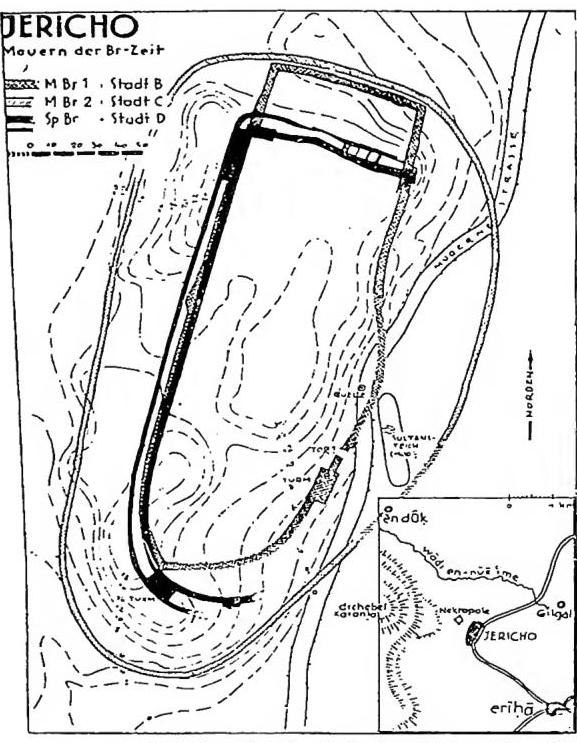
GERICO – Plan of the city of G., reconstructed through the excavations of E. Sellin-C. Watzinger (1907–1909) and J. Garstang (1929–36). The various hatchings are indicated in the German caption: the first denotes the perimeter of the city in the 1st period of the Middle Bronze Age (ca. 2000–1700 B.C. = city B); the second, the perimeter of the 2nd period of the Middle Bronze Age (ca. 1700–1550 = city C); the third, the perimeter of the Late Bronze Age (ca. 1500–1200 = city D). At the lower right is a topographical map of the region.
German, as well as the repeated invitations extended by all the German universities. Among his works, many of which still remain in manuscript in the Library of Gotha, the following should be mentioned: Methodus studii theologici (1600), Loci communes theologici (9 vols., Jena 1610–22), the most important, and Meditationes sacrae (Leiden 1637).