
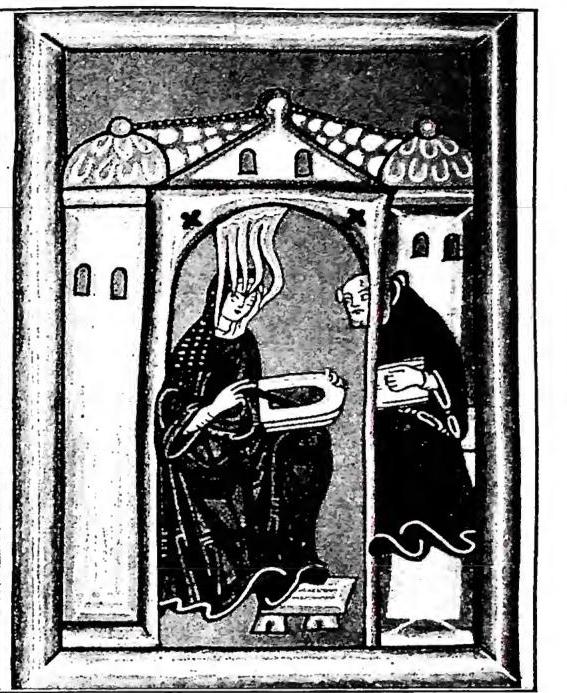
ILDEGARDA di BINGEN, saint. — Mystic, called, because of her importance, the “prophetess of Germany,” born of the noble Vermersheim family at Bermersheim (province of Rheinhessen) in 1098 (cf. M. Schrader, Heimat und Sippe der deutschen Seherin St. Hildegard, Salzburg-Leipzig 1941; cf. also: id., Die Heimat und Abstammung der hl. Hildegard, in Studies und Mitteilungen zur Gesch. des Benediktinerordens, 54 [1936], pp. 199-221; 57 [1939], pp. 117-133), died at Bingen on 17 September 1179. At the age of three she began to experience heavenly visions; at eight she was entrusted to the direction of Jutta di Spanheim, who at the abbey of Disibodenberg received noble girls in order to prepare them for monastic life; at fifteen she took the Benedictine habit. At Jutta’s death (1136), she accepted the direction of the small community, which between 1147 and 1150 she transferred to the monastery she had founded at Bingen. In 1165 she founded a branch at Eibingen near Rüdesheim.
It may be said that her entire life was an uninterrupted illness; this, however, did not prevent her from undertaking numerous journeys for the benefit of the Church, the clergy, and religious persons, nor from pursuing a prodigious literary activity, all the more so because, owing to her limited education (Jutta had taught her only the Psalms of David), she had to resort to many secretaries and correctors. Numerous miracles made her tomb famous; Gregory IX also ordered a process of canonization, which never reached completion (cf. Martyr. Romanum, p. 403); nevertheless, she was venerated as a saint from the thirteenth century onward. Her feast falls on 17 September.
Her principal works are: Liber Sciuias (= “Sciuias lucis”), composed between 1141 and 1151, in which she describes her visions and prophecies, approved in 1147 by Eugene III and by St. Bernard (PL 197, 383-738; better in J. B. Pitra, Analecta sacra spicilegio Solesmens parata, VIII [Montecassino 1882], pp. 503-17, 600-603) and in A. Damoiseau, Novae edit. opp. omnium s. Hildegardia experimentum [2 vols., Sampierdarena 1893-99]); Liber vitae meritorum, from 1159 to 1164, concerning the virtuous life (Pitra, op. cit., pp. 1-224); Liber divinarum operum, composed between 1164 and 1170, in which she derives symbols and expressions of spiritual realities from natural things (PL 197, 741-1038); other works deal with music, medicine, literature, and the natural sciences (particularly noteworthy, amid childish notions, is the view that the earth revolves around the sun, that the sun is the center of the world, that the fixed stars move, and that the blood circulates in the body); as well as poems and musical songs (Pitra, op. cit., pp. 441-67) and an important correspondence, which shows her as an adviser
on the most important questions concerning the reform of ecclesiastics and religious persons (145 letters in PL 197, 145-382 and another 145 in Pitra, op. cit., pp. 320-440; 518-82).