SLOTANUS (SLOTEN), JOHANN

Image from page 486
Image from page 486

SLOTANUS (SLOTEN), JOHANN. - Dominican theologian, born at Geffen (Brabant) at the beginning of the 16th century, died at Cologne on 9 July 1560. He studied at Cologne and was promoted master in theology in 1553. Prior at Cologne (1553-54), inquisitor general in the territories of Mainz, Cologne, and Trier, from 1554 he taught theology at the University of Cologne.

Article illustration

He wrote: *De retinenda fide orthodoxa et catholica adversus haereses et sectas et praecipue lutheranum* (Cologne 1545, ibid. 1560); *De octo beatitudinibus sermones XIV* (ibid. 1556); *De praecipuis Incarnationis divinae nostraeque Redemptionis mysteriis homiliarum libri tres* (ibid. 1557); *Apologiae Iusti Velsii Havelgani confutatio* (ibid. 1557); *Disputationes adversus haereticos liber unus* (ibid. 1558); he dealt with the primacy of the pope, the Sacrifice of the Mass, the Sacraments, the veneration of the saints, Purgatory, etc., against JUSTUS VELSIUS.

Bibl.: Quétif-Echard, II, pp. 175-76; Acta cap. gen. O. P., IV (Monumenta O. P. hist., 9), ed. B. Reichert, Rome 1901, p. 354; N. Paulus, *Die deutschen Dominikaner im Kampfe gegen Luther*, Freiburg in Br. 1903, pp. 156-62; G. Löhr, *Die zweite Blütezeit des Kölner Dominikanerklosters*, in *Archivum Fr. Praed.*, 19 (1949), pp. 233-44.

---

SILESIA. - The church of St Adalbert at Breslau (1497).

Thus in the second half of the 13th century S. entered the framework of the economic life of Germany while the ties of the dukes with Poland weakened. A new development was the investiture of the Duchies of Breslau and Lower Silesia, which fell vacant, granted by the King of the Romans to his son-in-law Wenceslaus II, King of Bohemia (1290), who in 1296 was proclaimed by the Poles as their king. From this point the Silesian dukes began to orient themselves towards Bohemia; and the kings of Bohemia of the House of Luxembourg took advantage of this. Various Piast dukes acknowledged dependence on King John, and later others on Charles IV. The latter in 1348 definitively incorporated S. into the Kingdom of Bohemia, together with Moravia and Upper Lusatia. In the 15th century, under Sigismund, the war of the Bohemian heretics had serious repercussions in S., and heresy also spread considerably. When in 1459 George of Poděbrady was proclaimed King of Bohemia, Breslau attempted to resist. In the conflict between Matthias Corvinus, King of Hungary, and Vladislav, King of Poland and Bohemia, an attempt was made in 1478 to detach S. from Bohemia in order to unite it with Hungary. S. continued its ties with Bohemia, and in 1526, after the death of Louis, son of Vladislav, Bohemia and S. passed to Ferdinand of Habsburg, brother of Charles V. Now the process of Germanization, which had been halted in the 14th century under the Luxembourg rulers, was resumed, and at the same time the spread of Lutheranism occurred. Only at the beginning of the 17th century did Charles of Habsburg, Bishop of Breslau, energetically begin the work of Catholic reaction. The Thirty Years' War was disastrous for S., which became an open battlefield between imperial and Swedish forces: the economy of the country was ruined. After the war the Habsburgs introduced new elements into S. by granting fiefs to Austrian families; in 1675 the last branch of the Piasts of Liegnitz disappeared. The peace of S. was suddenly broken by the invasion of Frederick II of Prussia in 1740. The attempts of the Vienna government to reconquer the region were in vain: in the Treaties of Berlin (1741), Dresden (1745), and Hubertsburg (1763) Prussian occupation was recognized, and the Habsburgs retained only the Duchy of Upper Silesia with Troppau (Opava). Prussian occupation led to deeper Germanization of S., especially when in the 19th century large textile and metallurgical industries were established there. The collapse of Germany in

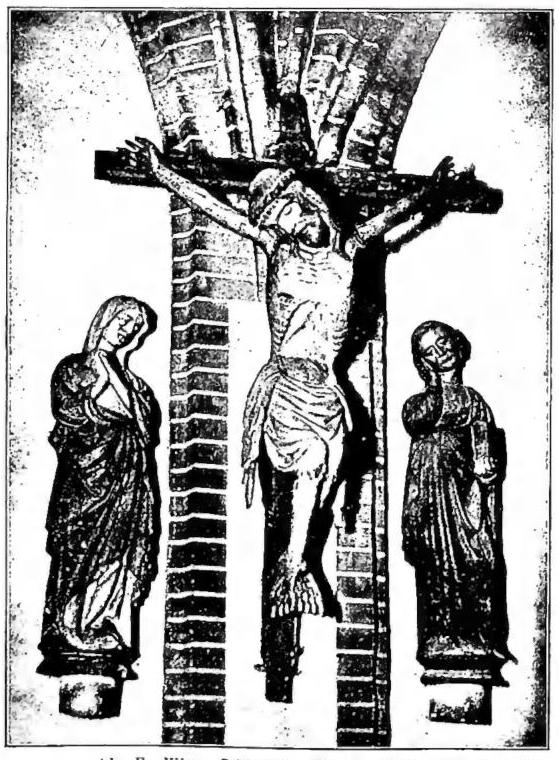
SILESIA. - The Crucifixion (c. 1380) - Breslau, church of St Barbara.

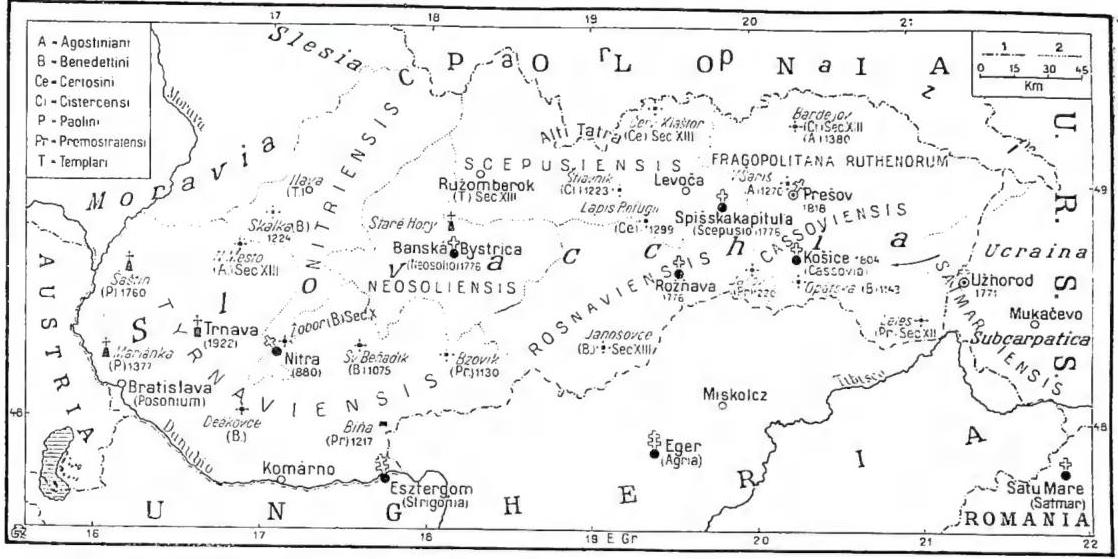
SLOVAKIA. - Historical map with the present ecclesiastical circumscriptions: 1) state boundaries; 2) ecclesiastical circumscriptions.