
NABATEI (gr. Nāḥāṭaṭṭo; lat. Nabataei). — A powerful Arab people who, during the last three centuries B.C. and the first centuries A.D., acquired considerable political and economic importance through the development of commerce between Asia and Syria. Flavius Josephus (Antiq. Iud., 1, 12, 4) and St. Jerome (Quaest. in Gen., 25, 12; PL 23, 977) trace their descent to the Ishmaelite tribe of Nabaioth (Gen. 25, 13; 28, 9; 36, 3; I Par. 1, 29). The Nabātu, associated with Qidri in Assyrian inscriptions and driven back by Ashurbanipal into the Naḡd, may have been the ancient ancestors of the N. of the Hellenistic and Roman periods. Still nomadic in the fourth century B.C., they gradually became sedentary and, advanc-
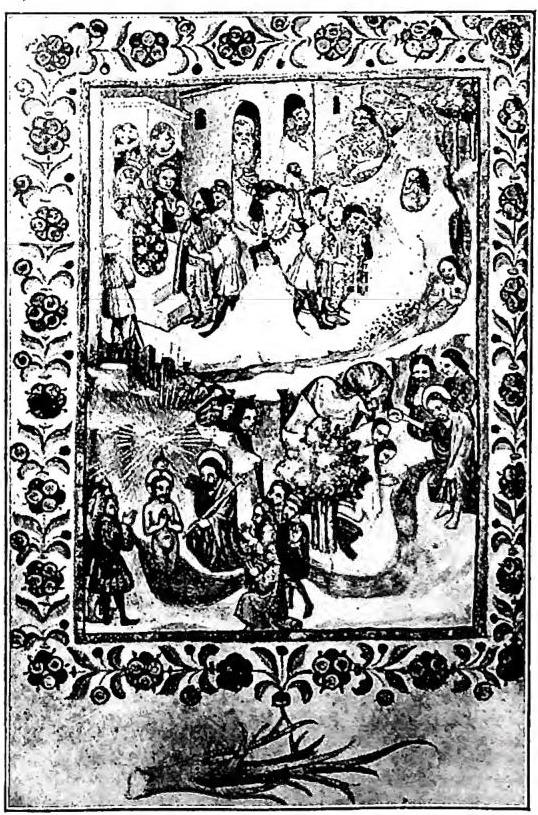
NAAMAN — N. healed of leprosy by Eliseus (above); the Baptism of Jesus (lower left); s. Giovanni Battista baptizing (lower right). Miniature from an Italian Psalter (2nd half of the 14th century) — Paris, National Library, ms. lat. 772, fol. 33′.
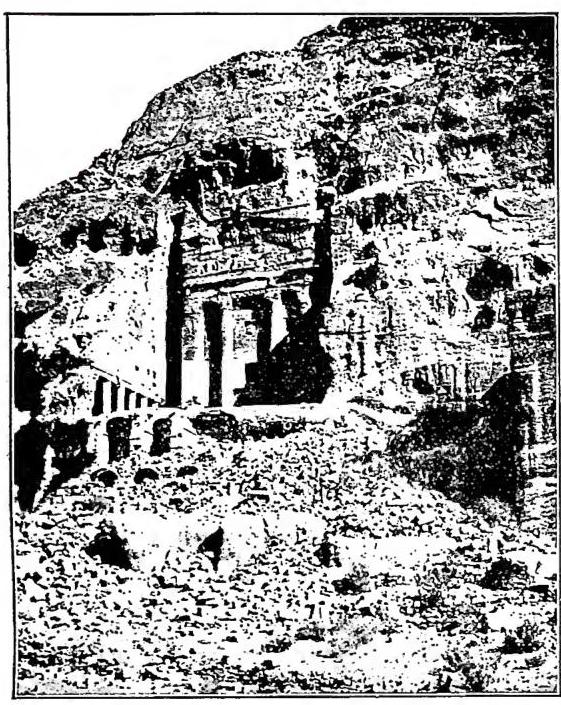
Having gained independence, in 312 B.C. they were strong enough to withstand two expeditions by Antigonus, king of Syria. The center of their commerce was the city of el-Hiğr (Madā'in Şālih), rich in rock monuments adorned with Nabataean inscriptions, where the routes from the Persian Gulf, Yemen, and the Red Sea intersected. From there, caravans supplied the depots of Petra, from which the goods were distributed, by way of Gaza, to Egypt, Greece, Italy, and the ports of Syria. The power of their Kingdom increased as that of the Seleucids and Ptolemies declined, and during the period of their greatest development they dominated from the Gulf of Elana to Damascus. In their well-organized and populous territory, they restored all the roads of Transjordan, equipping them with forts and guard posts to protect traffic and also to collect taxes on goods. They extended the boundaries of the cultivable land into the interior of the desert through effective irrigation and the construction of cisterns, dams, and aqueducts.
In addition to the reports of classical writers (Diodorus Siculus, 19, 94; Strabo, 16, 4), the civilization of the N. is known from the coins, which are important for establishing the chronology of the kings, and from the numerous inscriptions written in the Aramaic language but full of Arabisms, so that in the eyes of Roman writers they appeared to be Arabs. The Kingdom was incorporated into the new political organization of the East established by Trajan, who destroyed it in 106, reducing it to a province under the name of Arabia. Many rock monuments and temples remain in numerous localities of Transjordan: 'Abdē' (v.), Hirbet Tannūr, Petra, Kerak, Qaṣr Rabbah, 'Ajneh. The national god was Dusares, with Allāt as his paredra. Little is known of their civil and military organization.