Machine translation of the 1948–1954 Italian original. The original text is authoritative.
AKSUM. — City of northern Ethiopia, at an elevation of 2,130 m above sea level, with approximately 10,000 inhabitants. A very ancient population center (certainly of Agone stock), as numerous Paleolithic objects attest, it was occupied and named by South Arabian colonizers (aksum = “hortus viridis et densis herbis impletus”), who made it the capital of their state, whose ruler accordingly assumed the title of king of A.
It is mentioned for the first time by the Periplus Maris Erythraei in the 1st century A.D., although it is undoubtedly older. It seems to have reached its greatest splendor in the 6th century under King Ezane. It declined with the waning of the political power of the Abyssinians (from the 7th century onward) and as their expansion shifted no longer toward the Nile and Arabia but toward the south; it must have ceased to be the capital already before the 12th century. It suffered greatly in the 16th century from the invasions of Muslims (Somalis and Turks), and in 1511 from a Galla incursion. Nevertheless, it remained the principal religious center of Abyssinia, both because of its historical memories and because of its cathedral, built upon an ancient pagan temple and restored several times, among others by King Fascladus (17th century); Italian restorations altered II. In the church (called that of Zion) dedicated to Mary, the Abyssinians believe that the Mosaic Ark of the Covenant is located. The kings of Ethiopia aspired to be anointed there, with solemn ceremonial. The local chief, who possessed rich fiefs, often held considerable political and even military importance and bore the title of “nebran ed” (in the modern period nevraid) = praepositus manuum; at times the kings themselves assumed this office, which had long been reserved for ecclesiastics. The city is rich in the ruins of ancient buildings and has numerou-
(from Bernatish, the Black Continent)
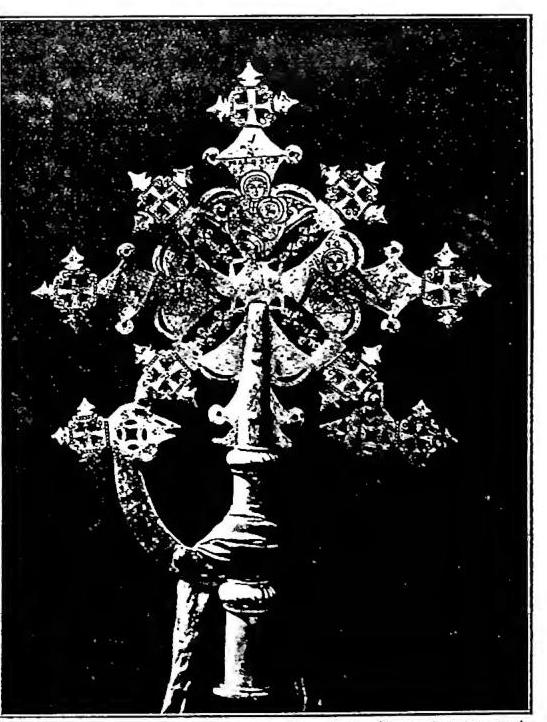
AKSUM – Silver processional cross of the church of Sion.
and numerous obelisks, worked or rough-hewn; one of them, lying on the ground in fragments, was 19 metres high, with a rectangular base whose longer side measured 4.70 m. Described by Alvarez in the sixteenth century, by Portuguese missionaries in the seventeenth century (Paes, Barradeas), and later by travellers (Bruce, Salt, Rüppels, Lefèvre, etc.), explored on the surface by Bents (another attempt by C. Conti Rossini was prevented by the xenophobia of the Shoan neurod), it was studied by a German expedition headed by B. Littmann, by U. Monneret de Villard, and by an Italian mission; much, however, remains to be done. For Christian archaeology
V. ETIOPIA
Vedi Tav. XLIII.
BIBL.: J. Bruce, Travales to disinter the name of the Vales, III. Edinburgh 1790; E. Ruppels, Reisen in Abyss., Frankfurt 1840; Th. Lefèvre, Voyage en Abyss., Paris 1845–51; G. Rohlfs, Meine Reise nach Ab., Leipzig 1883; Th. Bents, The sacred city of the Eth., London 1886; F. R. Alvarez, Verdadeira informacao das terras do Preste João, Lisbon 1889; C. Beccari, Rerum aethiopicarum scriptores, 15 vols., Rome 1903–17, passim; E. Salt, Voyage en Abyss., Paris 1912; Deutsche Alsum Exped., Berlin 1913; U. Monneret de Villard, A., Rome 1936; S. Puglisi, Primi risultati delle indagini compiute dalla Missione archeologica di A., in Africa Ital., 8 (1941), nos. 3–4. Carlo Conti Rossini
Cite this article
“AKSUM.” Enciclopedia Cattolica, vol. I (1948), p. 385. Azione Romana digital edition, https://azioneromana.com/article/aksum.