
RUUSBROEC, JAN di, blessed. - Prince of Flemish mysticism, called Admirabilis and Doctor divinus, born at Ruisbroek (Brussels) in 1293, died at Groenendael on Dec. 2, 1381. Ordained a priest at age 24, R. subsequently obtained a position as vicar.
In possession of a sublime experience, because he had made his own what had been produced most solidly and
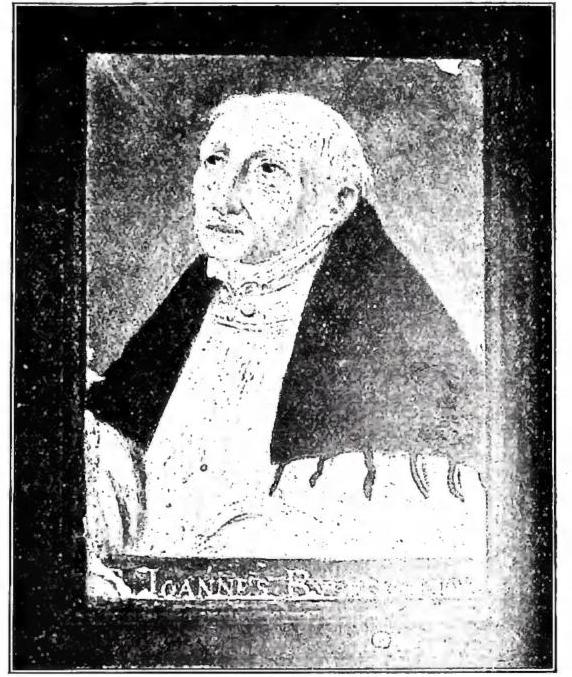
(courtesy of the Director of the R. Genootschap)
Around 1330 R. began writing in the vernacular. Of his 11 treatises, 6 were composed in Brussels: Dar Rijche der Ghelieven ("The Realm of the Lovers"); Die gheestelike Brulocht ("The Spiritual Espousals"); Vanden blinckenden Steen ("The Sparkling Stone"); Vanden vier Becaringhen ("The Four Illusions"); Vanden herstenen Ghelove ("The Christian Faith"); Vanden gheesteliken Tabernakel ("The Spiritual Tabernacle").
To dedicate himself to the contemplative life and to divine praise through the celebration of the Divine Office, which he desired to be more recollected than the one in which he had been participating, in 1343 R. isolated himself in the forest of Soignes, together with his relative J. Hinckaert and the canon Francon de Coudenberg, magister artium, occupying an old hermitage at Groenendael. In 1350 they adopted the Rule of the Canons of St. Victor of Paris; but they did not place themselves under the dependence of this motherhouse. Under Francon as provost, R. was the first prior.
There he wrote: Vanden VII Sloten ("The 7 Cloisters"); Een Spieghel der eeuwigher Salicheit ("The Mirror of Eternal Salvation"); Vanden VII Trappen ("The 7 Steps"); Dat Boecsken der Verclaringhe ("The Little Book of Clarification" or "Retraction"); Vanden XII Beghinen ("The 12 Beguines" or "The Highest Contemplation"). R. also left 7 "Letters" that reveal him to be a prudent and perceptive spiritual director; these are only partially preserved in the original language, while the remainder survives in the Latin translation of L. Surius. Among other writings attributed to R., only two can be authentic: a Gloss on the Our Father, extracted from a lost treatise on prayer, and an allocution on the Eucharist. From the very beginning, R.'s writings enjoyed wide circulation throughout all the Flemish regions. The sending of his masterpiece, The Spiritual Espousals (1350) to the "Friends of God" of the Oberland, gave rise to the translation of the work into a Germanic dialect. After a few years came the Latin translation by Jordaens, and then the Groote (v.): of these two Latin translations, the first circulated principally in Romance countries, the second in Germanic countries.
Based on a vigorous synthesis, R.'s writings are characterized by a didactic form and a concentric exposition. In substance, his mysticism is clearly Trinitarian and Christological; it is systematized with a Christian platonizing rhythm of ebb and flow, which brings to wonderful light the natural and supernatural dynamism placed in the soul in the image of the Most Holy Trinity.
R.'s influence was and remains European, as attested by the c. 250 known manuscripts of his works, the numerous editions and versions distributed in all European nations, and the extracts made of them by other writers. It is therefore not surprising to discern R.'s influence among notable mystics, such as John of St. Samson in France, John of the Angels, and St. John of the Cross in Spain. A renewed interest is noticeable in our century: the Benedictines of Nisques produced a new French version, and partial translations have appeared in English, Italian, Polish, and Russian.
Feast on Dec. 2. His cult was confirmed by Bl. Pius X on Dec. 9, 1908 (AAS, 1 [1909], pp. 164-67).