
CONVERSANO, diocese of. — A suffragan diocese of Bari, perhaps originating at ancient Norba; it was a Roman colony, then a municipium, and was subsequently occupied first by the Byzantines and later by the Goths. It covers 650 sq. km.; it has 18 parishes served by 95 diocesan priests and 15 religious priests; its population is 100,000, all Catholics (1948).
The origin of the diocese of C. is no earlier than the 7th century. The oldest documents, which in any event concern the abbey of S. Benedetto, date back to the 9th century, but it is plausible that the episcopal see was established during Lombard rule, when the town became a castrum incorporated into the Duchy of Benevento. The first two bishops in Ughelli’s series must therefore be excluded: Simplicius of 487 and Hilarius of 501; the former being the product of legends, and the latter belonging to Tempsa of the Bruttii rather than to C. Among the other prelates, the following deserve mention: Sasso, during whose episcopate the celebrated monastery of S. Benedetto, to which in 1087 Goffredo, nephew of Guiscardo, had donated the vico Castellano (or di Castellana), enjoyed numerous privileges granted by Paschal II (1110); and Casio or Cafisio, who
Thus two dioceses were created within one, producing a situation which, several centuries later, generated continual tension between the bishop of C. and the clergy of Castellana on the one hand and the abbey jurisdiction on the other. Nevertheless, it was only in 1810, by decree of the Napoleonic Murat, confirmed by the bull De ulteriori of Pius VII, that this privilege was abolished. Finally, another prelate, Romolo de Valenti (1561–79), is remembered as one of the fathers of the Council of Trent; Casimiro Gennari, later a cardinal, began in C. his periodical (1882–97), Monitore ecclesiastico (v.).
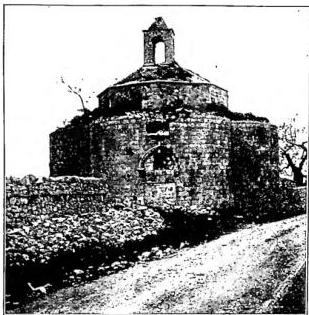
The most interesting monument is the Romanesque Cathedral (mid-13th century), renovated in the last decades of the 14th century and then almost destroyed by the fire of 1913. The perimeter walls and the façade with the Lombard portal remain; its lunette contains a Madonna between two angels. In addition to the ancient abbey of S. Benedetto, with its eponymous church and small cloister featuring Muslim motifs, mention should be made of the fragments of 14th-century frescoes in the Gothic church of S. Maria dell'Isola and the singular 13th-century little church of S. Caterina outside the walls, with a polygonal plan and four radial apses, a characteristic feature of Syrian architecture.