
TERAPEUTI (θεραπευταί). — Jewish sect of the first century A.D. Its existence and way of life are known only through a work by Philo (De vita contemplativa, 21–90; ed. L. Cohn–P. Wendland, VI, Berlin 1920, pp. 51–71).
Given the singular nature of the information, some Fathers (Eusebius, Hist. eccl., II, 16,2–17, 24; CB, II,1, pp. 140–52; Epiphanius, Haereses, 29,5; PG 41,397; Jerome, De vir. ill., 8, 11; PL 23, 6. 54. 659) supposed that Philo, through a misunderstanding, had regarded a group of Christian ascetics as Jewish. Some recent critics maintain that the De vita contemplativa is the work of an unknown Christian writer of the third century, not of the first-century Jewish philosopher, or that it presents a purely ideal profile rather than documentation of a real ascetic movement (M.-J. Lagrange, Le judaïsme avant Jésus-Christ, Paris 1931, pp. 581–86). In general, however, the authenticity of the work and its historical reliability are recognized.
(phot. Anderson)
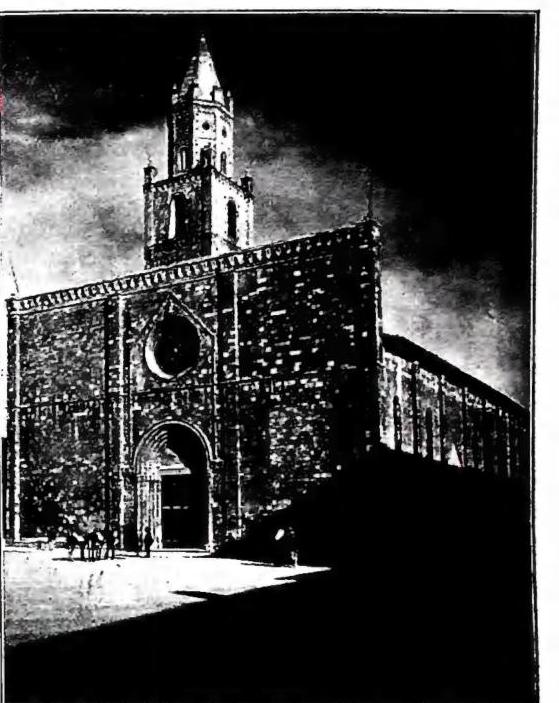
TERAMO E ATRI, DIOCESI di — Façade of the cathedral of Atri (second half of the thirteenth century and beginning of the fourteenth century).
The exclusively contemplative way of life and the admission of women (θεραπευτρίδες), who occupied separate places in the assemblies, divided by a partition, constitute the fundamental Essenes (v.). They shared with the latter renunciation of private property, celibacy, the striving for perfection, abhorrence of slavery, a life of prayer—which in the morning was conducted facing the rising sun—an esoteric doctrine, and the practice of interpreting the sacred books allegorically. Such similarities prove no dependence, still less an identity, between the two ascetic groups, which Philo himself (De vita contemplativa, 1) clearly distinguishes. Moreover, both appear to have been geographically well circumscribed: the Essenes were confined to Palestine, whereas the t. perhaps never moved beyond the region of Lake Moeris.
The paucity of sources concerning the t. is clear evidence of their limited number, in contrast with that of the Essenes, and of the precarious nature of the singular monastic institution. At least Philo, who also discusses them in other works (De migratione Abraham, 89–92), knew them. Nevertheless, they must have exercised very little influence on the numerous Jewish diaspora in Egypt; nor can one seriously regard the Christian monasticism that flourished there in subsequent centuries as an imitation of the ancient t.