SECONDO (SECONDINO) DI TRENTO

SECONDO (SECONDINO) di TRENTO. - Scrisse una «succinctam de Langobardorum gestis historiolam» che Paolo Diacono (v.) utilizzò.

Article illustration

In May 599 Pope Gregory I, addressing “Secundino, servant of God,” sent a reply to certain questions that the latter had posed to him regarding the Three Chapters controversy and other matters. In another letter to Queen Theodelinda he calls him “Secundus abbas.” Paul reports that Adaloald, son of the queen and Agilulf, “susceptus de fonte est a Secundo servo Christi de Tridento” in the church of St John the Baptist at Monza. He must therefore have played an important part in an event that broke with the Arian dynastic tradition among the Lombards, for King Authari had forbidden his subjects to receive Catholic baptism (St Gregory I, *Registri*, I, no. 17). S. died in 612.

BIBL.: St Gregory I, *Registri*, epist., XIV, nos. 12 and 147 in MGH, *Ep.*, I (1887); Paul the Deacon, *Hist. Langob.*, III, 209; IV, 27; IV, 40 in MGH, *Script. rerum Langob.*, ed. G. Waitz (1878); A. Zieger, *Storia del Trentino e dell’Alto Adige*, Trento 1926, pp. 35 ff.

---

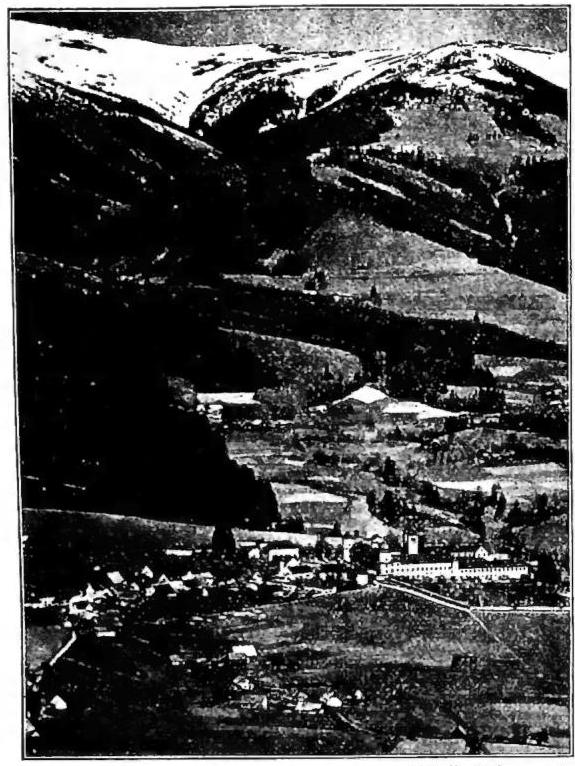
SECKAU, DIOCESE OF - View of the Benedictine abbey of Sekau with the Hochalm (alt. m. 1863).

The See of Seckau arose in the Upper and Lower Styria, so distant from the metropolitan see, and exercised a jurisdiction which, in the course of time, became practically that of a true ordinary bishop. The first official residence was the castle of Seggau in Lower Styria, a grand medieval complex; from the 13th century onwards a palace in the Styrian capital, Graz. The diocese also expanded considerably until the time of Joseph II, who, following the ecclesiastical reorganisation of the Austrian territories, suppressed, with subsequent papal approval, the suffragan bishoprics of Salzburg in their original form, replacing them with autonomous dioceses: for Styria he erected the see of S. with residence at Graz for all of southern Styria, and the see Göss (v.) for northern Styria. In 1859, however, through another reorganisation, the Slovenian-speaking part of Styria was erected into a separate diocese (Lavant, with seat at Maribor), the diocese of Leoben was suppressed, and all the German-speaking Styria united in the single diocese of S., still with residence in the capital Graz. In 1934, with the Austrian Concordat, the last prerogatives of the archbishop of Salzburg ceased, though he remains metropolitan according to common law.

Among the bishops of S. may be recalled Martin Brenner (1585–1615), dubbed the “hammer of the Protestants,” who energetically and steadfastly brought to completion the difficult work of the Catholic Reformation throughout Styria. In the last century a similar task fell to Bishop Roman Zängler (1824–48), a disciple of St Clement M. Hofbauer, who had to overcome, amid harsh struggles and immense difficulties, the deplorable religious and political situation created by Josephinism. Great influence was exercised, in the era of the Counter-Reformation, by the University of Graz, founded specifically by Charles II (1585) and recognised by Sixtus V in 1586. Charles entrusted it to the Society of Jesus, which ran it until its suppression (1773). During the 19th century, for many years, the Benedictines of Admont provided the professors for the university.

BIBL.: J. V. Zahn, *Urkundenbuch des Herzogtums Steiermark*, 3 vols., Graz 1879; E. Tomek, *Gesch. der Diözese S.*, I, 1917; id., *Kurze Gesch. der Diözese S.*, 1918; id., *Kirchengesch. Österr.*, I & II, Innsbruck 1935–49, see indices; H. Wetzler, W. Wetzler, *Graz*, in *Kirchenk.* 2nd ed., V, pp. 1657 ff.; V. Redlich, *Sekau*, in *LThK*, IX, cols. 395–98; *Schematismus der Diözese S.*, annual official publication.