
URARTU. — A region of ancient Armenia lying to the north of Assyria, with Lake Van (Wân) almost at its center.
The name U. is certainly indigenous, but in the inscriptions of the ancient kings, contemporaries of the Neo-Assyrian period, the region is called Bia and the nation bears the name Biaina; the Assyrians called the country and the nation U.; in the Old Testament the country is called Arārat (Gen. 8:4); even a few decades ago, the name Vannici, derived from Lake Van, on whose shores monuments of this people have been found, was in vogue among scholars. The Urartians were the pre-Indo-European inhabitants of the country; they spoke Urartian or Biainean, which is known through numerous inscriptions in cuneiform characters derived from Neo-Assyrian ones, some of which are bilingual, that is, also written in the Assyrian language; it is not known from where the Urartians immigrated into their country or to what race they belonged. In any case, it is certain that the civilization of the country was greatly influenced by that of Assyria. It is not always possible to follow the course of the invasions of U. by the Assyrian kings, because the overwhelming majority of the geographical names used by the Assyrian kings have uncertain meanings, such as, for example, the term Nairu, which should designate the entire region north of Assyria and also include U.
It is not known who founded the kingdom, although Sarduris I, son of Lutipris, calls himself in an inscription king of the universe, king of the kings of Nairu, and should probably be regarded as such. Yet already Salmanasar I (1272–1243 B.C.) states in one of his inscriptions that he conquered the entire country of U. in only three days. Sarduris I was defeated by a general of Salmanasar III (858–824 B.C.). Sarduris I was succeeded by Ispuinis, who calls himself great king, mighty king, king of the universe. He succeeded in extending the frontiers of his kingdom, particularly toward the East; nevertheless, the troops of Samai-Addu V (823–810 B.C.) penetrated as far as the heart of the country. His son was Menuas, probably the most capable of the kings of the country; he subdued the Mannei, fought against the Hittites of the West inhabiting northern Mesopotamia and Syria, penetrated into the land of Alsu, and invaded the region north of the Arasse. He was succeeded by his son Argistis I, a great commander who extended the frontiers of the kingdom from Lake Urmia to the Amanus in the west; since the Assyrians were seriously threatened, Salmanasar IV (781–772 B.C.) undertook several expeditions against U. Under Sarduris II the country reached its greatest power. This king wished to destroy Assyria and therefore allied himself with a broad league of Syrians and Mesopotamians in order to have Assyria attacked from the West as well. He was defeated, however, by the Assyrian king Theglathphalasar III (745–727 B.C.); in 736 he was attacked again by the Assyrians and, defeated, had to abandon most of his capital, while resisting in the citadel the onslaught of the Assyrian arms; the country was devastated. His son Rusas I succeeded in raising the country once more from the disaster it had suffered; he allied himself with Mita of Musku (Midas of Phrygia), without achieving any great success. His Minnean allies were defeated by Sargon II (721–705 B.C.), who in 714 attacked U. itself and penetrated deeply into it; he then turned toward Musasir, which was at that time ruled by Urzana, who fled before the Assyrian arms; Sargon seized immense booty, which also included the treasure of the king of U.; King Rusas committed suicide. He was succeeded by his son Argistis I (ca. 714–680 B.C.), under whose reign invasions by several nomadic tribes, the Alkuzai (Scythians), the Gimirrai, and the Phrygians, harassed the country, which had not yet recovered from the defeat inflicted on it by Sargon. At this time the country began to become Indo-Europeanized. Rusas II nevertheless claims to have subdued the Musku, the Hittites of northern Syria, and other tribes; harassed by the nomadic immigrants, he sought the support of Assurbanipal (668–626 B.C.) and therefore sent him an embassy. Sarduris III also sent his ambassadors to the king of Assyria. When the Assyrian Empire was destroyed after the fall of Nineveh, Rusas III of U. evacuated the capital, which had been conquered by the allies fighting against Assyria, and U. lost its independence.
The religion of the Urartians was polytheistic, with the national god Haldi at the head of the pantheon; he belonged to a divine triad together with Teiseba, god of
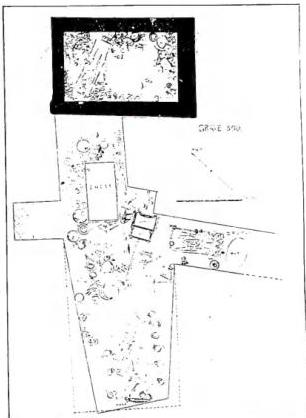
was rich in temples and other sacred buildings, which the kings, greatly and assiduously concerned to obtain divine favor, had built in the principal cities and first of all in the capital, the city of Haidi. The temples of Musasir resembled, if an image of one of them shown in a relief of the Assyrian king Sargon II is accurate, the sacred buildings of the Greeks; the sanctuaries of the capital Tuspas of the country had a different architectural character.