
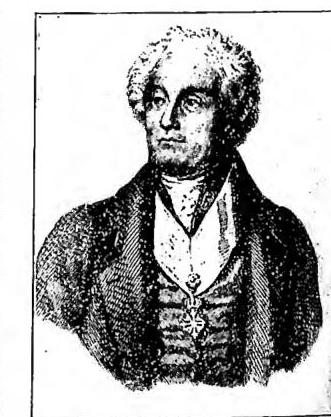
MAISTRE, JOSEPH de. - Thinker, polemicist, and writer, born at Chambéry on 1 April 1753, died at Torino on 26 February 1821. Educated in the “ancient severity” of his family, he nevertheless felt deeply the influence of contemporary thought. Certainly Enlightenment in character, too, was the curiosity that drew him toward the Masonic world, into which he was initiated as early as 1774. But beyond the enfantillage of the loges bleues, he came to establish ties with the group of “Illuminists” at Lyon, which, through Willermoz, was connected with Martinez de Pasqually. Only later, in the last of his Soirées de Saint-Pétersbourg, begun in Russia around 1809, would he declare that “aversion to every sacerdotal authority and hierarchy” was common to all “Illuminati,” without exception. Yet in 1790 he had undertaken to defend the “illuminated” Claude de Saint-Martin against every suspicion of heresy (IX, 9).
In the Mémoire au duc de Brunswick of 1782, de M. declares his ideal as an “illuminated” man: to achieve the unification of the Christian Churches through a kind of secret Masonic diplomacy; he accepts the Gnostic-Martinist idea of a primitive revelation, to which are added “the new gifts of the great Repairer.” The pessimistic theses concerning irreparable degeneration, linked to the necessity of esotericism and of “secret tradition” (an idea also tinged with mystical-intellectual aristocratism), do not exclude the dream, partly philosophical (Leibnizian echoes and the encounter with Abbé Raynal confirm this), partly mystical, of an imminent renewal of Catholic unity, victorious over the unbelief of the century, but also over intolerance and “theological pride.”
When Savoy was invaded in 1792, de M., initially uncertain, eventually chose the destiny of the émigré, faithful to his King. Between 1793 and 1797 he was at Lausanne as a Savoyard diplomatic agent: there he revealed himself as a great publicist, and finally as a “philosopher of Providence,” with the Considérations sur la France (1796), which had a European resonance.
It was at once the programme of a non-violent monarchical restoration and a deepening of his eschatological, historical-religious reflections: the revolution is not an “event,” it is an “epoch,” and it is a negative but visible sign of God’s work in the world. So long as God wills it, “it guides men” (I, 4). But here there emerges, alongside Burke’s historicist doctrine and Mallet du Pan’s thesis of the “force of things,” an initial germ of the historical pantheism of the Romantics, which culminates in the worship of divinized historical necessity. There is, moreover, more than a germ of counter-revolutionary “nationalism,” yet one born of the revolution. As early as 1795 de M. had addressed the essential themes of this and all his works in the unfinished Etude sur la souveraineté and in the Fragments sur la France: there appears the first praise of the Jesuits and the exaltation of the “mission” of nations, of the “souls of peoples.”
During the troubled years between 1797 and 1802, de M. was first at Torino, then a fugitive at Venice, and finally in Sardinia, the Savoys’ last refuge, as regent of the Grand Chancellery. But from 1803 to 1817 he served his King at St Petersburg and maintained a celebrated correspondence with his court, which would be published between 1858 and 1860 by A. Blanc, in order to show that the Catholic de M. had foreseen and explained the necessity of a national policy for the house of Savoy. Important, but almost futile, was de M.’s politico-religious action with Tsar Alessandro I, especially in favour of the Jesuits; more effective was his religious apostolate in the aristocratic world, which brought about significant conversions, including that of Mme Swetchine. In 1809 he wrote an Essai sur le principe générateur des constitutions politiques, and then passed from the problem of temporal sovereignty to that of spiritual sovereignty, outlining the Du Pape, whose composition was subsequently stimulated by the rise, in 1815, of the Holy Alliance’s vague interconfessional and anti-papal universalism (Latreille).
Having returned to Piedmont, disappointed by the French restoration and by the errors of all monarchies, and unable to exercise genuine political influence, he completed the last works he had outlined, the Du Pape and the beloved Soirées.
A modest ecclesiologist, he availed himself, for the Du Pape, of the assistance of a learned man from Lyon, G. M. de Place, and detached from it a chapter on l'Eglise gallicane; the unfinished Soirées appeared posthumously, and with them the cycle of his reflections as a “lay theologian of Providence” came to a close. As such, he prepared the Catholic revival, from the early Lamennais to Newman: the latter developed and enriched his concept of the dynamic-organic development of dogma. He conceded much to his adversaries, especially to the Saint-Simonians and to Comte.
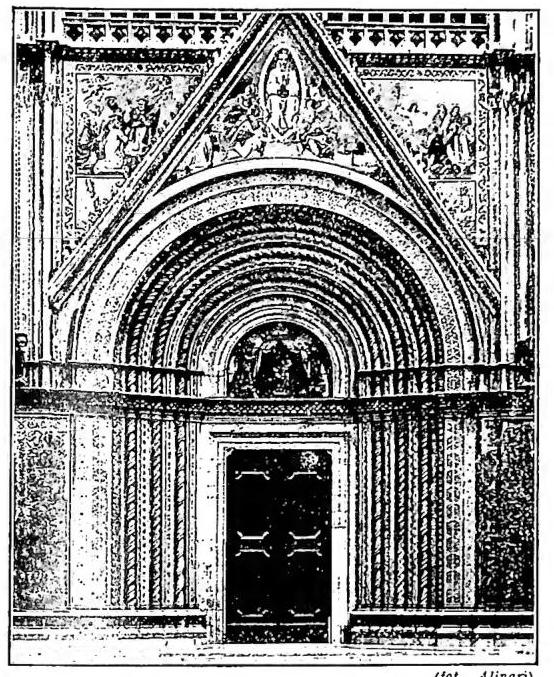
(photo Alinari). MAITANI, LORENZO - Portale del duomo di Orvieto (1315).