Machine translation of the 1948–1954 Italian original. The original text is authoritative.
MAZZOLINO, LODOVICO. — Painter, born in Ferrara around 1480, died there between 27 September 1528 and 22 December 1530. He was principally influenced by L. Costa, but in his chromatic preferences he approaches Dosso Dossi and Garofalo, while in the types and the fictitious architectures of his sacred paintings he reflects the contemporary Germans and Flemings.
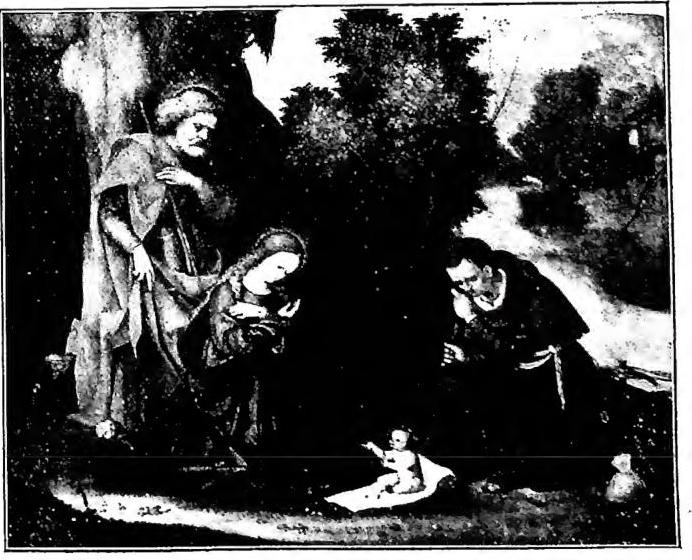
He worked without interruption in Ferrara, for the Este court, from 1504 to 1524, and then moved, for approximately two years, to Bologna, where he painted for the church of S. Francesco a Jesus among the Doctors, now divided between the Berlin Museum and the Pinacoteca of Bologna, and a Christ among the Money Changers, now in the Wiekopolskie Museum in Posen. Numerous works by him are scattered among the galleries of Rome, Florence, Turin, Berlin, Munich, Paris, Vienna, London, Dublin, Cambridge, Philadelphia, etc. The art of M. represents a delightful provincial phenomenon of storytelling, at once rustic, grotesque, and fairy-tale-like, on the margins of the poetic realism of early sixteenth-century Ferrara. Compared with those of the Parmesan miniaturist Marmitta, his readily recognizable qualities are best concentrated in the subjects he favored, and in small dimensions: the Holy Family, the Nativity, the Massacre of the Innocents, Christ in the Temple, etc. But even in a large and demanding panel such as the Nativity with SS. Alberico and Benedetto, in the Pinacoteca of Ferrara, M. stands out for the sharpness of his strongly marked types of men and adolescents, for the sweetness of the Virgin, whose profile is almost Leonardesque, for the splendor of the enamels, and for the mysterious, peaceful gentleness of the lakeside landscape in the background. Other admirable works by him are, in Rome, in the Galleria Borghese, the Orientalizing little painting of the Nativity, with its splendid vermilions and ochre yellows, and, in the Galleria Doria,
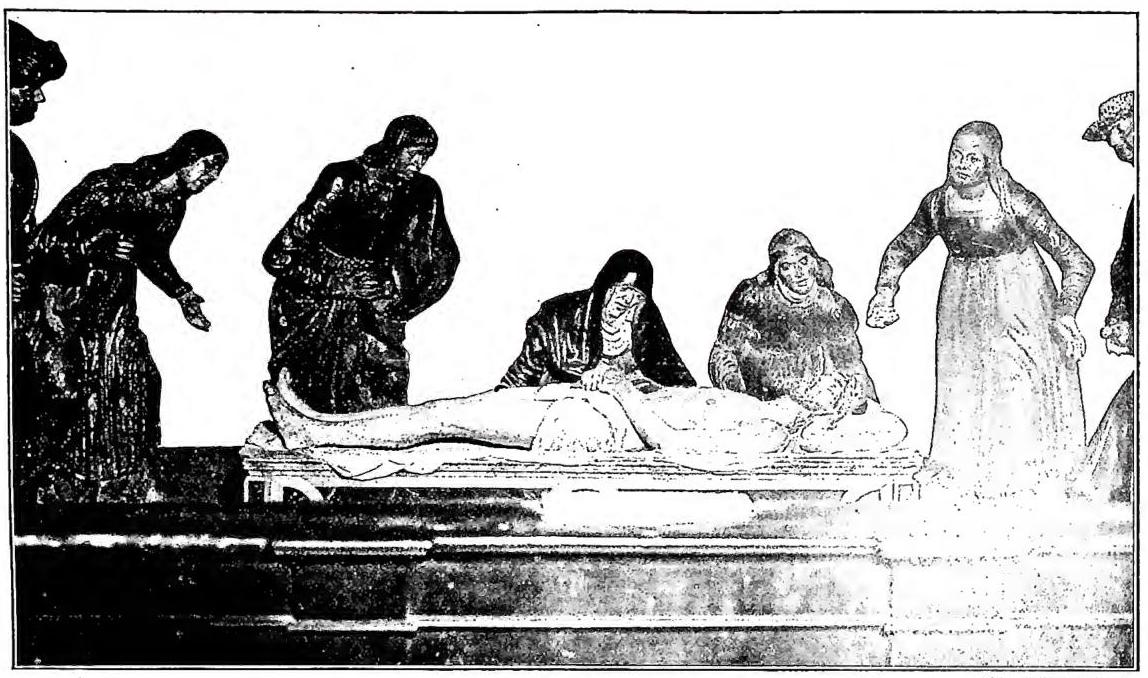
MAZZONI, GUIDO - Deposition. Polychrome terracotta - Ferrara, church of S. Maria della Rosa.the pathetic Pietà with its mountainous, wooded background and the highly tangled Massacre of the Innocents (in the upper right corner, a Rest in Egypt of rare idyllic refinement), which alternates chromatic harshness and frenzied gestures with exquisite alabaster-like ornamentation, of distinctly Po Valley aestheticism.
BIBL.: G. Gruyer, L'art ferrarese, II, Parigi 1897, p. 245 ff.; Venturi, VII, p. 738 ff.; G. Gronau, s. V. in Thieme-Becker, XXIV, pp. 313-14; R. Longhi, Officina ferrarese, Roma 1934, pp. 115-18; B. Berenson, Pitture italiane del Rinascimento, Milano 1936, pp. 306-308. Alberto Neppi
Cite this article
“MAZZOLINO, LODOVICO.” Enciclopedia Cattolica, vol. VIII (1952), p. 329. Azione Romana digital edition, https://azioneromana.com/article/mazzolino-lodovico.