
MUSICAL PALEOGRAPHY. - It is the science of ancient notations, of the systems used to translate music into the visual field. In the broadest sense, its subject is therefore the reading of ancient musical texts, their understanding and, consequently, their restitution in the auditory field. In the more precise sense, attention has been limited to the first two objects; and today there is a tendency to restrict m. p. to the study of the scripts alone, with their forms, their history, and their geographical distribution, while the musical interpretation of the writings would become a distinct science, called musical diplomatics.
M. p. is a relatively recent science. The 17th and 18th centuries regarded it merely as a curiosity. The names of Pretorius, Jumilhac, and Gerbert may nevertheless be mentioned, to which Villoteau was added at the beginning of the 19th century. A few years later this science made great progress with Lambillotte, Coussemaker, Danjou, Nisard, La Fage, Fétis, and others, who were true pioneers in the field of Gregorian chant. The domain of m. p. soon broadened: interest turned to the chants of antiquity as well as to the chants of the various peoples of the world. At the same time, the liturgical movement intensified research into the music of the different rites of East and West; but the chant of the Latin Church is currently the best known. Here we shall limit ourselves to what concerns II. Let us say meanwhile that the study of Byzantine m. p. is less advanced, whether it concerns the Palaeo-Byzantine notation (9th–11th centuries) or the later notation.
After the publication of Mélodies grégoriennes de dom J. Pothier (Tournai 1880), two major collections attested to the interest shown in m. p.: one was the work of the Plainsong and medieval musical Society, which followed the Oxford Society for the study of plainsong; the other was entitled Paléographie musicale. Les principaux manuscrits... par les Bénédictins de Solesmes, sous la direction de dom Mocquereau (Solesmes 1889 ff.; 1st series, 15 vols., 2nd series, 2 vols.). In German, the works of Riemann, Fleischer, Wagner, and Wolf should be recalled. Research and monographs have now multiplied; among many others, the names of Bannister, Ferretti, and Mocquereau deserve mention.
1. The neumes
The signs used in the notation of the chants of the Latin or Greek Church have been given the name neumes, meaning signs or breaths, according to the etymology adopted. Along with modern notes, they thus enter into the system of musical writing called “diastematic,” in opposition to the “phonetic” system. The latter uses lettersor numbers to indicate intervals or simply melodic pitch; used by the ancient Greeks, the Hindus, and the Chinese, it was exalted, following in the footsteps of J.-J. Rousseau, by Paris, then by Galin and Chevré in France and by “Tonic fa-sol” in England. It has been pointed out that, although the term phonetic notation may be acceptable, the term diastematic notation cannot be admitted in the form in which musicologists use it: it is ambiguous and inaccurate. It would be better to speak of semiography in order to designate the conventional signs representing music, and to reserve the word diastematy for a more precise use, as we shall see below.
The neumes consist of the acute and grave accents and their combinations. But other signs also occur in neumatic semiography, so that simple neumes and special neumes must be distinguished. Simple neumes are themselves divided into original and derived neumes. There are three simple original neumes, or signs. The virga is an ascending accent from left to right. The grave accent descends from left to right and has no particular name. Its length, much shorter than that of the virga, is often reduced to a point, so that it is not always easy to distinguish it from the third original neume, the punctum. This is, as its name says, a simple point, but it may be lengthened to become a horizontal stroke.
Derived neumes combine these three elements. It is sufficient to give the basic nomenclature, which is easily understood. The pes or podatus consists of the grave accent + acute accent; the clivis of the acute accent + grave accent. Pes and clivis are the neumes of two notes. In three-note neumes, the combination may be made according to two types of figure, triangular or linear. In the triangular type, one distinguishes the torculus (grave-acute-grave) and the porrectus (acute-grave-acute), according to the relative position of the sounds; in the linear type, the scandicus and the climacus, according as the melody rises or falls. Since the possible combinations are still more varied, there are resupini neumes, which end with a high sound; flexi neumes, which end with the grave; and subpunctis neumes, which are followed by several points placed one beneath another. There are many other combinations whose complexity has not received any name, except sometimes from more or less fanciful theorists; it is simpler to designate them by the generic name of chains of neumes.
Special neumes use the signs we have described, but juxtapose them (bivirga, trivirga, bipunctum) or add other signs to them.
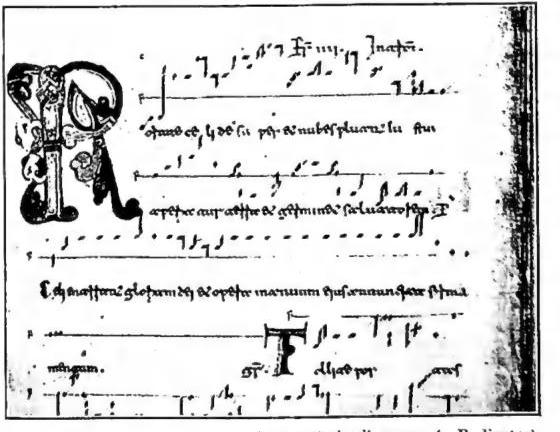
(from H. E. Wooldridge, Early English harman, London 1987, fasc. 2) MUSICAL PALEOGRAPHY - Primitive black notation: chironomic neumes - Cambridge, Corpus Christi College, ms. 473. f. 135 (ca. 1050).
the musical context or the intentions of the notator. The oriscus may stand alone, but more often enters into a combination, either at the beginning of a neume (pes quassus), at the end (franculus, pes stratus), or in the middle (salicus); when followed by a point, it forms the pressus. A final category includes neumes that cannot be included in the preceding classification: the trigon, formed by three points arranged in a triangle, and the quilisma, a kind of serration placed at the base of a virga, or a hook attached to its top, according to the scripts. Thus far we have described the normal forms of the neumes: almost all of them can be substantially modified by a final curl to express a sound generally capable of graphic nuances, which distinguish round, square, disjunct, and episematic forms. The first are easily understood; the last consists in the addition of a horizontal or vertical stroke to the neume. We should add that certain scripts use intermediate curls which, in such cases, are far from being merely a graphic ligature.
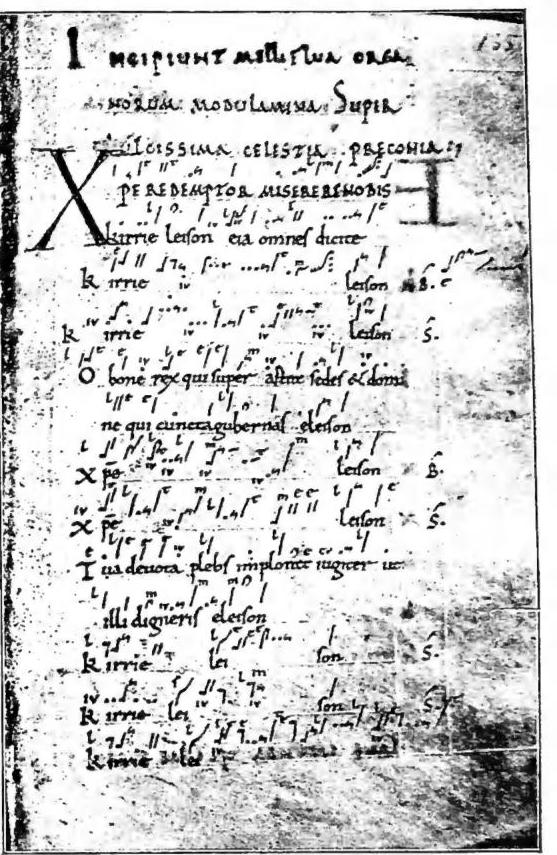
2. Origin of the neumes. - Gregorian neumes constitute a highly coherent system of notation that appears abruptly in the manuscript tradition toward the end of the 9th century. Before the 9th century there are neither manuscripts notated with neumes nor neumes written by the original hand: this is the conclusion reached by an eminent specialist such as E. A. Lowe, after establishing the Corpus of the Codices Latini antiquiores (so far 5 vols., Oxford 1934–50). The system of notation will therefore be
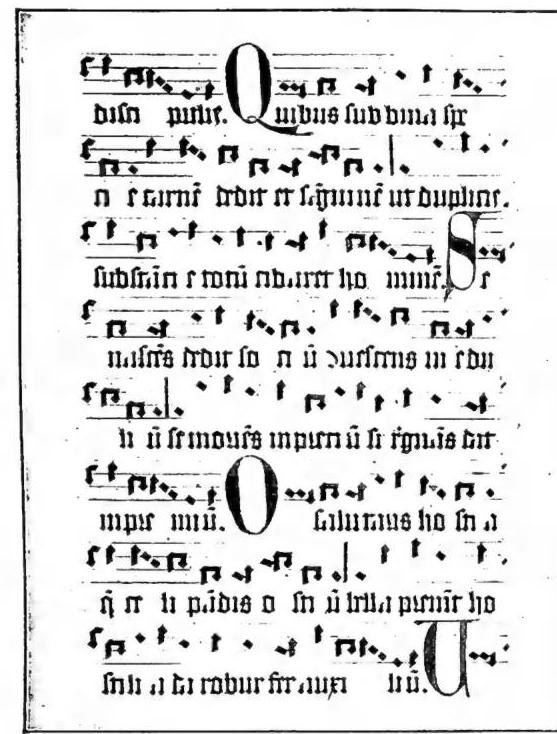
PALEOGRAFIA MUSICALE - German musical script of approximately the fifteenth century, with nail-shaped notes. Fragment of an antiphonary (Office of the Most Blessed Sacrament: hymn “Verbum supernum”) on parchment removed from a binding - Vatican Library, cod. Pal. lat. 1945.
was elaborated one or two generations before our oldest manuscripts. Although it is not yet possible to determine precisely the place of origin of the neumes, it should undoubtedly be sought between the Seine and the Rhine, without excluding the influence of the Anglo-Saxon milieu and, still less, exchanges between scriptorium and scriptorium. Without revisiting here the theories proposed to explain the origin of the neumes, it will be prudent to adhere to the following points. The inventors of the neumes elaborated a notation whose point of departure was the grammatical accents; they also made use of ecphonetic signs and prosodic signs; they may have come to know both through manuscripts, chiefly through the treatises of grammarians, and perhaps through certain books intended for public reading.
While retaining the primitive meaning of the acute and grave accents, they gave the other signs a new meaning. At the basis of the system lies the intention of translating a melody through gesture and fixing the gesture by means of the graphic sign. Such, in its broad outlines, appears to have been the process by which the neumatic systems were elaborated, whether in the case of the Visigothic notation of Spain, the Gregorian notation of the Frankish countries, or the Byzantine notation. It may moreover be thought that the Visigothic was somewhat earlier than the Gregorian and contributed to its formation. These explanations concern neumatic notation based on the accent and for this reason called that of accent-neumes. Alongside it there exists another notation, that of point-neumes, which gives precedence to points and groups of points over accents. It has sometimes been thought to be older, but it must be admitted that its evidence is, on the contrary, more recent.
3. Regional notations
For the various regional schools, their geographical diffusion, and examples of the neumatic notation of the schools of S. Gallo, Metz, Chartres, and Nonantola: V. CANTO. Examples of Mozarabic notation are found under MOZARABICA LITURGIA, vol. VIII, pl. 100.4. The problem of melodic pitch
Accent-neumes indicate pitch in a relative and imprecise manner; they are written without a staff, “in an open field.”Point-neumes are more informative with regard to pitch. Moreover, they were soon written at regular intervals: they are then diastematic. And it was not long before lines were drawn on which to place the neumes. The future belonged to this procedure, and not to the various attempts at phonetic notations made by theorists of the eleventh century. To satisfy every requirement, it was in fact sufficient to specify the position of the semitone. Guido d'Arezzo (v.), who colored the line of fa red and that of do yellow. At the same time, the practice arose of indicating the corresponding melodic letter on these lines, and also on the other lines: from this usage derive the modern clefs.
Written on the staff, generally of four lines, with letters at the clef, the neumes changed appearance considerably, especially in the notations in which the accents had to be placed at precise intervals, with divisions to mark the exact pitch: French notation successively became a notation of linked points, small squares, and large squares. Square notation, for its part, replaced the others or modified them in its own image, while German Gothic notation assumed the appearance of hammered nails that gave it the name of nail notation. Square notation, with its stems, after giving rise to the modern notations of measured music and polyphony (v. oltre), was once again employed by the current books of Gregorian chant, which are moreover progressively returning to ancient forms of neumes, the only ones capable of expressing certain nuances.
5. The interpretation of the neumes
All paleographers agree in recognizing in the neumes a wealth of expression that modern notations do not possess. But they must be properly understood: such understanding is the object of a science that has every reason to distinguish itself from paleography properly so called. By analogy with other disciplines, it has been called a musical diplomatics. Here only some essential principles will be recalled.If every melody is a logically organized succession of sounds that offers meaning to the ear and the intellect, and if, on the other hand, the neume, like every notation, is the graphic representation of a melody, it necessarily follows that the neume possesses a meaning that is at once rhythmic, melodic, and expressive. This meaning is known through the study of the script and its peculiarities (paleography), through the comparison of manuscripts with one another (comparative paleography), and through the statistics of cases, all correlated with musical phenomena. It is appropriate, moreover, to distinguish the neume in itself from the neume modified either in its structure or by additions.
The rhythmic meaning of the neume is the first to present itself, especially in accent-neumes. A single, isolated neumatic sign undoubtedly has no rhythmic value in itself: it derives that value from the literary text (syllabic chant) or from the musical context (melisma). But every neumatic sign comprising at least two elements constitutes the initial cell of rhythmic synthesis.
The melodic meaning is imperfect in accent-neumes and perfect in diastematic notations or notations on lines. In themselves, accent-neumes already provide certain indications, the simplest of which is the higher position of the virga in relation to the punctum. It is also observed that certain notators use graphic peculiarities to mark the semitone. They also employ letters, such as aequaliter (e) and sursum (s), to provide an additional melodic indication.
The expressive meaning emerges first of all from the script: one may consider the diversity of the pes in Sangallese notation (s forms for each first element) or of the Beneventan scandicus (8 forms in a single manuscript). It may also be modified by an added element, an episema or a significant letter. Finally, the notator’s style sometimes conveys the nuances of the voice through the very movement of the stroke.
These brief indications concerning “musical diplomatics” can only barely unveil the full wealth of meaning contained in neumatic notations. Despite their imperfections, which are particularly perceptible to the musician of today but much less troubling to the musician of earlier times, these notations constitute an adequate translation of a perfect monody. Their evolution makes it possible to follow at a glance the radical change in musical taste that took place between the ninth and sixteenth centuries, passing from the purity of a melodic line to the harmonic richness of polyphony.
Giacomo Hourlier
POLYPHONIC PALEOGRAPHY. — From the figures of square choral notation there arose, with a continuity that becomes even more evident when one observes the groups of notes represented by a single sign, that is, the “ligatures,” which graphically reproduce corresponding Gregorian neumes, polyphonic notation. Since it was based on the simultaneity of two or more sounds in the practice of note-against-note combinations—which was not yet harmony in the modern sense, but rather a well-ordered concurrence of several melodic lines—it required from its very beginnings, as a necessary condition of its existence, measurement, that is, an exact criterion by which to determine the duration of individual sounds and of the silences interposed between them, so as thereby to guarantee the synchronism of the consonances.
The period of transition between black square notation (which remains unchanged for liturgical books in Gregorian chant to the present day) and black mensural notation occurred between the end of the 12th century and the middle of the 13th (approximately 1175–1250). During this period the notation was established that would endure for two centuries, subsequently developing into white mensural notation (1450–1600), and finally, with further modifications, into the notation now in use throughout the world.
The present notation was adopted both for instruments and for voices, and this occurred after the 17th century; before then, voices and instruments often had different forms of writing, as, for example, in ancient Greece, which used two distinct notations for the one and the other, both alphabetic. For instruments in particular, from the 14th to the 18th century special notations were employed for keyboard instruments (organ, harpsichord) and string instruments (lute, guitar, etc.), with different characters that, according to nationality (German, Spanish, Italian, French), variously combined letters, figures, and symbols, and were called “tablatures.”
Of the ancient alphabetic notations, only the “clefs” of do, fa, and sol remain in current use: these are signs derived from letters of the alphabet corresponding to the musical notes placed at the beginning of each staff, indicating that, on the stave, all the notes found on the line occupied by this conventional sign correspond to the note to which that sign was attributed in ancient times, when it was still an alphabetic letter. The musical staff itself, now fixed at five lines (the pentagram), did not come into being at a single moment. As diastematic neumatic notation evolved toward criteria for the more exact determination of intervals, lines began to be used around the 9th century, upon which the corresponding note could be placed. At first these lines were incised with the tip of a stylus, and later drawn in colored ink (red for fa and yellow for do); they increased from 1 to 4 (the tetragram still used for Gregorian chant),
to 5 (our present pentagram), and even to 10 lines. Theoretical sources for the history of the musical staff are the Musica enchiridis (9th century) and, in particular, the Regulae de ignoto cantu Guido d'Arezzo (v.). The development of square notation in the polyphonic sphere soon became identified with the development of mensural notation, since the need to establish different durations for the various parts (vocal or instrumental) required the creation of new figures. At first (around 1225) these were the longa and the brevis, originating respectively from the virga and the punctum; then, around 1250, two other figures were added: the maxima or duplex longa and the semibrevis, derived respectively from a doubling of the longa and a halving of the brevis.
With these limited figurative elements, the first polyphonic forms of the Ars antiqua (v.) were constructed, namely: a) the conductus, monophonic songs, and the organa dupla Leoninus (v.); b) the organa tripla and quadrupla and the clausulae Perotinus (v.). With regard to rhythm, after the School of St-Martial of Limoges (ca. 1100–50), which, from the intense production of sequences and tropes (10th and 11th centuries), had moved on to the first flowering of the organum in its pre-mensural phase, the School of Notre-Dame (ca. 1175–1250) attained, during the two aforementioned periods, which intersected and followed one another, a maturity whereby rhythm, organized according to the six rhythmic modes (whose names go back to ancient Greece but were restored with a different meaning by the theorist Walter Odington around 1290), acquired substance in the second period (the Perotinian), whereas in the first (the Leoninian) the modal interpretation remains doubtful and still controversial. The expansion of the repertory of figures brought about by the introduction of the longa and the brevis corresponds to the flowering of the motetus with its various vocal parts (v. ms. of Montpellier, Fac. de Médecine H. 196, of Bamberg, Ed. IV 6, etc), and is accompanied by a development of rhythm which, around the middle of the 13th century, began to become independent of the modal meter used until then. Through the Franco of Cologne (v.), Petrus de Cruce, ODINGTON, WALTER (v.), Roberto de Handlo, and others, the values of ligatures, notes, and rests were fixed, as was the binary and ternary division of the brevis, which, while ternary rhythm—called perfect in analogy with the perfection of the Holy Trinity—prevailed, had until that point always been divided only into three semibreves.
In the 14th century, the figures of the minima and the semiminima were added to those already mentioned, producing the complete set of five figures, which could have either ternary (perfect) or binary (imperfect) value. The different interpretation to be given to the notes was indicated at the beginning of the line by conventional signs (a square containing three small lines to indicate the perfect mode and two for the imperfect mode; or a circle to indicate perfect time and a semicircle for imperfect time), but also, without recourse to special signs, by the color red (color), which, alternating with black in the filling of notes in ternary time, imparted imperfection to them, that is, automatically, binary value. If red ink was unavailable, the copyist left such notes white, that is, empty, achieving the same result (notes albae, dealbatae, cavatae).
The particular features of the new notation are explained with clarity and a wealth of detail by the French theorist Philippe de Vitry (in Coussemaker, Scriptores, cited in the bibliography, III, 33), but they had already been masterfully outlined in the Pomerium of Marchetto da Padova, which marks an important turning point in the development of that Italian notation which Prosodocimo de Beldenandis, also a native of Padua, would summarize in his Tractatus pratice cantus mensurabilis ad modum Italicorum, written at the beginning of the 15th century (Montagnana 1412).
After rhythm, he studies the figures that conform to it; around 1400 these were six: the maxima or duplex longa, the longa, the brevis, the semibrevis, the minima, and the semiminima.
The rhythmic divisions of the values, which received one of their first systematic treatments in the work of Prosodocimo, number three: modus, tempus, and prolatio.
The modus governs the relationships between the maxima and the longa (modus maior, or modus maximarum), as well as between the longa and the brevis (modus minor, or modus longarum, the modus par excellence in the Ars nova); the tempus governs those between the brevis and the semibrevis, and the prolatio those between the semibrevis and the minima, which, as the last value to be added, was at that time indivisible.
Mode, tempus, and prolation could in turn be perfect or imperfect: in the first case, the ratio of maxima to longa (modus major), longa to brevis (modus minor), brevis to semibrevis (tempus), or semibrevis to minima (prolatio) was 1 to 3 (the ternary figure, that is, the perfect figure, symbolizing the perfection of the Holy Trinity, was equivalent to 3 lower figures); in the second case, it was 1 to 2 (the figure taken as the unit of measurement was divided into 2 immediately lower figures). The punctus of mensural notation had 3 principal uses and names: punctus additionis or augmentationis, punctus divisionis, and punctus perfectionis; the first (which has remained in modern notation) was used only in imperfect tempus and, when placed after a note (binary, that is, imperfect), added to it a value corresponding to half the value of the note itself; the second, used only in perfect tempus and perfect prolation, was equivalent to a bar line, since it isolated a group or a note from the other notes so that they would not influence one another.
The third, to which the punctus imperfectionis, alterationis, syncopationis, etc., may be assimilated, was nevertheless a punctus divisionis, but one that perfected or imperfected the notes after which it was placed: that is, it was a punctus divisionis that imparted a particular character to the values placed under its direct influence. The ever-greater diffusion of binary rhythm, which by then had joined ternary rhythm (the legacy of the thirteenth-century Ars antiqua) on equal terms, officially took hold in the early 1300s with the Ars nova. This brought the multiplication of rhythms—from the simplest to the most complex—to an extraordinary richness, demanded by the forms themselves, which were predominantly secular and often composed for dancing (rondeau, virelai, ballade in France; madrigale, ballata, caccia in Italy).
After the representative figures of Philippe de Vitry for France and Marchetto da Padova for Italy, who impressed particular characteristics upon musical notation and contributed to the formation and development of the French and Italian notations, one arrives, after 1350, at a notation that combines features of both systems and is known as mixed notation: a period of transition, with tendencies toward complication and mannerism, which became more pronounced toward the end of the fourteenth century, before declining into a process of clarification that took place in the first half of the fifteenth century and culminated in the establishment of white mensural notation. With this notation, between 1450 and 1600, Flemish, French, and Italian masters produced the masterpieces of sacred polyphonic art. This writing comprises 8 signs with their corresponding rests and an entire code of rules of its own, both for the exact interpretation of ligatures and for the reciprocal relationships among the notes simplices (not joined to one another). A first phase in the development of ligatures extends from the late twelfth century to the middle of the thirteenth, with Franco of Cologne, whose rules remained unchanged until the fifteenth century; a second phase is connected with the development of white notation after 1450. Ligatures developed from the neumatic figures, or groups, podatus, clivis, torculus, porrectus, and were divided into descending or ascending ligatures according to their origin (descending ones being derived from the podatus, and ascending ones from the clivis). According to the number of notes of which it consisted, a ligature was called binary, ternary, quaternary, etc.; and according to the configuration of the first or last note it was defined as « cum » or « sine proprietate », « cum » or « sine perfectione », or « cum opposita proprietate ». The resolution of ligatures is governed by special rules to be applied to the nota initialis or finalis and to the « middle » notes enclosed between them (which are generally to be interpreted as « breves »). After 1600, as figures of greater value, such as the maxima, longa, and brevis, were gradually discarded, the repertory of graphic symbols, based on the semibreve as its largest unit of measurement, was further enriched by smaller values and their corresponding rests; the divisions implicit in each note were by then only binary, even in ternary tempus. Thus, apart from the figure of the triplet, which recalls the fifteenth-century proportio sesquialtera or proportio hemiolia, in which each group of three notes stood against two of the same kind, every value could always be decomposed into, or was equivalent to, other lower values in an even number. An important innovation, already emerging sporadically in fifteenth-century organ tablatures (cf. Fundamentum organisandi by K. Paumann, 1452) and already generalized in sixteenth-century instrumental music (keyboard instruments, lute, etc.), the bar line became definitively established in instrumental and vocal notation from the seventeenth century onward, even though the character it assumed was not always the same. In the sixteenth century as well, however, the score—which already, although rarely, brought together in a single overall view the parts of polyphonic vocal music, ordinarily written in separate booklets for the individual vocal parts—bore clear divisions marked by a line at the end of each measure. In both vocal and instrumental music, the eighteenth century saw a flourishing of virtuosic ornaments, which found their graphic expression in embellishments (v.), and of interpretive indications for dynamic, qualitative, or quantitative expression, the intensity of a particular inflection, speed, and rhythmic or mechanical devices or licenses, all aimed at enriching expressive possibilities and mitigating the dangers of an overly personal interpretive realization.
A particular genre of musical notation for instruments is represented (in the fifteenth to seventeenth centuries and beyond) by tablature, which assumed different forms and aspects according to the country in which it arose and developed. Although this kind of writing was also used on a large scale for other instruments (for the organ and keyboard instruments: German and Spanish tablatures, fourteenth to eighteenth centuries; for guitar, violin, flute, etc., seventeenth century), its principal and most widespread use was for the lute, an art instrument that became general throughout Europe, perhaps beginning in Spain, where its Arab origin had brought it, from the fifteenth to the eighteenth century.
Italian lute tablature consisted of figures placed on the 6 horizontal lines representing the 6 strings of the lute; rhythmic values were represented above the musical staff by signs indicating the semibreve, minima, semiminima, and croma.
French tablature used letters instead of numbers; and the staff, at first consisting of 5 lines (for a 5-string lute), was expanded to 6 around the middle of the seventeenth century, when the entire system was radically modified. Time indications were expressed by actual notes written on the staff. German tablature, the most complex of all, likewise began as notation for a 5-string lute (fifteenth century), was later enriched with the signs required by the added 6th string (sixteenth century), and comprised numbers and alphabetical letters arranged diastematically beneath the time signs (of a type similar to the Italian ones) and between the bar lines.
Tablatures for folk instruments are still in use, with features similar to those of sixteenth-century tablatures: 6 lines for the guitar, 4 for the 4-string ukulele, etc.
Of the ancient alphabetical notation, supplanted in the Latin countries by the Guidonian syllables, a living trace remains in the nomenclature of the scale among the Anglo-Saxon and Germanic peoples, among whom the scale « la-si » is expressed by the letters A-H. It should be noted, however, that there is a difference in the designation of « si b »: for the Germans it is symbolized by the letter B, whereas for the English it is symbolized by the letter H. — See Plate XL.
Geschichte der Notation Notenschrift und Notendruck, Lipsia 1878; H. E. Wooldridge, Early English harmony, Ics. Londra 1897; G. Gasperini, L'arte di interpretare la scrittura della musica vocale del Cinquecento, Firenze 1902; J. Wolf, Geschichte der Mensuralnotation von 1250 bis 1460, 3 voll., Lipsia 1904; G. Gasperini, Storia della semiografia musicale, Milano 1905; H. Bellermann, Die Mensuralnoten und Taktzeichen, Berlino 1906; J. Wolf, Handbuch der Notationkunde, 2 voll., Lipsia 1913-19; M. Scheider, Geschichte der Mehrstimmigkeit, Berlino 1935; W. Apel, The notation of polyphonic music 900-1600, Cambridge (Mass.) 1949; O. Strunk, Source readings in music history, Nuova York 1950. Luisa Cervelli