
MINIATURA. – Properly speaking, the art of painting or adorning manuscripts; ornamentation which in ancient times was carried out predominantly with the color red, minium, whence the name m. Initially limited to initials, with the passage of time it came to include actual paintings in small proportions, executed with a special technique, which made manuscripts veritable treasures, of great importance for the study of art history.
I. TECHNIQUE. – With regard to technique, it should be noted that ancient m. was always executed on parchment with opaque colors, and white lead was therefore also used; this was later set aside when, from the eighteenth century onward, miniatures began to be painted on thin sheets of ivory with transparent colors, so that the “highlights” were supplied by the whiteness of the ivory. The colors are diluted in a mixture of gum arabic, candied sugar, and water, while the parchment is suitably prepared with fish glue.
II. HISTORY OF M. – 1. Antiquity. – Certainly m. was not unknown to the ancients; several writers speak of it, including Ovid, Pliny, and Aulus Gellius. Varro employed a Greek artist, Lala of Cyzicus, to adorn his Hebdomades with portraits, but nothing has survived to the present day apart from a few copies, none of which goes beyond the fourth century; among these is the famous Virgil codex (Vatican Library, lat. 3225), in the summary style characteristic of Alexandrian art. With Byzantine art, m. established itself among the greatest forms of artistic expression, undergoing the influence of Egypt, Syria, and Armenia. It appears, in fact, that the Egyptians were the first to adorn their papyri, and that the Byzantines drew their pictorial manner from Alexandrian art, while the later Syrian and Armenian influence was predominantly ornamental in character. Although the works that have survived to the present day are often no more than copies, it has nevertheless been possible to establish, with sufficient approximation, the prototype from which they derive. Among the best products one may thus cite the Calendar of 354, with features of Hellenistic art, to which the Iliad (Ambrosian Library [fifth century]), the Dioscorides (Vienna [524], a copy of a more ancient original), and the Joshua Roll (Vatican [seventh century]) may be related. The prototype of Cosmas Indicopleustes’ Topography (Vatican) also dates from the sixth century; in it one can already discern the beginning of an evolution, probably determined by mosaic art. The same is true of the group of Purple Codices (Genesis of Vienna [570]; Gospel Book of Rossano [ca. 580]; fragments of the Gospel Book of Sinope [ca. 600], National Library, Paris). Among the group of Syriac and Armenian manuscripts, mention should be made of the Gospel Book of Rabbula (586, Florence, Laurentian Library) and Gospel Book no. 229 (Library of Eisschmiadzin [902], but reproducing an original of the sixth century). The iconoclastic controversy does not seem to have had a great impact on m.; indeed, some tend to assert the contrary. One should recall the Chludov Psalter (tenth century, Moscow), with marginal vignettes. The golden period of Byzantine m. was that between the tenth and twelfth centuries; its most important productions are the Psalter of the National Library of Paris (Greek 139), the Bible, the Menologion, and the Codex of John Climacus (all in the Vatican: Reg. I, Greek 1613, Greek 394).
2. Medieval m. in Europe outside Italy (v. Art). – M. spread throughout Europe especially through the efforts of Irish monks; there were, however, various schools: the Merovingian, in which representations were reduced almost exclusively to stylized ornaments and a few flat colors (e.g., the Frédigaire of the seventh century [National Library of Paris, lat. 19910]); the Visigothic (the prototype being the Ashburnham Pentateuch, National Library of Paris); and the extremely important Irish school, characterized in its initials by ornamental interlacing (Gospel Book of St. Gall [ca. 760]; Book of Kells [ca. 760], Dublin, Trinity College; Gellone Sacramentary [end of the eighth century], National Library of Paris, lat. 12048). Anglo-Saxon m. derived from the Irish; a combination of the Irish manner with the Byzantine and classical is found in southern England (Gospel Book of Canterbury [ca. 785], in the British Museum; Codex Aureus of Stockholm [ca. 790]). But the importance of Irish m. also lies in the influence it exerted on Carolingian m. and on the ornamental style of Romanesque sculpture.
The Carolingian revival (v. ART) produced its finest works precisely in m., and several schools of monastic character distinguished themselves in this field: the Ecole du Palais, with the Gospel Book of Aix (ca. 800) and the Gospel Book of Charlemagne (ca. 810; Vienna, Imperial Treasury), rather Byzantine in derivation; the school of Reims, also Byzantine in derivation, with the Liber Canonum (Vallicellian Library, Rome, cod. A. 5) and the Utrecht Psalter (before 837; Utrecht, University Library); the Rhenish group, also called the Ada or Godescalc group, with the Gospel Book of St-Sernin of Toulouse (ca. 785; Paris, National Library), executed by Godescalc for Charlemagne, and the Gospel Book of Ada (ca. 800; cathedral of Trier); the school of Tours, with the Bible of Fleury (before 818; Paris, National Library); the Bible of Bamberg (ca. 835; Bamberg Library); the Gospel Book of Lothair (Paris, National Library, lat. 266; ca. 840); the Bible of Charles (Paris, National Library, ca. 850); the school of Metz, with productions close to the Rhenish style (Sacramentary of Metz [ca. 850, Metz Library]); the school of St-Denis and that of St. Gall, rather conservative; and the school of Fulda, derived from the Ada group and anticipating the style of Ottonian m. (Codex Wittschindeus [ca. 950], Berlin). Of particular importance is the Mozarabic group of Spain, to which southern France is also linked. A notable document, especially for the formation of Romanesque iconography, is the Commentary on the Apocalypse by Beatus (composed in 784 in the Asturian monastery of Liebana, known to us through many illustrated copies, most of them from the early tenth century and revealing the influence of Muslim m.); there are also the Beatus of Madrid (from the abbey of Tavara, completed in 970), that of Valladolid (970), that of Gerona (975), and the best-known one of S. Sever (National Library of Paris, between 1028 and 1072; ms. lat. 8878); the Bible
of St. Isidore of León (completed in 960), with Arab influences, the Vigilianus (Library of the Escorial, no. 976), and the Aemilianus (there, no. 980).
Among the most celebrated productions of the 10th–11th centuries are the works belonging to the Ottonian revival, derived in part from the Carolingian one. The principal schools are: the Benedictine school of Reichenau, with Egbert’s Gospel Book (960; Trier Library), the work of the illuminators Kerardus and Heribertus, and Otto III’s Gospel Book, known as the Bamberg Gospel Book (ca. 1010; Bavarian State Library, Munich); that of Trier, which gained importance in the mid-11th century, when the school of Reichenau declined; and the lesser schools of Cologne and Regensburg, together with those derived from the latter, at Salzburg, Prüfening, and Prague.
In England, the school of Winchester is important, with the Benedictional of Aethelwold (ca. 975, Devonshire Collection at Chatsworth) and the Missal of Robert of Jumièges (11th century; Library of Rouen). Connected with it is the Franco-Saxon illumination of northern France, with the Gospels of Amiens (ca. 1040) and the Life of St Omer (ca. 1050; Library of Saint-Omer).
During the Romanesque period, in France in the 12th century, the Benedictine abbeys were important centres, especially the school of Cîteaux, with its characteristic initial letters ornamented with animals (Bible of Souvigny, ca. 1125; Paris, National Library). Zoomorphic initials are also found in the miniatures of the “Franco-Saxon” school of the North (Bible of St Bertin [ca. 1150], Paris). In Germany, in the face of the prevailing Byzantine influence, the school of the Middle Rhine became established around the end of the 12th century, with miniatures already almost Gothic in their draughtsmanship (Hortus deliciarum of Herrad of Landsberg, from 1205; Scivias of St Hildegard of Bingen, ca. 1190, at Wiesbaden). But the most interesting and original miniatures of this period are undoubtedly those of England (Psalter of St Albans [ca. 1130, Hildesheim], Psalter of Eadwin of Canterbury [ca. 1150, at Cambridge], Psalter of Henry de Blois [ca. 1160, British Museum], Bible of Winchester [ca. 1180]).
3. The Gothic period outside Italy. — In France, illumination became the art par excellence; it displays very close affinities with that of southern England, and it is sometimes difficult to distinguish the two schools. Paris in particular, however, saw many lay workshops at work in the 13th century, and as early as the beginning of the 13th century there were works with clearly defined stylistic characteristics, and compositions in medallions that were in some way related to the then flourishing art of stained glass (Psalter of Blanche of Castile [ca. 1215; Paris, Arsenal Library, no. 1186]; Psalter of Joan of Navarre [ca. 1225, at Manchester]; the historiated Bibles, including the Moralized Bible in 4 volumes, with more than 5,600 compositions [ca. 1240; National Library of Paris, Oxford, and British Museum]). Between 1250 and 1275, many works appear to have been produced by Parisian workshops for St Louis; they are distinguished by their light tones, the almost complete abolition of the gold background, and their refined and elegant figures set in realistic surroundings. Also characteristic
(photo. Enc. Catt.)
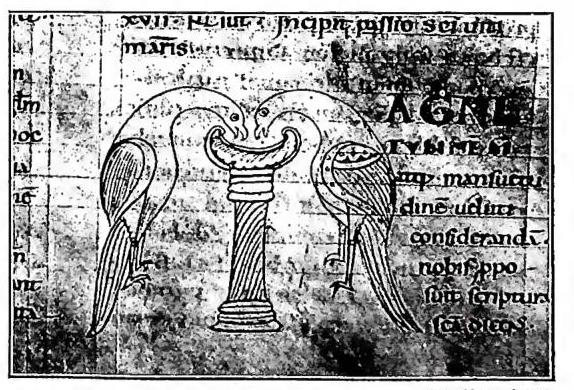
MINIATURA – Zoomorphic initial. Cod. Lateranense 79, f. 251 (11th–12th century) – Rome, Archive of the basilica of S. Giovanni in Laterano.
(photo by Orlandini)
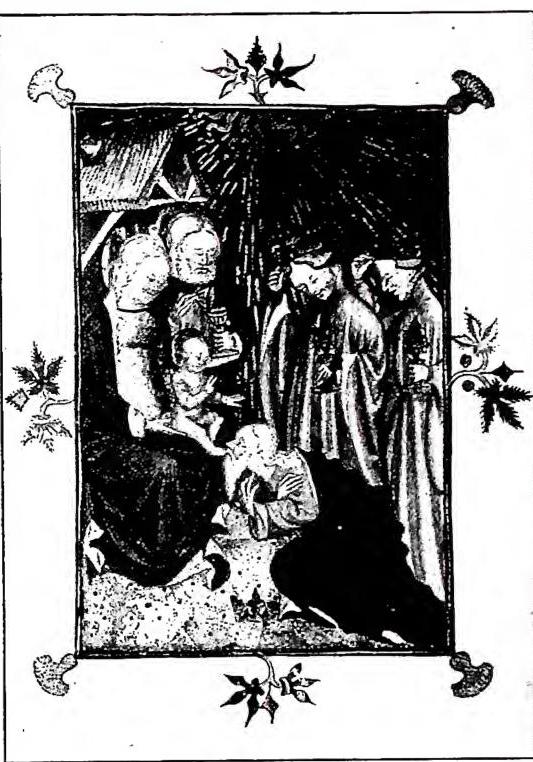
MINIATURA - M. of the Lombard school. Adoration of the Magi. Officium Bratae Virginis Mariae, fol. 230 (15th cent.) - Modena, Biblioteca Estense.
the « drôleries » (animated little scenes in the decoration of the margins), for example, in the Lectionary of the Ste Chapelle (Paris, Bibl. Naz.). More important works are the two Psalters of s. Louis (1254, Paris, Bibl. Naz.; ca. 1270, Thompson collection). Among the productions of southern England, the following should be mentioned: the Psalter of s. Louis (ca. 1210, Leyda), the Psalter of Queen Ingeburga (ca. 1210, Chantilly), the two Psalters of Trinity College (before 1220), and the Psalter of Roberto di Lindeseye (ca. 1220; Soc. Antiq. of London); the « drôleries » of the Missal of Enrico di Chichester (ca. 1260, Manchester); but the style of a group of Franco-English Apocalypses (Doucé Apocalypse, ca. 1270, at the British Museum; Apocalypse of Trinity College [cod. R. 16.2]) and of Lives of saints (Life of s. Alban, ca. 1260, in Dublin, Trinity College) is of particular interest. Among the Parisian workshops of the late century, one of the most famous was that of Maître Honoré, author of the Breviary of Filippo il Bello (1296, Paris, Bibl. Naz.) and of the Decretum of Gratian (1288, Bibl. of Tours).
In Germany, an important centre developed in Saxony during the 13th century; its masterpiece is the Psalter of Hermann of Thuringia (ca. 1210, Stuttgart). In general, however, Romanesque forms survived, since Gothic art established itself in German illumination only in the first decade of the 14th century.
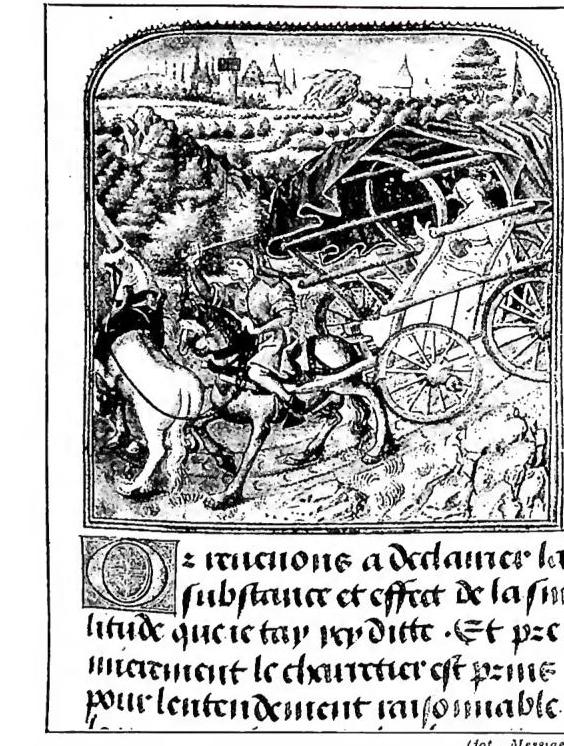
4. Illumination in the 14th–15th centuries outside Italy. - French illumination is dominated by Jean Pucelle, to whom are owed the Bible of Roberto di Bilyng (1327, Paris, Bibl. Naz., lat. 11.935) and the Breviary of Belleville (1317, Paris, ibid., lat. 10.483), and in the meantime it exerted a great influence on Germany and also on Italy, especially in Naples under the Angevins. In the time of Carlo V, a more pronounced note of realism entered illumination, and many productions of this period are associated with the name of Jean de Berry, who gathered around him the most famous illuminators: Maître aux Bouqueteaux, so called from his manner of drawing little trees (Bible of Carlo V [at the Arsenal in Paris]), Jacquemart
(phot. Messueta)
MINIATURA – The Mortiflement de la vaine plaisance, illuminated by Jean Tavernier (1434) for Filippo il Buono – Brussels, Royal Library, cod. no. 10308.
de Hesdin (Petites e Grandes Heures de Berry [ca. 1390–1405], National Library, lat. 919), André Beauneveu (Psalter of the Duke of Berry, Paris, National Library, franc. 13.091), down to the productions of the Limbourg brothers at the beginning of the fifteenth century (Très Riches Heures of the Duke of Berry, 1408–16, Chantilly), in which Italian influences are not lacking. In the other countries of Europe, m. during this century was inferior to the French; one may recall: in England, the East Anglian school with the Lanterell Psalter (1340, British Museum); while around 1370 several manuscripts illuminated by the Bohun family were important; toward the end of the century, Continental influences became increasingly evident. Flemish art at the beginning of the fifteenth century was dominated by the Van Eyck brothers, among whose works the Books of Hours for William of Bavaria should be remembered (Hours of Turin, ca. 1417).
In France one must await the end of the Hundred Years’ War before being able to count among the important works those of Jean Fouquet of Tours (Heures of Etienne Chevalier [ca. 1450, at Chantilly]; Antiquités Judaïques [ca. 1455, at the National Library in Paris]); and those of Jean Bourdichon, the last French miniaturist before the advent of the printed book (Heures de Anne de Bretagne [completed ca. 1508; Paris, National Library, lat. 9474]), both revealing Italian influences. The influence of the French school was felt in England; while on the Continent, around Filippo il Buono, there arose the fully developed Flemish school of artists, often trained in Parisian workshops, yet nevertheless connected with the major Flemish masters: such as Jean Dreux, who reflects the style of Van der Weyden in his works; Guillaume Vrelant, Jean Tavernier, and Simon Marmion, with his masterpiece, the Pontifical of the church of Sens (Brussels, Royal Library); and above all Hugo Van der Goes, who influenced the work of Gérard Horenbaut (to whom the Hortulus animae of Vienna is attributed), who worked on the famous Breviaria Grimani of Venice, most of which would have been the work of Simon Bening, and in which, nevertheless, the signs of the decline of m. can already be seen, as it sought to achieve effects proper to painting.
The extension of m. to secular books helped to bring about, on the part of lay amateurs, the establishment of fine private libraries; it is enough to recall that of Petrarch, the first nucleus of the Marciana Library of Venice. Above all, however, the Lords liked to have book illustrators at their courts as well; in Milan, at the Visconti court, during the second half of the fourteenth century, there worked Pietro da Pavia (v. his realistic scenes and representations of birds and insects in Pliny’s Naturalis Historia in the Ambrosian Library, E 24 inf); Anovelo da Imbonate (illuminator of the Missal of the coronation of Gian Galeazzo Visconti); Giovannino and Salomone de Grassi, to the former of whom several m. in the Tacuinum sanitatis are also attributed (Rome, Casanatense Library, ms. 459), which, however, also includes later m., to be assigned to the fifteenth century. The Sienese school in the sixteenth century was dominated by Simone Martini (v. Ambrosian Library), who also exercised his influence on the French school, to which the follower known as the Master of the St. George codex seems to have been connected. Also active were Niccolò Tegliacci (v. Siena), Lippo Vanni, who reveals Lorenzettian influences, and in the fifteenth century Giovanni di Paolo and Sano di Pietro. The diffusion of the Sienese school of painting can be observed in Perugia, Naples, the Abruzzi, and elsewhere. At the beginning of the sixteenth century, Florence had a miniature school of Sienese influence in the convent of S. Maria Novella (Evangeliarum of the National Library of Florence, II, I, 167), while the sculptural tendencies derived from Giotto were asserted by Pacino di Bonaguida (Biblia of the Trivulziana Library of Milan [cod. no. 2139]), and by others (Laudario of the National Library of Florence [II, I 122 BR 18] and Ammaestramenti degli antichi of Bartolomeo da San Concordio, from 1342). In the second half of the fourteenth century, Sienese influence, on the other hand, is very evident in the works of the Camaldolese school of S. Maria
With the sixteenth century, throughout Italy, m. came to an end, both through internal exhaustion and through the arrival of external causes—the foremost being the introduction of the printed book, which nevertheless continued for some time to be embellished with m. as well. - Vedi tavv. LXVII-LXIX.