
INSULARE, WRITING and MINIATURE. — The Latin script of Great Britain between the 7th and 10th centuries and of Ireland between the 7th and 12th centuries is today designated as a whole by the name i., first given to it by L. Traube: it should be included among the national scripts, but its origin and development differ from those of the others. Moreover, undergoing various influences, it also extended to the Continent, in the monastic centers that the missionary activity of Irish and Anglo-Saxon monks scattered throughout France, Switzerland, Germany, and Italy. Insular script properly so called is essentially divided into two types: a round script and a minuscule; the intermediate type,
| 1. | α=a; b=b; σ=d; Γ=f; L=f; H=n; |
|---|---|
| 2. | u a a α=a; θ=e; ρ=p; ν=r; ν=s; |
| 3. | δ=θ; ρ=w; 4. Α=a; θ=h; Σ=σ; |
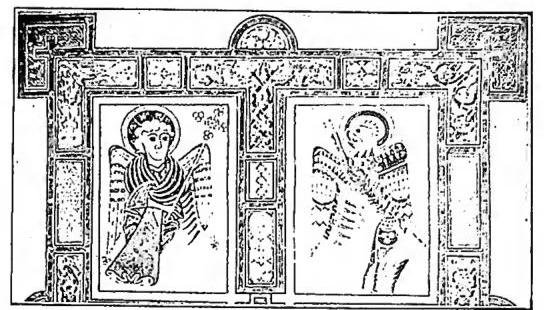
INSULARE, SCRITTURA E MINIATURA – Symbols of the Evangelists.
Detail of a miniature from the Book of Kells (8th–9th centuries).
Dublin, Library of Trinity College.
I.
I. ROTUNDA
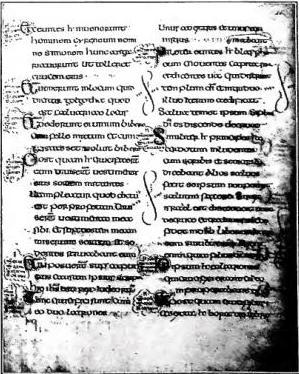
This is the oldest type of insular script (7th–8th centuries), immediately following an imitative phase in which the classical Roman forms (especially uncials and half-uncials) introduced into Ireland and Great Britain through Christian evangelization were reproduced. For a long time it was believed that the land of origin of the new forms was Ireland, and that from there they spread among the Anglo-Saxons as well; today the contrary view is rather preferred, but essentially the problem remains open. It can only be stated with certainty that insular rotunda derives from uncial and half-uncial and is therefore a mixed script, in which, however, the ascenders are so reduced that even the letters of minuscule form can almost always be contained within a two-line system: hence the inappropriate name “insular majuscule.” Its rounded ductus constitutes its fundamental distinguishing element, but its most characteristic feature is a triangular finial (“wolf’s tooth”) that bounds the long vertical strokes, and at times also the short ones (i, n), at the upper left: due to the influence of runic script, it was transmitted also to insular minuscule. Among the individual letters (cf. table, no. 1), the following should be noted: a, formed by two curved strokes, the left one thicker and closed in a loop over the right one; b in minuscule form, with the left ascender short and slightly bent and the bowl very broad; d almost always in uncial form, with the upper stroke strongly bent to the left, almost parallel to the line; f in majuscule form but in a minuscule position, with the lower horizontal stroke placed on the line and the vertical stroke descending below it; l with a wavy ascender; n often in majuscule form, with the middle stroke almost horizontal.A distinction between the insular rotunda of England and that of Ireland is not palaeographically possible, and perhaps not even justified, although Irish products are generally acknowledged to have more angular and less regular penwork.
II. INSULAR MINUSCULE
In the eighth century, a form of minuscule script takes precedence, whose origin has not yet been sufficiently clarified, but which must nevertheless be recognized, at least in part, as the result of a new fusion of those elements found in the round script, in response to the need for simpler and more rapid execution. Its use was therefore initially limited to documents, although it never attained truly cursive forms; only in the ninth century did it also triumph as a book script. It is rich in ligatures; it presents letters developed more in length than in width, with very angular strokes, and with descenders ending in a point. At first it preserves some uncial elements, especially the round r, but at the height of its development only the d of this form remains. Characteristic letters are (cf. table, no. 2): the a, either of cursive type (open) or closed in three different forms: with the loop bounded at the top by an oblique, rigid stroke running from left to right; with the loop bounded by a horizontal upper stroke; with the loop curved but lower than the right-hand vertical stem; the e, which in ligature projects above the line; the p with the bowl open and ending in a thick point; the r with the left-hand stem descending below the line and the complementary stroke greatly elongated downward; the z, in which the upper curved line becomes rigid and divides into two broken strokes, the first obliquely ascending, the second, thicker, vertically descending. Other signs are also found (cf. table, no. 3) to express the sounds th and w: the former is rendered by an uncial d crossed by an oblique stroke and, later, by the runic sign for doru (= d); the latter by the runic sign for vcn, very similar to a Latin p. The influence of runic writing is also apparent in a special capital alphabet, used especially for titles (cf. table, no. 4).In insular minuscule, the distinction between Anglo-Saxon and Irish is more pronounced than in the round script; the former has a freer movement and broader curves, whereas the latter is rigid, angular, marked by strong contrasts, and has less development of the long strokes. This aspect becomes even more pronounced in the eleventh century, when in England the Norman conquest suppresses every remnant of insular script, which instead survives in Ireland in more thickened and stereotyped forms, still used today for Gaelic texts.
Abbreviations. — Without entering into the heart of the discussion concerning the origin of insular-type abbreviations and their relations of dependence with those of the Continent, it should nevertheless be recalled that the texts of the British Isles abound in abbreviations derived from the Tironian system and the notae iuris, some of which are subsequently also found on the mainland (v. ABBREVIATORE). Certain characteristic contractions are likewise frequent (per, pro, propter, proprius, quam, quia, quis, et reliqua, etc.) that have no counterpart in the other Latin scripts.
III. MINIATURE I
In the codices of England and Ireland, miniature appears with characteristics markedly different from those of other countries; nevertheless, recent studies (Masai) have demonstrated that these are not original Celtic elements, but rather motifs already known, employed in goldsmithery and transferred, first to England(Cath. Enc.)
INSULARE, SCRITTURA E MINIATURA – Insular rounded script. Gospel book of the 8th century – Vatican Library, cod. Barb. lat. 570, f. 40².
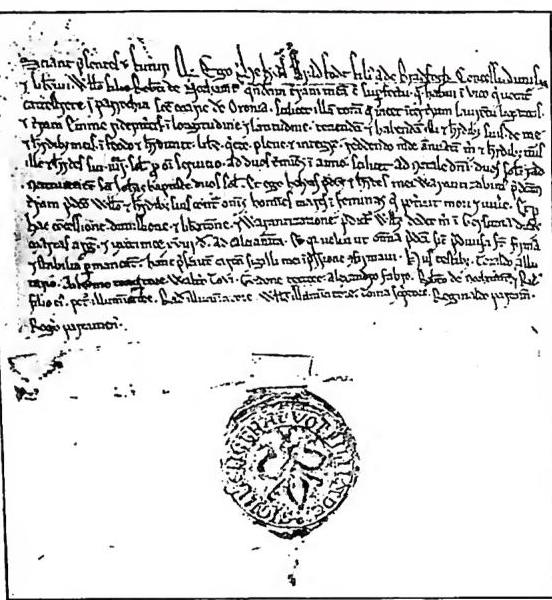
INSULARE, SCRITTURA E MINIATURA – Anglo-Saxon minuscule script. Helyas Bradford conveys a piece of land in Oxford to William, son of Roberto of Norhamt (ca. 1180) – Oxford, University Archives, ms. CLXVII.
and then in Ireland, in manuscript illumination. This should be said above all of the decoration, which in insular manuscripts predominates widely and appears in complex interlacings, geometric friezes around and within the initial letters, and red dots outlining the first element of each paragraph. The ornamental element is often composite, distributed across the entire page with painstaking attention to patterns and proportions; the same animated figure (man or beast), always crudely drawn, assumes a fantastic, grotesque appearance and remains limited to a purely decorative function. The colour is generally sombre, particularly in Irish texts; in Anglo-Saxon ones the page is sometimes enlivened with gold. These characteristics subsequently exert their influence in various ways also in certain centres on the continent. But in the 9th century Carolingian art penetrated the English schools, especially from Reims; the new direction found its fullest expression in the monastery of Winchester.
Among the most notable products of insular illumination are the Lindisfarne Gospels, the Codex aureus of Stockholm, and the Book of Kells. – Vedi tav. VIII.